Harry and Meghan Return to Britain Six Years After Fleeing Royal Life — And the Contradiction Is Impossible to Ignore
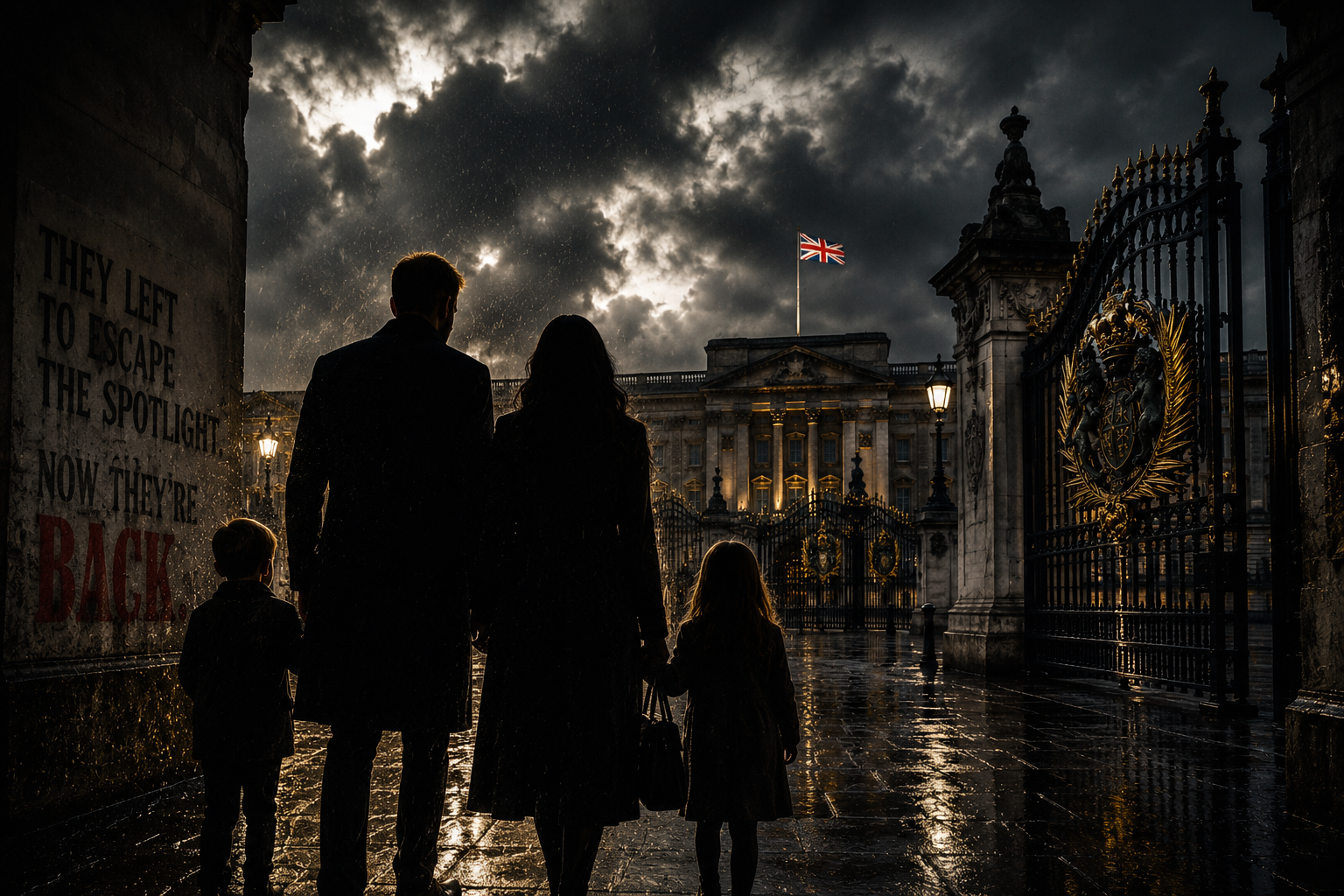
Why have Harry and Meghan returned to Britain?
The Great Sussex U-Turn
Prince Harry and Meghan have returned to Britain with Prince Archie and Princess Lilibet, completing one of the most extraordinary reversals in the modern history of the Royal Family. Six years after leaving royal duties behind and building a new life in California, the Sussexes are again going to live in the country they once portrayed as an environment in which intense media attention, family conflict and security concerns had made their position increasingly intolerable.
There is no restoration of the old royal order. Harry and Meghan remain non-working members of the Royal Family, are expected to live in a private home rather than a royal residence and will retain their American base. Yet Archie, seven, and Lilibet, five, are due to start school in Britain in September, meaning this is considerably more significant than another short Sussex visit.
Why Harry and Meghan Have Come Back
The clearest explanation is their children. The Sussexes want Archie and Lilibet to develop a stronger connection with Britain, the country of their father's birth and the country over which their grandfather reigns as King. School arrangements were a significant factor in the timing of the move, while the family is expected to remain in Britain for an extended period rather than merely visiting for a few weeks.
For Harry personally, the pull appears deeper. Britain contains almost everything from which he tried to distance himself after 2020, but it also contains his family history, military identity, charities, friends and much of the legacy of his mother, Diana. Harry has never convincingly presented himself as emotionally finished with Britain. His repeated interventions over security and reconciliation arguably demonstrated precisely the opposite: he cared enormously about retaining a viable relationship with his home country.
There is also King Charles. Relations between father and son have improved from their lowest point, and Charles is understood to welcome the opportunity to see Harry, Meghan and especially his grandchildren more frequently in a private capacity. The Sussex children have spent most of their lives thousands of miles from their paternal grandfather, cousins and wider royal family.
This does not necessarily mean California has been abandoned. The couple are retaining their American home, and Meghan can continue pursuing commercial projects without becoming a working royal. The emerging arrangement therefore looks less like recreating their pre-2020 existence and more like attempting to construct the transatlantic life they originally wanted: independent of the institution, but not independent of Britain.
The Awkward Reversal Meghan Cannot Escape
For Meghan, however, the optics are difficult.
The country to which she is returning is substantially the same country from which the Sussexes departed. The British press still exists. Royal coverage remains relentless. Public fascination with Harry and Meghan has hardly diminished, and Meghan remains deeply unpopular among a large section of the British public. In July, only 22 per cent of Britons surveyed held a favourable view of her while 65 per cent viewed her unfavourably. Harry performed better, although he was still underwater at 33 per cent favourable against 58 per cent unfavourable.
That makes the return hard to reconcile with some of the rhetoric surrounding their departure.
Harry said as recently as May 2025 that he could not see a world in which he would bring his wife and children back to Britain under the security arrangements then in place. He also said he missed parts of the country and wanted reconciliation with his family. Fifteen months later, the family is back.
Circumstances can change, and changing one's mind is not hypocrisy by itself. But Meghan in particular now faces an obvious credibility problem: the couple spent years explaining why royal Britain had become unbearable while simultaneously remaining commercially and culturally tied to the attention generated by their royal identities.
Their most valuable international distinction has always been precisely the connection they walked away from.
Meghan's American career has produced successes, including major streaming exposure and her lifestyle business, but the post-royal commercial experiment has been uneven. The Sussexes' Spotify arrangement ended, several entertainment projects failed to generate the impact of their first documentary series, and their Netflix relationship evolved into a more limited first-look arrangement. None of that proves financial trouble forced them home, and claims that the move is simply the collapse of their American dream go beyond the available evidence. It does, however, undermine the idea that California rendered royal relevance unnecessary.
If anything, the six years in America demonstrated how difficult it is to separate the Sussex commercial brand from the monarchy itself.
They Wanted Less Attention — But Never Really Became Private
This is perhaps the greatest contradiction.
Harry has repeatedly condemned intrusive media behaviour, and some of his grievances cannot simply be dismissed. He has pursued extensive litigation against newspaper groups and has spoken powerfully about what he believes aggressive press treatment did to his mother, his wife and his own mental health. The couple were entitled to stop being working royals and seek a different life.
But leaving royal duties was not followed by disappearance from public life.
There was the Oprah interview. There was the six-part documentary about Harry and Meghan. There were further television interviews. Harry published Spare, containing intimate descriptions of arguments, resentments and encounters involving members of his family. Meghan built brands around her personality and lifestyle. Harry continued campaigning publicly on security and his relationship with the monarchy.
That is fundamentally different from asking to be left alone.
The Sussex position has increasingly appeared to be that they wanted control over attention rather than an absence of attention: privacy from coverage they considered invasive, but freedom to speak publicly when and how they chose.
There is a legitimate distinction between those things. A public figure does not surrender every right to privacy merely because he gives interviews or writes a book. Yet the strategy inevitably makes complaints about relentless attention more difficult to communicate, because every major Sussex intervention creates another cycle of the very attention they say has caused them harm.
Returning to Britain intensifies that contradiction dramatically.
They are walking directly back into one of the most concentrated royal media environments in the world.
Charles Appears Ready to Rebuild the Relationship
King Charles appears to represent Harry's clearest route back into a functioning family relationship.
The King was informed of the return before it became public and is understood to welcome the prospect of seeing the Sussex family more often. Crucially, however, that welcome is personal rather than constitutional. There are no plans to restore Harry and Meghan as working royals.
That distinction matters.
Charles can behave as a father and grandfather without reversing the settlement that followed Harry and Meghan's departure. He can invite his son to private family occasions, see Archie and Lilibet and attempt to repair their relationship without giving the Sussexes royal duties, public funding or a parallel official role.
It may actually be the arrangement most likely to work.
Trying to recreate the old "half-in, half-out" model would reopen questions the monarchy believed it settled six years ago. A private reconciliation asks far less of everyone.
For Charles, age and illness may also have changed the emotional calculation. He has been receiving cancer treatment, and Harry has spoken publicly about the finite amount of time remaining with his father. Family estrangements can look different when time no longer feels unlimited.
Harry's return therefore gives Charles something he has lacked for years: proximity.
Whether it produces trust is another question.
William Is the Much Bigger Problem
Prince William is where any optimistic reconciliation narrative runs into reality.
Harry and Charles can rebuild a father-son relationship without fundamentally altering the future monarchy. William and Harry present a much harder problem because the dispute is both personal and institutional.
The brothers are still understood to have no meaningful contact. William has made no public statement welcoming Harry's return, and there is no confirmed evidence that the move has produced a breakthrough between them.
That should not be surprising.
Harry's memoir included intensely personal allegations about William, including Harry's account of a physical confrontation between the brothers. Harry and Meghan also publicly challenged the behaviour and operation of the institution William is destined to lead.
From Harry's perspective, those disclosures were part of explaining what happened to him.
From William's perspective, the problem is likely to be more basic: how can a private conversation be trusted to remain private?
That is the central obstacle to reconciliation.
Family disputes can survive anger. They struggle to survive the destruction of confidentiality.
William also has far less institutional incentive than Charles to rush a settlement. Charles is a father nearing the later stages of his reign who may understandably prioritise healing his family. William is the heir who must think about what happens when he becomes King.
His calculation therefore extends beyond brotherly affection.
Any relationship with Harry must be sustainable without creating another cycle of disclosures, television revelations, disputed briefings or public argument. William may conclude that civility is possible while closeness is not.
That could produce the eventual Windsor compromise: the brothers attend the same major events, their children have some relationship and the open warfare subsides, but the extraordinary intimacy Harry and William once shared never returns.
Meghan's Relationship With the Waleses Could Be Even Colder
The chances of Meghan simply walking back into a warm relationship with William and Catherine look smaller still.
There has been no public indication that the Princess of Wales has opposed the Sussex return, and speculation about precisely how she privately feels should not be mistaken for evidence. William and Catherine have made no substantive public response.
But the history cannot simply be erased.
Meghan's relationship with Catherine became part of the Sussexes' public narrative, particularly following competing accounts of a disagreement surrounding bridesmaid dresses before Harry and Meghan's wedding. Harry later placed further private family material into the public domain through Spare.
For William and Catherine, reconciliation therefore demands more than agreeing to stop arguing. It requires confidence that the boundaries between private family life and the Sussexes' public storytelling have changed.
There is currently no way of knowing whether that confidence exists.
Catherine could potentially become a moderating influence over time, particularly if the royal cousins begin seeing more of one another. But depicting her as secretly campaigning for reconciliation would be speculation.
Who Actually Supports Their Return?
Charles is the clearest royal figure apparently receptive to it.
His reported attitude is not that Harry and Meghan should return to the royal workforce. It is that their physical presence provides an opportunity to repair personal relationships and allows him more time with his grandchildren. That is a significant difference.
There is no equally strong evidence that William shares that enthusiasm.
Nor is there reliable public evidence allowing the rest of the Royal Family to be divided neatly into pro-Harry and anti-Harry camps. Claims that individual royals such as Princess Anne, Edward or Sophie are privately fighting either for or against the Sussexes should therefore be treated cautiously unless those positions emerge from credible direct sourcing.
Public opinion is clearer.
Harry remains unpopular overall but has recovered somewhat from his lowest ratings. Meghan remains considerably less popular. William and Catherine, by contrast, remain Britain's most favourably viewed senior royals, with roughly three-quarters of the public holding positive opinions of them in July.
That imbalance matters because the Sussexes are returning to a Britain where the public argument over who was right during the royal rupture has largely not moved in Meghan's favour.
Security Remains the Unanswered Question
Perhaps the strangest part of the return involves security.
Harry fought a long legal battle over changes to his publicly provided protection after he ceased being a working royal. When he lost his appeal in May 2025, he said the situation meant he could not envisage bringing Meghan and the children back to Britain.
Yet they are now here.
That does not prove Harry's previous concerns were exaggerated. Risk assessments and personal arrangements can change, and being resident in Britain potentially alters some of the circumstances considered by authorities.
But until the new arrangements become clearer, it leaves a perfectly reasonable question.
What changed?
If a security problem Harry considered serious enough to prevent his family living in Britain has now been overcome, the mechanism matters. If it has not been overcome, then the family's willingness to return suggests other priorities have become important enough to outweigh it.
Either explanation would represent a major change.
Harry Is Coming Home — Not Coming Back as a Royal
The easiest mistake would be to interpret the Sussex return as the restoration of Harry and Meghan to royal life.
It is not.
Buckingham Palace still lists the Duke and Duchess of Sussex as having stepped back from being working members of the Royal Family. Their return does not change that status.
They are coming back as members of the King's family, not as representatives of the Crown.
That distinction may be exactly what makes the experiment possible. Harry can bring his children closer to their British heritage. Charles can see his grandchildren. Meghan can continue pursuing commercial projects. The palace does not have to surrender the institutional boundary established after Megxit.
But Britain will also test whether the Sussexes genuinely want a quieter relationship with royal life or merely a different platform from which to participate in it.
Six years ago, Harry and Meghan's answer to an apparently impossible royal existence was distance.
Now they have discovered that distance created problems of its own.
Their children are growing up. Charles is getting older. Harry remains estranged from the brother who once defined much of his life. American celebrity never entirely replaced British identity, and the Sussex name never stopped deriving much of its power from the monarchy they left behind.
Harry has finally brought his family home.
Charles appears prepared to open a personal door.
William may eventually open one far enough for peace.
But reconciliation and restoration are entirely different things — and Meghan's return to Britain does not erase six years of accusations, interviews, books and broken trust.
If the Sussexes truly want a different future with the Windsors, their greatest challenge will not be crossing the Atlantic.
It will be proving that what happens inside the family can finally stay there.
