How Nike ‘Went Woke’ — Now Its Stock Is Down 75% From Its Peak
Nike’s “Woke” Gamble: Boycotts, Scandals And A Collapsing Share Price
What Happened To Nike? Inside The Politics, Backlash And $41 Stock
Nike was once one of the clearest brands on the planet. Michael Jordan. Tiger Woods. Cristiano Ronaldo. Serena Williams. Air Max. Just Do It. The company sold sporting greatness, rebellion and aspiration with almost unmatched effectiveness.
Then something changed. Over the past decade, Nike increasingly attached that rebellious identity to racial politics, social justice, diversity programmes and LGBT inclusion. Supporters saw a global company standing for its values. Critics saw one of the world's greatest sports brands becoming another corporation consumed by progressive politics.
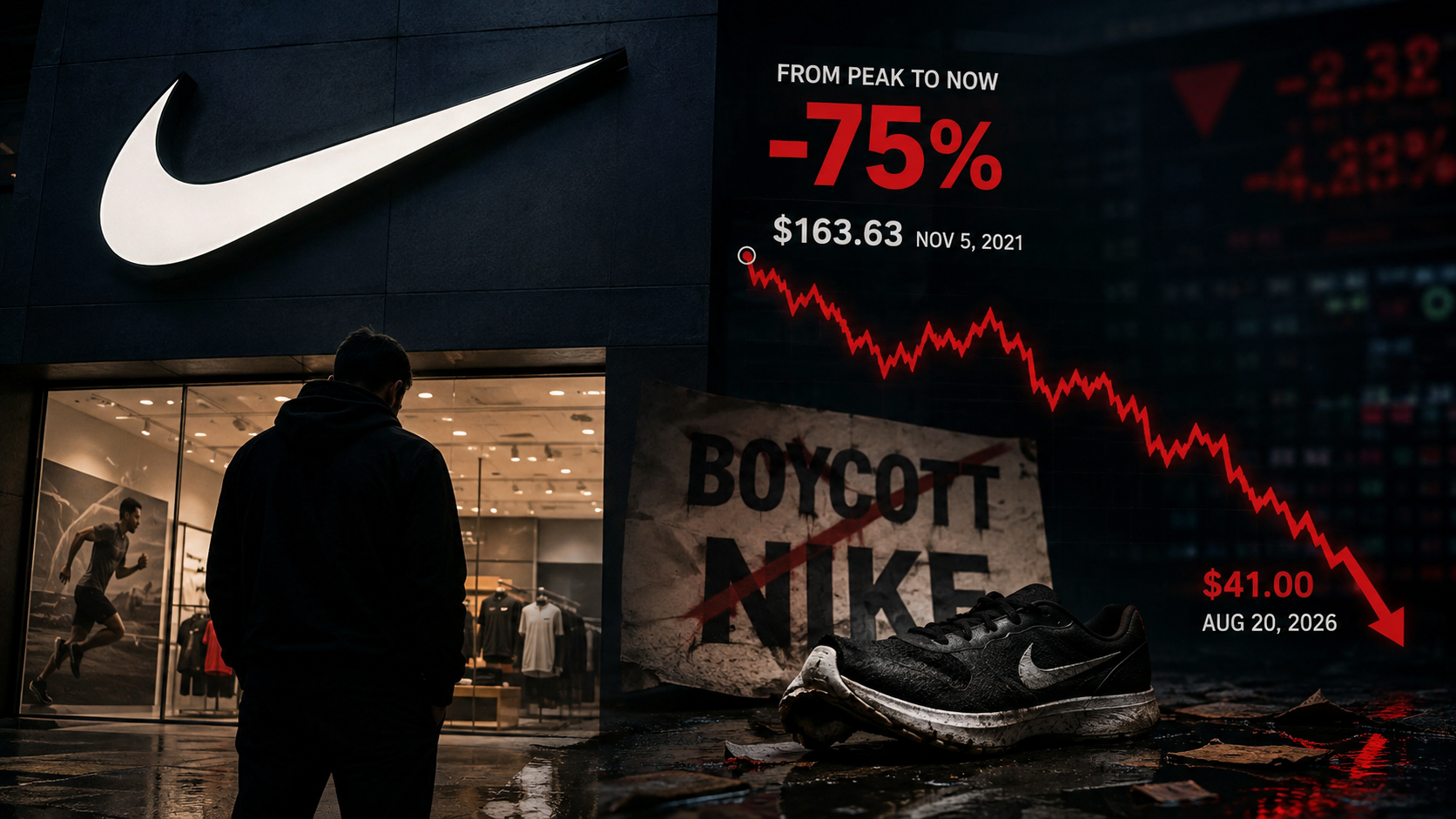
Now the argument carries a new dimension. Nike shares are trading at roughly $41, close to their 52-week lows and dramatically below the company's pandemic-era peak. The adjusted closing record was $163.63 on 5 November 2021, meaning the stock has lost roughly three-quarters of its value from that level.
That does not prove that Nike's political positioning caused its financial decline. It did not. Nike's current problems include weakening demand in Greater China, struggling digital sales, product problems, competition and a difficult attempt to rebuild its wholesale relationships. But the combination has created an uncomfortable question for one of corporate America's most recognisable brands: while Nike was trying to influence the culture, did it lose focus on selling the products that created its cultural power in the first place?
The Moment Nike Became A Political Brand
Nike had touched controversial subjects long before 2018, but its partnership with Colin Kaepernick represented a genuine turning point.
Kaepernick had become one of America's most polarising athletes after refusing to stand for the national anthem and later kneeling during it, saying he was protesting racial injustice and police treatment of black Americans. Donald Trump turned the protests into a national political issue and repeatedly attacked NFL players who knelt during the anthem.
Then Nike put Kaepernick at the centre of the 30th anniversary of Just Do It.
The advertisement carried the message: “Believe in something. Even if it means sacrificing everything.” Nike was no longer simply sponsoring a politically outspoken athlete. It had turned his political controversy into the emotional centre of one of its most important advertising campaigns.
Donald Trump condemned the decision, describing Nike's message as “terrible”. Consumers filmed themselves destroying Nike shoes and cutting the Swoosh from clothing, while boycott hashtags spread online. Country musician John Rich publicised an image of Nike socks with the logo removed.
Yet the crucial part of the story is that Nike initially appeared to win.
The immediate controversy generated enormous attention, online sales reportedly jumped following the campaign, and Nike's share price subsequently reached new highs. The Kaepernick campaign therefore taught corporate America a powerful lesson: controversy could be profitable.
Nike had discovered that political polarisation itself could become marketing.
From Kaepernick To Corporate DEI
The company's political identity did not end with one advertisement.
Following the racial protests of 2020, diversity, racial representation and equity became increasingly embedded in corporate America. Nike was part of that shift, establishing representation targets and programmes covering recruitment, leadership development and workplace diversity.
This went much further than putting athletes in advertisements. Diversity, Equity and Inclusion became connected to the internal operation of the company.
That distinction matters because Nike is now facing federal scrutiny over precisely those policies.
In February 2026, the US Equal Employment Opportunity Commission went to federal court seeking information as part of an investigation into allegations that Nike discriminated against white employees and applicants through DEI-related policies.
The allegations being investigated are extensive. The EEOC said it was examining potential disparate treatment involving hiring, promotion, demotion, layoffs, internships, mentoring and leadership-development programmes. It also sought information concerning Nike's collection and use of race and ethnicity data and its relationship with executive compensation.
Nike denies discriminatory practices and said it had been cooperating with the investigation. The subpoena-enforcement lawsuit was dropped in August 2026 after Nike provided the requested material, but that did not end the underlying investigation.
That is an important distinction. Nike has not been found guilty of systematically discriminating against white workers. The allegations remain allegations.
But politically, the investigation is significant because one of the central criticisms directed at corporate DEI has always been that policies designed to correct discrimination can themselves become discriminatory when opportunities are allocated according to race.
Nike is now inside that argument rather than merely commenting on it.
The Dylan Mulvaney Backlash
Nike entered another culture war in 2023 when transgender influencer Dylan Mulvaney promoted Nike women's leggings and a sports bra.
The timing made the partnership particularly combustible. Mulvaney had simultaneously become the centre of a huge backlash over a promotion involving Bud Light.
Nike was immediately pulled into the same debate.
Olympic swimmer Sharron Davies called for a boycott of Nike and described the decision to use Mulvaney to advertise women's sportswear as insulting to women. Caitlyn Jenner, herself transgender, also attacked Nike and labelled the company “woke”.
The dispute was not merely over transgender visibility. Critics argued that biological women were being pushed aside in the marketing of products specifically designed for women, linking the advertising campaign to the much larger fight over transgender participation in women's sport.
Nike took the opposite position. The company defended inclusive participation and warned users on its social platforms that bullying and hate speech would be removed.
Once again, Nike was making a deliberate cultural choice.
For some consumers that represented inclusion. For others it strengthened the impression that Nike increasingly viewed progressive political identity as inseparable from the brand itself.
Nike’s Stock Collapse Cannot Simply Be Blamed On ‘Wokeness’
This is where the story requires more discipline than the slogan “go woke, go broke”.
Nike shares are unquestionably depressed.
At around $41 on 20 August 2026, the stock is close to its 52-week low and approximately 75% beneath its November 2021 adjusted record close. Its market value is now around $61 billion.
But there is no credible evidence demonstrating that Nike lost three-quarters of its peak stock value because customers rejected progressive politics.
The company's own financial results reveal more conventional—and serious—commercial problems.
For fiscal 2026, Nike generated $46.4 billion in revenue. That was flat in reported terms and down 2% on a currency-neutral basis. Nike Direct revenue fell 6%, while Nike Brand Digital fell 12%. Converse revenue collapsed 31%.
The fourth quarter showed the same weakness. Nike Direct declined 7%, Nike Brand Digital dropped 12%, and company revenue fell 4% on a currency-neutral basis. Greater China was specifically identified as one of the territories dragging performance lower.
That is not a political boycott story. It is a business execution story.
Nike spent years pushing aggressively towards direct-to-consumer sales while reducing its dependence on traditional wholesale partners. Rivals gained attention. Running brands challenged Nike in categories where its dominance once appeared almost automatic. Product franchises became overexposed and consumers gained more alternatives.
The company is now trying to repair that machinery.
CEO Elliott Hill says Nike has been making structural changes intended to rebuild product innovation, brand strength and relationships with consumers. The company's financial numbers show some progress in wholesale, but digital weakness remains difficult to ignore.
So anyone claiming Nike's share-price collapse mathematically proves that “wokeness” destroyed the company is going beyond the evidence.
The more interesting argument is subtler.
Nike spent extraordinary cultural capital on politics at precisely the period when its commercial advantage began eroding elsewhere.
Nike’s Oldest Scandal Had Nothing To Do With Wokeness
There is another contradiction in Nike's moral positioning.
Long before Kaepernick, transgender advertising or corporate DEI, Nike faced one of the most damaging labour scandals in modern corporate history.
During the 1990s, conditions at factories producing Nike products in Asia became an international controversy. The company faced allegations surrounding low wages, excessive overtime, unsafe working conditions, restrictions on organising and child labour within parts of its outsourced supply chain.
Nike became so closely associated with sweatshops that the scandal became a case study in how global brands could suffer enormous reputational damage from outsourced manufacturing.
Phil Knight later acknowledged how damaging the association had become. Nike subsequently introduced stronger labour standards, auditing systems, minimum-age requirements and other supply-chain reforms. Modern Nike explicitly prohibits forced, bonded and indentured labour in supplier facilities.
But the historical episode created a criticism that continues to follow the company: it is easier for a multinational corporation to issue progressive advertising than to guarantee perfect working conditions through an enormous global manufacturing network.
That criticism returned during controversy over Xinjiang.
Nike says it does not source products from China's Xinjiang Uyghur Autonomous Region and has stated that its contract suppliers do not use textiles or spun yarn from the region. The company has also acknowledged that reports of forced labour connected to Xinjiang represent a serious concern and strengthened its auditing procedures.
Again, allegation and confirmed misconduct must not be confused. Nike's stated position is explicitly against forced labour.
But reputationally, the contrast is damaging whenever a company selling social justice in Western advertising simultaneously faces questions about labour conditions elsewhere in its supply chain.
Nike Has Always Used Controversy
There is also a danger in pretending that Nike only recently became provocative.
Nike's marketing DNA has always contained confrontation.
The company built itself around athletes who broke barriers, ignored criticism and challenged authority. Even Just Do It is fundamentally rebellious. Nike did not become successful by being culturally neutral.
That explains why Kaepernick made sense inside Nike's advertising philosophy.
Nike calculated that younger consumers were more likely to identify with Kaepernick's racial-justice message than abandon the company because of it. Initially, the calculation worked.
The problem comes when rebellion becomes predictable.
A multinational corporation supporting views already dominant across much of advertising, entertainment, academia and corporate management no longer necessarily looks rebellious. To critics, it can look institutional.
The image changes from Nike challenging the establishment to Nike becoming part of it.
That is potentially far more damaging to a brand whose mythology has always depended on individual defiance.
The Biggest Threat To Nike Is Losing Its Identity
Nike's greatest problem in 2026 may therefore be neither DEI nor Donald Trump.
It may be confusion.
The strongest Nike advertising told consumers something about themselves. Wearing Nike meant ambition, athleticism, competition and refusing to accept limits.
Politics complicated that message.
Kaepernick initially strengthened it because sacrifice and defiance fitted perfectly with Nike's existing identity. Later corporate activism did not always carry the same authenticity.
At the same time, Nike's product and distribution problems were becoming increasingly serious.
That combination matters.
Consumers will tolerate almost anything from a company whose products they desperately want. Cultural controversies become much more dangerous when the underlying products no longer command the same unquestioned attention.
Nike's share price around $41 is therefore a warning, but not the simplistic warning sometimes presented online.
The evidence does not establish that Nike “went woke and went broke”. Nike remains a $46 billion-a-year business and one of the most recognisable consumer brands ever created.
What the evidence does show is that Nike has experienced an extraordinary destruction of shareholder value while simultaneously fighting declining digital sales, weakness in China, product challenges, a federal investigation into DEI-related discrimination allegations and continuing political hostility from prominent public figures.
That should concern the company.
Nike once understood better than almost anyone that a brand needs an enemy. Complacency. Doubt. Failure. The limits everyone else places upon you.
Over the past decade, Nike increasingly chose political and cultural enemies instead.
The company's next transformation may depend on remembering that the most powerful thing Nike ever sold was never politics.
It was the belief that putting on a pair of its shoes could make you better.
