

Iran Fires Missiles Across the Middle East as War Spreads Beyond Israel
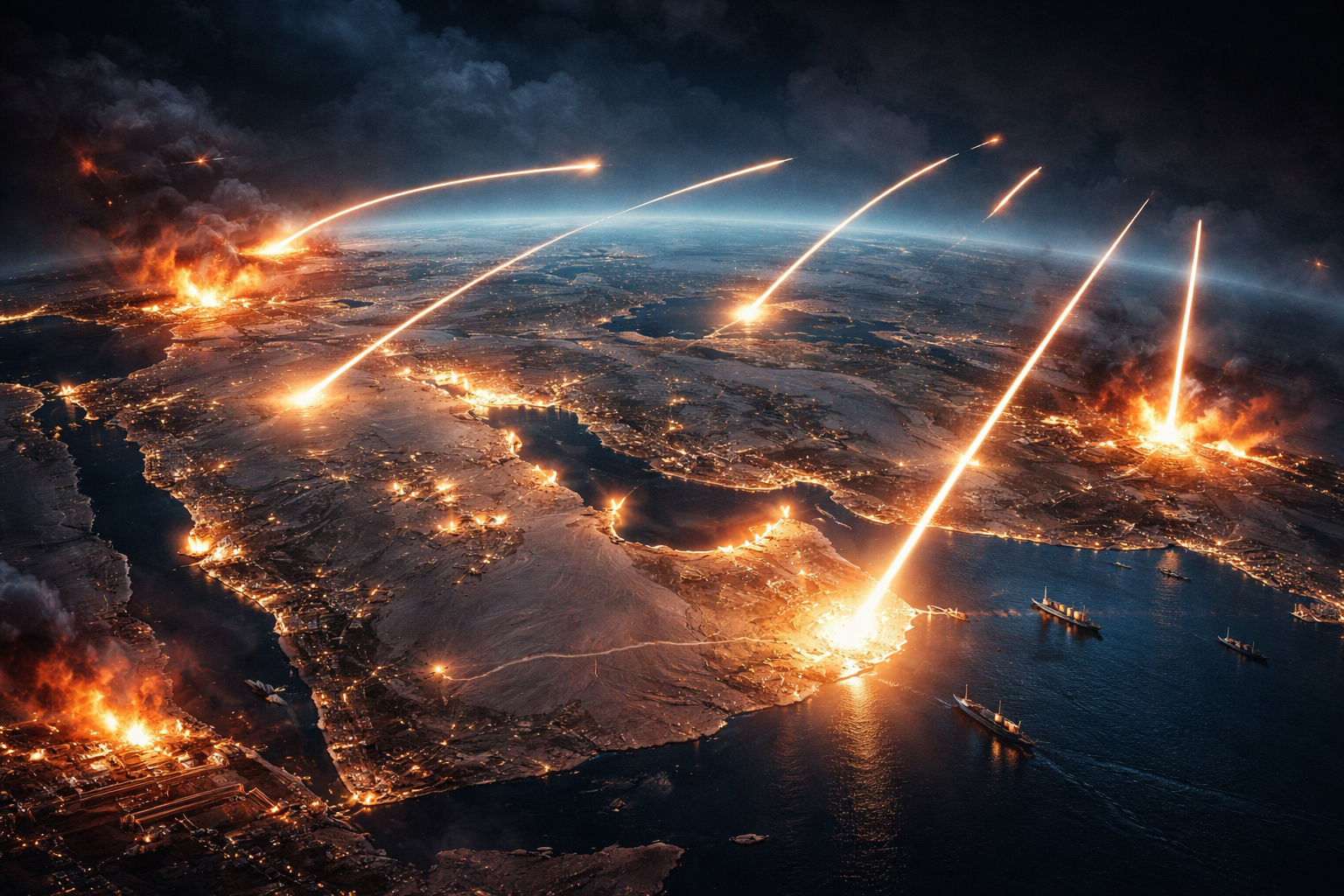
Middle East War Widens After Iran Launches Missiles Across Gulf States
Iran’s Missile Barrage Engulfs the Gulf as Regional War Looms
The Middle East war that began with U.S. and Israeli strikes on Iran has entered a far more dangerous phase. Iranian missile and drone barrages are now reaching beyond Israel, striking or threatening Gulf states including Qatar, Bahrain, Kuwait, and the United Arab Emirates.
Iranian forces and allied militias have launched waves of ballistic missiles, cruise missiles, and attack drones across the region, triggering interceptions by Gulf air defenses and Western aircraft. The attacks mark one of the most geographically widespread missile campaigns in modern Middle Eastern conflict.
The widening attacks are turning what began as a direct Iran–Israel confrontation into a regional war involving multiple states, energy infrastructure, and international militaries.
The story turns on whether Iran can broaden the battlefield faster than the United States and its allies can contain it.
Key Points
Iran has launched missiles and drones toward Israel and multiple Gulf states as retaliation for U.S.–Israeli strikes on Iranian territory.
Several Gulf countries—including Qatar, Bahrain, and the UAE—report intercepting incoming projectiles targeting military bases and infrastructure.
Western forces, including U.S., Israeli, and British aircraft, are now actively involved in regional air defense operations.
The conflict has already disrupted oil flows through the Strait of Hormuz, sending global energy markets into volatility.
Iran appears to be targeting energy infrastructure and U.S. military sites to increase the economic cost of the war for Washington and its allies, which could lead to further escalation of tensions and potential retaliation from these countries.
The risk of a multi-country Middle East war involving Gulf monarchies, NATO forces, and Iranian proxies is rising rapidly.
How the War Expanded Beyond Israel
The immediate trigger for the escalation was the February 28 U.S.–Israeli campaign targeting Iranian military and nuclear facilities. The strikes reportedly killed senior Iranian officials and severely damaged parts of the country’s military infrastructure.
Tehran responded with what it described as a “regional retaliation campaign.”
Instead of targeting Israel alone, Iran began launching missiles and drones across the broader Middle East—aiming at U.S. military bases and allied infrastructure located in Gulf countries.
The targets include:
U.S. bases in Qatar, Bahrain, Kuwait, and Jordan
Energy facilities and ports in Gulf states
Israeli cities and military sites
Since the beginning of the war, thousands of Iranian missiles and drones have been detected across the region, though the majority have been intercepted by regional air defenses.
In Israel, Iranian cluster warheads and rocket strikes have caused civilian casualties and damage in several cities.
The Gulf Becomes a Battlefield
The most consequential shift is geographic.
Missile strikes and drone attacks have now been reported across a wide arc of the Middle East:
United Arab Emirates: Hundreds of missiles and drones have been launched since late February, with debris causing civilian casualties.
Bahrain: Air defenses intercepted dozens of missiles and drones targeting military and civilian sites, including areas near the U.S. Fifth Fleet headquarters.
Kuwait: Iranian strikes have targeted military installations and U.S. assets inside the country.
Oman: Drone attacks have targeted ports and oil tankers in the region.
Missiles have also crossed Jordanian and Turkish airspace, prompting interceptions by regional and NATO air defenses.
This expansion effectively turns the Gulf states—long considered rear areas in previous Iran-Israel confrontations—into active participants in the war.
The Oil and Energy Dimension
The Gulf escalation is not random.
Iran appears to be targeting energy infrastructure and shipping routes to create global economic pressure, particularly by threatening key chokepoints like the Strait of Hormuz, which could lead to significant disruptions in oil supply and increased prices worldwide.
The conflict has already disrupted the Strait of Hormuz, through which roughly one-fifth of the global oil supply normally passes.
Market volatility has surged, and major economies are considering emergency releases of strategic oil reserves to stabilize prices.
This introduces a powerful new variable: the war now directly affects global energy security, not just regional geopolitics.
What Most Coverage Misses
Much of the immediate coverage focuses on the spectacle of missiles flying across the region.
The deeper strategic logic is endurance.
Iran likely understands it cannot defeat the United States or Israel in a conventional military contest. Instead, its strategy appears aimed at expanding the conflict geographically and economically.
By forcing Gulf states into the war and threatening global energy flows, Tehran increases the political cost of continued U.S. and allied military operations, which may lead to a reevaluation of their strategies and alliances in the region.
In other words, Iran’s most important weapon may not be its missiles—but its ability to widen the battlefield faster than its enemies can stabilize it.
How the Military Balance Is Shifting
Despite the dramatic scale of the attacks, Iranian capabilities are under pressure.
Recent assessments suggest U.S. and Israeli strikes have already degraded parts of Iran’s missile and drone infrastructure.
Air defense networks across the region—including Israeli Iron Dome, Gulf missile defense systems, and Western aircraft—have intercepted the majority of incoming projectiles.
However, Iran does not need every missile to land to achieve strategic impact.
Even limited strikes that damage energy facilities or kill civilians can escalate the political stakes of the war, potentially leading to increased military responses from affected nations or a broader regional conflict.
The Escalation Paths Ahead
Several possible scenarios could now unfold.
The first is containment.
U.S. and allied forces could gradually degrade Iran’s launch capacity and prevent the conflict from expanding further.
The second is regionalization.
If Gulf states suffer heavier casualties or infrastructure damage, they could enter the war directly, transforming it into a coalition conflict.
The third is systemic escalation.
Further attacks on shipping lanes, oil facilities, or Western forces could trigger a much larger military response from the United States and NATO allies.
The critical signals to watch include
sustained Iranian missile launch capacity
attacks on major oil export infrastructure
direct Gulf military retaliation against Iran
whether the Strait of Hormuz remains open
The trajectory of the war will hinge on whether Iran’s strategy of widening the battlefield forces outside powers into deeper intervention—or pushes them toward negotiation.
The outcome will shape not only the balance of power in the Middle East but also the stability of global energy markets for years to come.
