Iran Oil Facilities Burning After Overnight Airstrikes
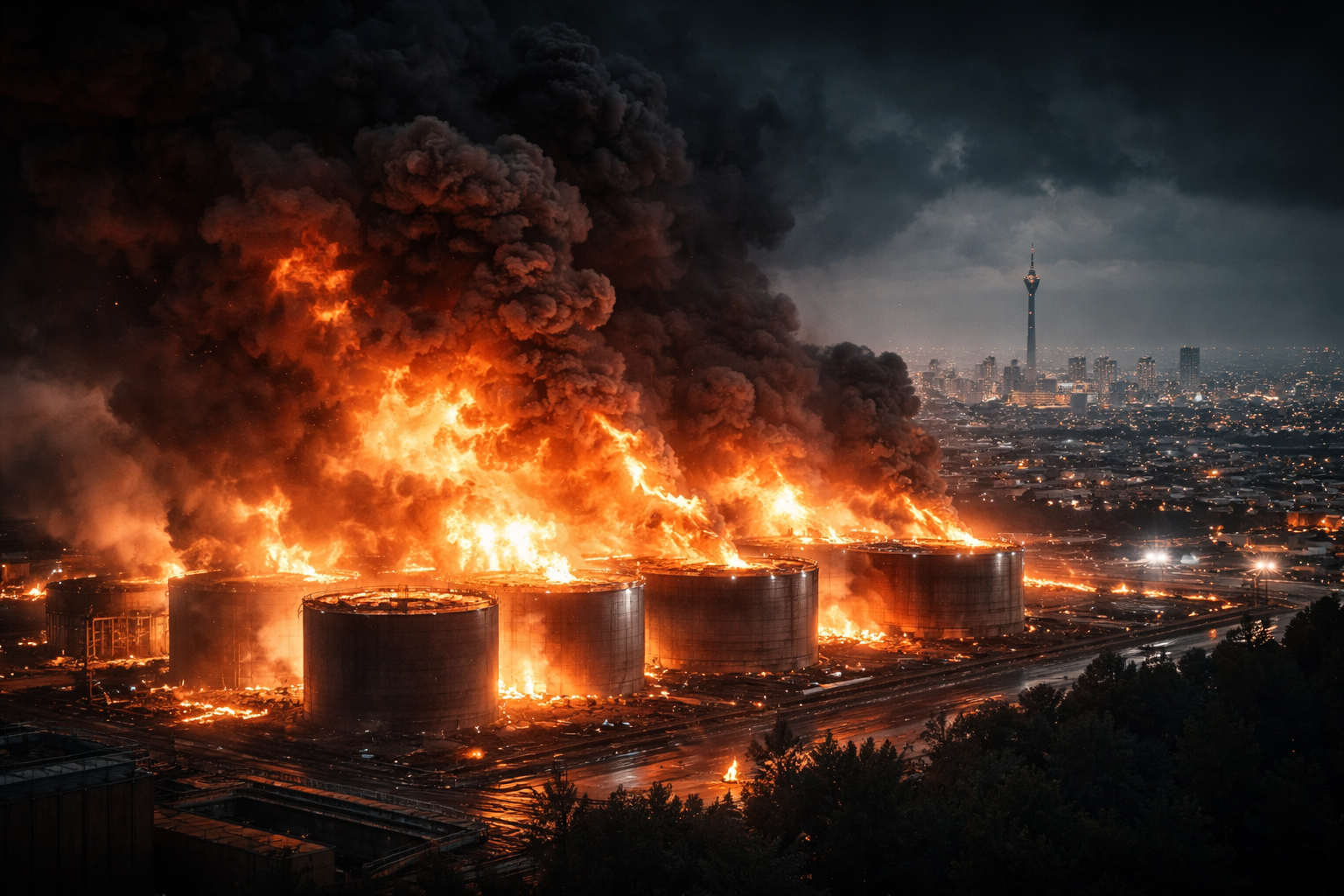
Tehran Oil Depots in Flames After Massive Strikes Rock Iran
Fireballs Over Tehran: Oil Depots Hit in Major Iran War Escalation
Massive fires lit up the skies over Tehran and nearby Alborz overnight after multiple Iranian oil storage facilities were struck in what appears to be a major escalation in the ongoing Israel–Iran war. Explosions at fuel depots and petroleum transfer infrastructure triggered towering flames and thick black smoke that spread across parts of the Iranian capital.
Iranian officials say at least four oil-related facilities and a petroleum transfer center were hit, igniting large fires and disrupting fuel distribution in the area. Initial reports indicate casualties among tanker drivers and workers at the sites, though the full toll remains uncertain.
The attacks mark one of the first times that major domestic oil infrastructure near Tehran itself has been directly targeted during the conflict, raising fears that the war may be entering a more economically destructive phase.
More than the immediate damage, the strikes may signal a shift in strategic logic: targeting energy systems that sustain both Iran’s military operations and its domestic stability.
The story turns on whether Iran’s energy infrastructure becomes a central battlefield in the war.
Key Points
Israeli airstrikes reportedly struck multiple Iranian oil storage depots and a petroleum transfer facility in Tehran and Alborz.
Massive fires and smoke clouds were visible across the capital as fuel tanks burned overnight.
Iranian authorities warned residents about polluted air and potentially hazardous rainfall caused by chemical smoke from the fires.
Early reports indicate at least several fatalities among workers and tanker drivers at the targeted facilities.
Israel claims that the sites had connections to military fuel supplies utilized by the Islamic Revolutionary Guard Corps.
The attacks could push global oil prices higher and increase risks around the Strait of Hormuz, one of the world’s most critical energy chokepoints.
How the Strikes Unfolded
The strikes reportedly occurred overnight on March 7–8, with explosions first reported in Tehran and the nearby industrial city of Karaj in Alborz Province.
Witness videos showed giant fireballs and orange smoke rising over fuel depots as storage tanks ignited. Some fires were large enough to illuminate the skyline of the Iranian capital.
Iranian media and officials report that the attack targeted at least five oil-related facilities, including four fuel storage depots and a petroleum products transfer center.
According to Israeli military statements, the targets were linked to fuel infrastructure used by the Islamic Revolutionary Guard Corps (IRGC). The strikes were intended to disrupt fuel distribution supporting Iranian military operations.
Emergency crews battled fires across the capital as fuel tanks burned for hours. Thick smoke plumes spread across Tehran, a city of roughly ten million people.
Authorities urged residents to remain indoors as air quality deteriorated.
Tehran Under Smoke: Environmental and Civilian Impact
Beyond the explosions themselves, the environmental effects have quickly become a major concern.
The Iranian Red Crescent warned residents that toxic smoke from burning petroleum could contaminate the air and even rainfall. In some areas, reports described dark precipitation carrying hydrocarbon residue falling from the sky.
Air pollution levels rose sharply across the capital, with officials advising people to avoid outdoor exposure where possible.
Fuel shortages may also emerge as a secondary effect. Some petrol stations reportedly closed temporarily while authorities rationed supply and assessed damage to distribution infrastructure.
While officials insist there is no nationwide shortage yet, the attack has introduced a new vulnerability: Iran’s ability to move fuel inside its own capital region, which could impact both local economies and the overall stability of the region during the ongoing conflict.
Why Oil Infrastructure Matters in This War
Oil and fuel systems are not only economic assets. They are also logistical lifelines for modern militaries.
Fuel depots around Tehran serve several roles simultaneously:
Supplying military vehicles and aircraft
Supporting domestic transport networks
Maintaining political stability through energy availability
Striking them therefore creates pressure on multiple fronts.
Militarily, the attacks complicate Iran’s ability to fuel aircraft, missile launch units, and logistics vehicles.
Economically, damage to domestic energy infrastructure threatens to amplify internal stress during wartime.
Politically, energy disruptions can quickly translate into public frustration inside large cities like Tehran.
What Most Coverage Misses
Most reporting focuses on the spectacle of the fires or the environmental danger. However, the choice of target holds deeper significance.
These were not export terminals on the Persian Gulf. They were domestic fuel storage facilities serving Tehran itself.
That distinction matters. Export terminals influence global oil markets, but domestic storage sites influence internal stability.
By striking fuel depots that feed the capital’s distribution system, the attackers may be targeting Iran’s wartime resilience rather than its export earnings.
It is a strategy that pressures the regime from inside its own logistical network.
If replicated across multiple cities, it could turn the conflict into a slow erosion of Iran’s ability to sustain military operations and urban life simultaneously.
The Escalation Ladder
The attacks also fit into a wider escalation pattern that has been unfolding across the region.
Recent weeks have seen strikes on missile facilities, military bases, and industrial infrastructure inside Iran. Previous waves of attacks have already targeted gas fields, refineries, and military facilities tied to Iran’s weapons programs.
At the same time, Iran and its allies have launched drones and missiles at energy infrastructure elsewhere in the Middle East.
This expanding target list shows how energy systems are becoming central to the conflict.
Each strike risks pushing the war toward a wider economic confrontation, potentially affecting global energy prices and supply chains as nations respond to the escalating conflict.
Global Energy Markets Watching Closely
Oil markets reacted quickly to news of the strikes.
Even limited damage to Iranian facilities can rattle energy traders because of Iran’s strategic geography.
Roughly one-fifth of the global oil supply passes through the Strait of Hormuz, the narrow maritime chokepoint connecting the Persian Gulf to the world. Any escalation involving energy infrastructure raises concerns about potential disruptions to shipping routes.
If tankers begin avoiding the region or if Iran threatens to close the strait, global oil prices could surge.
That possibility means the consequences of the Tehran fires extend far beyond Iran itself.
The Dangerous Question Ahead
The attacks on Tehran's oil facilities signify a pivotal shift in the conduct of the war.
Energy infrastructure, previously avoided due to its global economic impact, now seems to be entering the battlefield.
That raises a stark strategic dilemma.
If fuel depots, refineries, and export terminals become regular targets, the conflict could rapidly transform from a military confrontation into an energy war with global consequences.
The key signposts to watch now are clear: further strikes on refineries, disruptions to shipping in the Strait of Hormuz, or retaliatory attacks on Gulf oil infrastructure.
If those begin to appear, the burning fuel depots in Tehran may be remembered as the moment the war crossed into a far more dangerous phase.
