Iranian Drone Strike Hits Gulf Water Supply in Bahrain
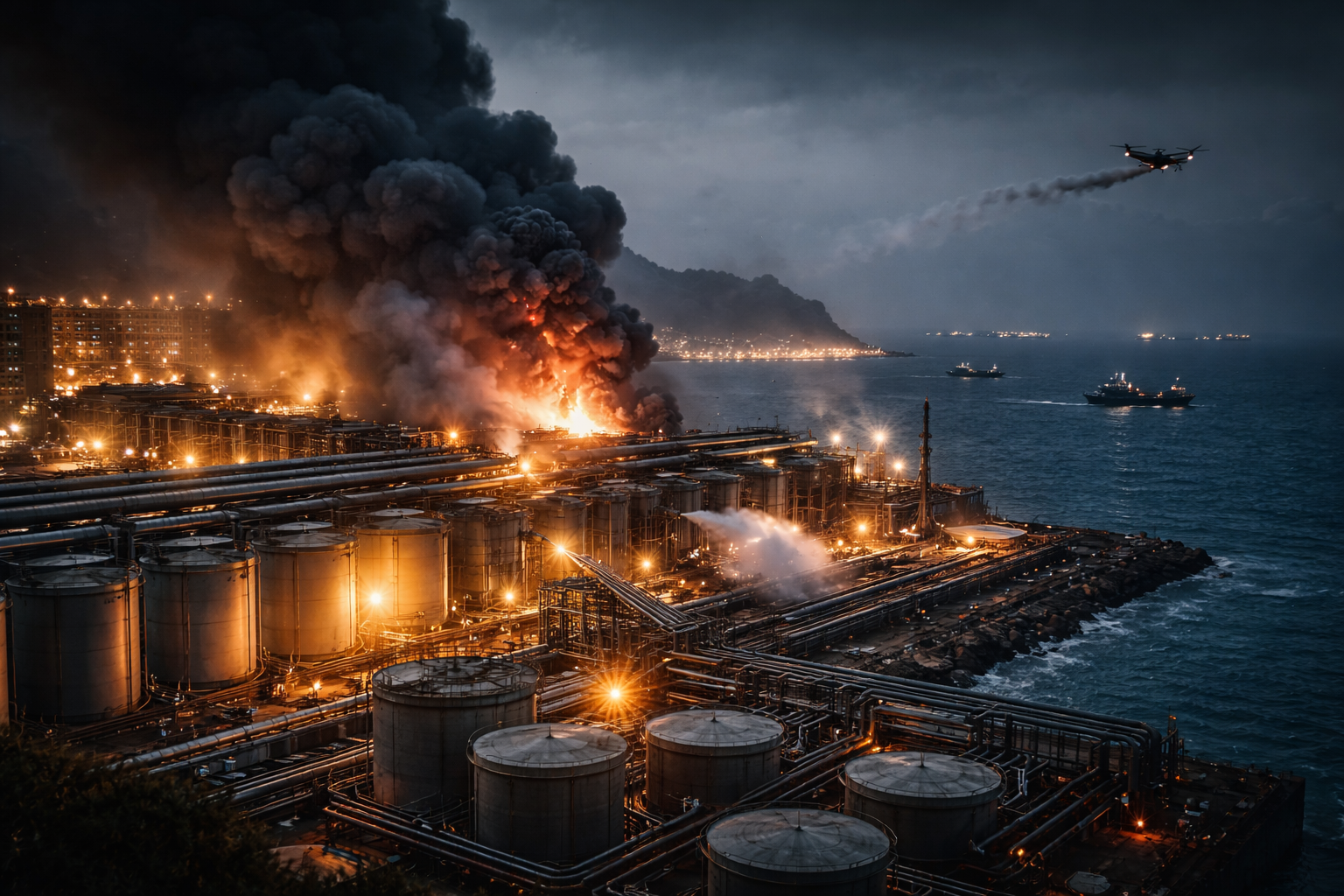
Iranian Drone Strike Hits Gulf Water Supply in Bahrain
Water Enters the War: Iranian Drone Damages Bahrain Desalination Plant
The Middle East war that began with strikes on Iranian targets has entered a dangerous new phase. On March 8, 2026, Bahrain said an Iranian drone struck and damaged a desalination plant—a piece of infrastructure that provides drinking water to millions in one of the driest regions on Earth.
The attack marks a notable escalation. Oil terminals, ports, airports, and military bases have already been targeted during the widening conflict involving Iran, the United States, Israel, and regional allies. But water infrastructure has largely remained off limits—until now.
Three people were reportedly injured by debris after the strike, and authorities described “material damage” to the facility, though full operational impacts were still being assessed.
At first glance, the incident might appear like just another infrastructure strike in a fast-spreading regional war. But the deeper significance lies in what desalination plants represent in the Gulf: not simply industrial sites, but the foundation of everyday life.
The story turns on whether water infrastructure becomes a legitimate target in this war.
Key Points
Bahrain says an Iranian drone damaged a desalination plant that converts seawater into drinking water.
Desalination provides the majority of drinking water in many Gulf states, making such facilities strategically critical.
The strike signals a shift toward targeting civilian infrastructure during the widening regional conflict.
Gulf states host hundreds of desalination plants that support both population growth and economic activity.
Analysts warn that attacks on water infrastructure could have deeper humanitarian consequences than strikes on oil facilities, potentially leading to water shortages, increased disease, and displacement of populations in the affected areas.
The incident may trigger new regional security responses from Gulf countries hosting U.S. forces, particularly in terms of increased military readiness and collaboration with allies to protect critical water infrastructure.
The Strike That Brought the War to Water
Bahrain’s government said an Iranian drone struck a desalination facility early Sunday, damaging the plant and sending debris into nearby areas. Authorities reported that fragments injured three people and caused additional damage to buildings in the Muharraq area.
The strike comes amid a rapidly expanding conflict that began in late February after U.S. and Israeli airstrikes targeted Iranian leadership and military infrastructure. Iran has since launched missile and drone attacks across the region, hitting or threatening sites in Bahrain, Kuwait, Oman, and elsewhere in the Gulf.
While Gulf air defenses have intercepted large numbers of incoming drones and missiles, some attacks have still landed. Bahrain says it has already intercepted dozens of Iranian missiles and drones during the current escalation.
The desalination strike marks the first confirmed instance in this war where a Gulf state has reported an attack on a water production facility.
Why Desalination Plants Are So Critical in the Gulf
Desalination plants remove salt and impurities from seawater to produce drinking water. The technology is essential in the Persian Gulf because natural freshwater sources are extremely limited.
Across the Gulf Cooperation Council countries, desalinated water supplies a significant share of domestic consumption. In some states, the dependence is overwhelming: desalination provides around 90 percent of drinking water in Kuwait and major shares across the wider region.
Hundreds of such plants line the Gulf coastline, collectively producing a large portion of the world’s desalinated water.
Without them, cities such as Dubai, Kuwait City, Doha, and Manama would struggle to sustain their populations. In practical terms, desalination plants function as the region’s water lifeline.
That reality makes them both vital and vulnerable.
How the Conflict Spread Across the Gulf
The Bahrain incident did not occur in isolation. Over the past week, the war has spread beyond its initial battlefields.
Iranian missiles and drones have targeted military bases, ports, and energy facilities across several Gulf states. At the same time, U.S. and Israeli forces have conducted extensive airstrikes inside Iran, hitting oil depots and military sites in and around Tehran.
The resulting cycle of retaliation has expanded the war’s geography far beyond the initial strike zones.
The crossfire increasingly catches civilian infrastructure. During the escalation, airports, ports, residential complexes, and industrial zones have all faced attacks or threats.
The desalination attack raises the question of whether water systems will now join energy facilities as routine targets.
The Strategic Power Shift
Targeting water infrastructure carries different implications from targeting oil.
Oil infrastructure affects global markets and government revenues. But water infrastructure directly affects civilian populations—potentially within days.
A desalination plant outage can lead to immediate shortages in drinking water supply, especially in smaller Gulf states with limited redundancy in their systems.
For countries such as Bahrain and Kuwait, which rely heavily on desalination, even temporary disruptions could ripple through hospitals, industry, and basic household life.
The strategic logic is clear: water systems represent a pressure point that could force governments to prioritize internal stability over external military operations.
What Most Coverage Misses
Most early reporting on the Bahrain strike focuses on escalation and infrastructure damage. But the deeper strategic shift is subtler.
Oil has historically been the region’s most famous strategic asset. Water is the one that actually sustains the population.
Desalination plants are uniquely vulnerable. Many are large coastal facilities with limited physical protection and predictable locations. They cannot be easily hidden, relocated, or rapidly rebuilt.
In effect, they function as fixed lifelines for entire cities.
This means that if desalination plants become regular targets, the conflict could evolve into a form of infrastructure warfare where civilian resilience—not battlefield outcomes—becomes the decisive factor.
That would dramatically raise the humanitarian stakes of the war.
The Real-World Stakes
For residents in Gulf states, the implications are immediate.
Desalination disruptions can reduce water pressure, restrict supply to neighborhoods, or force governments to implement emergency conservation measures. In extreme cases, tanker deliveries or rationing may be required.
Water shortages would also impact hospitals, construction, and the energy sector—all of which rely heavily on stable water supplies.
The psychological effect could be just as important. Water infrastructure strikes signal that the war is moving closer to civilian life across the region.
That alone can alter political calculations in Gulf capitals.
The Next Phase of the Conflict
The Bahrain attack leaves regional leaders facing a difficult strategic question: whether to escalate further or reinforce defensive systems around critical infrastructure.
Several signposts will indicate the direction of the conflict.
The coming days will reveal whether additional desalination plants or water systems become targets. Another is whether Gulf states increase direct military involvement alongside U.S. forces.
A third indicator will be defensive investments—including missile defense upgrades and new protections around energy and water infrastructure.
For decades, the Gulf’s security architecture revolved around protecting oil.
If desalination plants become targets, the region may soon discover that water—not oil—is the infrastructure that truly defines the limits of modern warfare in the Middle East.
