Iran’s Nuclear Mountain May Be Too Deep For America’s Biggest Bomb
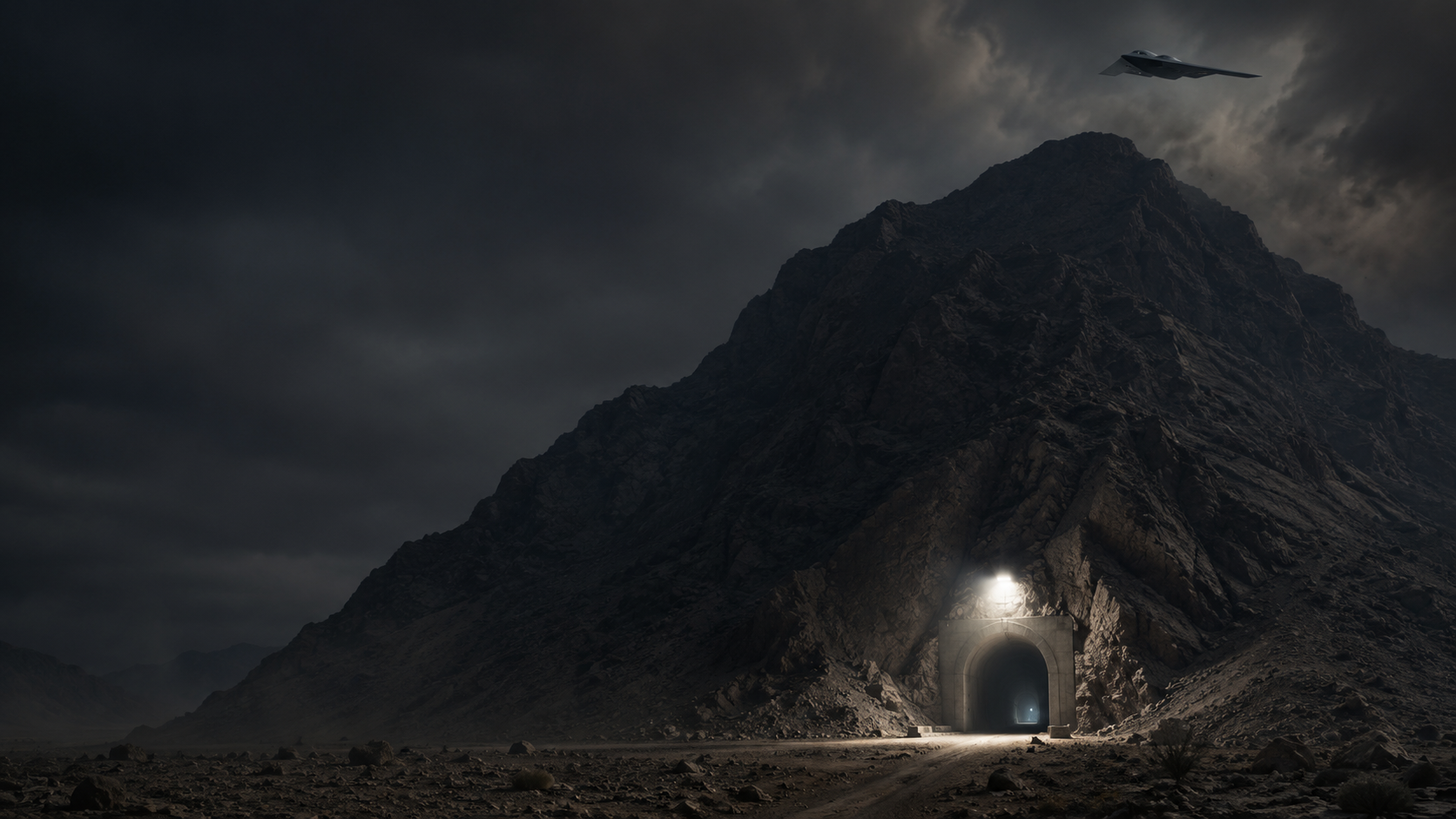
Inside Pickaxe Mountain: The Nuclear Facility America May Struggle To Destroy
Trump’s Pickaxe Mountain Threat Could Trigger The Most Difficult US Strike Yet
Donald Trump has placed Iran’s Pickaxe Mountain facility directly in America’s crosshairs, warning that the deeply buried nuclear-linked complex could be attacked “pretty soon” and “very heavily.” The threat is clear. Whether the United States can permanently destroy what lies beneath the mountain is far less certain.
Parts of the complex are estimated to sit at least 100 metres beneath the ridge, protected by rock, reinforced tunnel entrances and a growing security perimeter. That depth may place its most important underground halls beyond the reliable destructive reach of the GBU-57 Massive Ordnance Penetrator, the largest conventional bunker-busting bomb in the American arsenal.
What Is Pickaxe Mountain?
Pickaxe Mountain is the informal English name given to Kuh-e Kolang Gaz La, a mountain immediately south of Iran’s Natanz uranium-enrichment complex. The name comes from “Kolang,” a Persian word translated as pickaxe, rather than from any officially declared Iranian project title.
Construction began in late 2020 after an explosion destroyed an above-ground advanced centrifuge assembly facility at Natanz. Iran said the replacement would be built underground, where it would be far less vulnerable to sabotage, drones and airstrikes. The destroyed facility had reportedly been designed to assemble thousands of advanced centrifuges each year, giving the replacement site obvious strategic importance.
Satellite analysis indicates that the newer complex has four tunnel entrances—two on the eastern side and two on the western side—which may connect to one large facility or possibly several internal levels. The difference in height between the entrance areas has raised the possibility that the underground structure is more complicated than a single horizontal hall.
A separate and older tunnel system, constructed around 2007, also sits within the wider secured area. Its entrances have been sealed and its contents are not publicly known, adding another layer of uncertainty to what Iran may be storing or developing beneath the mountain.
Why Trump Is Threatening The Facility Now
Trump has repeatedly said the United States intends to “take out” Pickaxe Mountain. On Tuesday, he went further, telling reporters that America would hit the area soon and with considerable force as the wider US-Iran conflict continued to escalate.
The immediate concern is that Iran could use the facility to protect advanced centrifuges or eventually establish a new uranium-enrichment capability beyond the easy reach of aerial attack. Centrifuges are the machines used to enrich uranium by separating uranium isotopes. Large numbers of advanced models can substantially reduce the time required to produce highly enriched material.
Trump has acknowledged the possibility that centrifuges were moved into the mountain, but the facility’s actual contents have not been independently verified. The International Atomic Energy Agency has never been granted access, meaning inspectors cannot confirm whether it contains centrifuge manufacturing equipment, operational enrichment machinery, stored components or largely unfinished chambers.
That distinction matters. Recent satellite analysis assessed the larger complex as still under construction and not yet operational. Vehicles and construction equipment have continued moving around the site, but visible activity alone does not prove that uranium is being enriched or that an operational centrifuge plant exists underground.
How Deep Is The Facility?
The strongest public estimates place parts of the complex at least 100 metres beneath the mountain. The ridge is approximately 100 metres above the western entrances and around 145 metres above the eastern entrances, although the underground halls may not sit directly beneath the mountain’s highest points.
This makes simple claims about its precise depth difficult. Satellite images show entrances, excavation spoil, roads, walls, electrical infrastructure and possible ventilation points, but they cannot reveal the exact internal layout. Estimates of 80 to 100 metres describe the likely protective overburden above significant parts of the facility rather than a confirmed measurement of every chamber.
Even so, Pickaxe Mountain appears to be substantially deeper than the original underground enrichment halls at Natanz, which were reportedly only around eight metres below ground. It may also rival or exceed the depth of Fordow, the Iranian enrichment facility long regarded as one of the world’s most difficult aerial targets.
Iran has reinforced this natural protection with defensive engineering. Satellite imagery has shown strengthened portals, concrete work, rock channels surrounding the entrances, buried or partially buried access points and a perimeter composed of fencing, walls and patrol routes.
Could America’s GBU-57 Destroy It?
The GBU-57 Massive Ordnance Penetrator is a roughly 30,000-pound precision-guided bomb developed specifically to attack hardened and deeply buried weapons facilities. It can only be carried operationally by America’s B-2 Spirit stealth bomber and is considerably more powerful than earlier bunker-busting weapons.
The Pentagon does not publicly provide a definitive maximum penetration figure for every type of rock, soil and reinforced concrete. Its effectiveness depends on geology, impact angle, construction materials, accuracy, detonation timing and whether several bombs can be delivered against the same point.
That uncertainty is crucial. A weapon does not necessarily need to physically travel all the way into an underground chamber to damage it. The blast can generate shockwaves through surrounding rock, collapse tunnels, destroy ventilation systems, cut electricity or seal access routes. Repeated strikes against the same point could also remove protective material and allow later weapons to detonate deeper.
But destroying the entrances is not the same as destroying the facility. A strike could leave underground halls intact while trapping equipment, workers or nuclear material inside. Iran could later excavate new access routes, reopen damaged portals or repair external infrastructure unless the site remained under constant surveillance and threat of further attack.
Analysts assessing the complex have warned that strikes focused solely on the tunnel portals might only deny Iran access temporarily. The underground structure could survive even when its entrances, power connections and surface support systems were heavily damaged.
The Facility Has Vulnerabilities
Pickaxe Mountain is formidable, but it is not invulnerable. Two western tunnel entrances reportedly remained open in satellite imagery taken on July 9, leaving obvious points that precision weapons could target.
Possible ventilation shafts may present another weakness. Underground industrial facilities require air circulation, electricity, communications, cooling and routes for moving people and machinery. Those systems must connect with the surface somewhere, creating targets even when the central halls are unreachable.
America could therefore pursue a mission based on disabling rather than physically annihilating the site. Power lines, ventilation equipment, access tunnels, security infrastructure and construction machinery could all be struck. Such an operation might prevent the facility from becoming operational without proving that every underground chamber had collapsed.
A more ambitious attack could involve repeated GBU-57 strikes, specialised cruise missiles and follow-up surveillance designed to detect repair work. A ground operation entering through exposed tunnels is theoretically possible but would carry much greater risks to American personnel and could require control of the surrounding area.
The Nuclear Risk Is Still Unclear
The central problem is that Washington may be preparing to strike a facility whose exact purpose and contents remain uncertain. Iran originally associated the underground project with centrifuge assembly, but its size and depth have fuelled suspicion that it could eventually support enrichment or other sensitive nuclear activity.
There is currently no publicly verified evidence that Pickaxe Mountain is enriching uranium. A detailed June assessment found no evidence that Iran had resumed enrichment across its damaged programme and judged the larger Pickaxe Mountain complex not ready for operations.
Nor is there conclusive public evidence that Iran’s stockpile of highly enriched uranium has been transferred to the newer complex. Analysts have considered Pickaxe Mountain a possible storage location, but other underground sites at Esfahan, Fordow and Natanz remain more likely candidates for much of the material.
Iran maintains that its nuclear programme is peaceful. The United States and Israel argue that Tehran’s enrichment capabilities, limited inspector access and heavily fortified nuclear infrastructure create an unacceptable route towards a weapon, even without proof that a bomb has been assembled.
Why An Attack Could Escalate The War
Bombing Pickaxe Mountain would represent more than another strike against Iranian military infrastructure. It would signal that Washington intends to prevent Iran from rebuilding a protected nuclear programme, even by attacking facilities that may not yet be operational.
The immediate Iranian response could include missile and drone attacks against American forces, regional allies, energy infrastructure or shipping. Tehran could also use the strike to justify ending what remains of its cooperation with international inspectors and moving more nuclear work into smaller, dispersed and covert facilities.
There is also a radiological question, although the danger would depend entirely on what the tunnels contain. A centrifuge assembly workshop without nuclear material would present a different risk from an enrichment plant or storage complex containing uranium compounds. The absence of inspector access means planners cannot publicly eliminate that uncertainty.
An attack that failed to destroy the underground halls could strengthen Iran’s argument that only a fully dispersed and concealed nuclear programme can survive. It could delay Iranian activity in the short term while encouraging an even more secretive programme in the long term.
Trump’s Hardest Target
Trump’s warning has turned Pickaxe Mountain from a mysterious construction site into a potential test of American military credibility. Having promised publicly to destroy it, the administration may face pressure to produce visible and lasting damage rather than merely crater roads and close tunnel entrances.
The United States almost certainly has the capability to devastate the surface infrastructure, seal access points and interrupt construction. What remains unproven is whether even repeated strikes could reliably destroy chambers protected by approximately 100 metres of mountain rock.
Pickaxe Mountain therefore presents Trump with a brutal strategic choice. Leaving it untouched could allow Iran to complete the most protected nuclear-linked facility it has ever constructed. Attacking it could deepen the war without guaranteeing that the most important parts of the target have actually been destroyed.
