Iran’s Revolutionary Guards Seize Wartime Power—And the Conflict May Last Longer
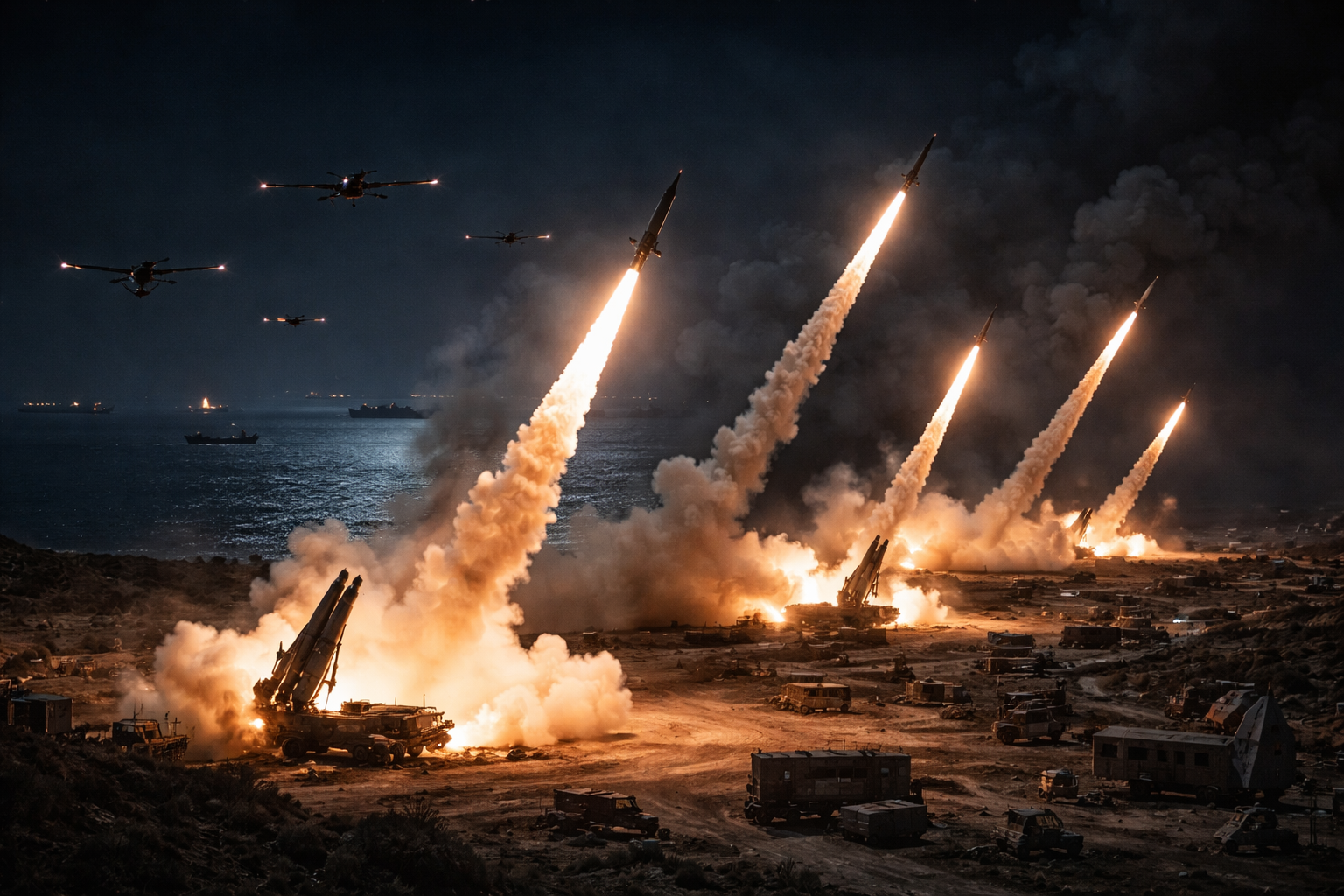
After Khamenei’s Death, Iran’s Revolutionary Guards Become the Real Power
Iran’s War Enters a Hardline Phase as Revolutionary Guards Take Control
Iran’s war strategy is shifting sharply. The country’s powerful Islamic Revolutionary Guard Corps is now driving wartime decision-making at every level of the state, tightening control and pushing Tehran toward a more aggressive posture across the region.
The change comes days after the killing of Iran’s Supreme Leader, Ayatollah Ali Khamenei, in joint U.S.–Israeli strikes—an event that triggered the most severe leadership crisis Iran has faced since the 1979 revolution.
Rather than weakening the system, the shock appears to have accelerated the rise of Iran’s security state. The Revolutionary Guards, already a dominant military and political force, are now shaping the war effort directly, expanding drone and missile attacks while tightening internal control.
The overlooked hinge in this moment is structural: Iran’s military command had already been decentralized in anticipation of leadership losses, allowing mid-level officers to continue operations even if senior leaders were killed.
The story turns on whether Iran’s new security-driven leadership structure makes escalation more likely—or simply makes the state more resilient under attack.
Key Points
Iran’s Revolutionary Guards have taken a leading role in wartime decision-making following the death of Supreme Leader Ali Khamenei.
Command structures were deliberately decentralized before recent strikes, enabling operations to continue despite leadership losses.
Mid-level commanders now have greater authority to launch drone and missile operations, raising the risk of miscalculation.
The succession battle for Iran’s next supreme leader could further cement the Guards’ dominance over politics and security policy.
Analysts say the shift reduces the chances that military pressure alone will trigger regime collapse in Tehran.
The result may be a longer and more unpredictable regional conflict.
The Islamic Revolutionary Guard Corps—commonly called the IRGC—was founded after Iran’s 1979 Islamic Revolution to protect the new political system from internal and external threats.
Over decades it evolved far beyond a military force. The organization runs missile programs, oversees elite units such as the Quds Force, controls major economic sectors, and maintains powerful intelligence and security networks inside Iran.
That dual role—military and political—has made the Guards central to the survival of the Islamic Republic.
The latest shift comes after a dramatic escalation in the Iran conflict.
A joint U.S.–Israeli strike killed Supreme Leader Ali Khamenei and several senior Iranian military figures, setting off a succession crisis in Tehran while Iran launched retaliatory attacks across the region.
Despite those losses, Iran’s command system remained functional. Military planning had already delegated authority deep into the chain of command, allowing operations to continue even after top leaders were killed.
Now that structure is shaping the war itself.
Political and Geopolitical Dimensions
The IRGC’s expanding authority reflects a broader shift inside Iran’s power structure.
With the death of the country’s supreme leader, Iran’s clerical establishment temporarily lost its central coordinating figure. In moments of crisis, power tends to move toward institutions capable of immediate action—and the Revolutionary Guards fit that role.
Several possible scenarios now loom.
One is consolidation. The Guards could effectively dominate the political system, ensuring that the next supreme leader aligns closely with their interests.
Another is the hybrid rule. Clerical leaders may retain formal authority while the IRGC controls the country’s security and foreign policy.
A third scenario is fragmentation. Empowering mid-level commanders increases operational flexibility but also raises the risk of independent action that escalates the war unexpectedly.
Key signals to watch include:
Whether the IRGC publicly shapes the supreme-leader succession process
Whether new strikes occur outside the usual Iran-Israel theatre
Whether Iran centralizes or expands proxy operations across the region
Each would reveal how centralized the war strategy really is.
Economic and Market Impact
Military escalation has already begun to spill into global markets.
Iran has threatened shipping through the Strait of Hormuz—a chokepoint that carries a large share of the world’s oil supply—after U.S. and Israeli strikes on its territory.
Any sustained disruption would ripple through energy markets and global shipping routes.
The IRGC’s growing influence could increase that risk. The organization has long favored asymmetric tactics: drone strikes, missile launches, proxy militias, and attacks on energy infrastructure.
Those strategies aim to impose costs on adversaries without requiring conventional battlefield victories.
But they also create volatility.
A single attack on a major tanker, pipeline, or refinery could transform the conflict from a regional war into a global economic shock.
Technological and Security Implications
Iran’s military doctrine increasingly relies on drones and precision missiles.
These systems allow Iran to strike across the region while minimizing the need for large conventional forces. They are also well suited to decentralized command structures.
When mid-level commanders can launch relatively inexpensive weapons without waiting for centralized approval, the tempo of conflict rises.
That dynamic increases two risks simultaneously.
First, retaliation cycles accelerate. Attacks can happen faster than diplomatic channels can respond.
Second, miscalculation becomes more likely. A strike intended as a signal could trigger a broader military response.
What Most Coverage Misses
Much of the immediate coverage of Iran’s leadership crisis focuses on the death of the supreme leader and the succession battle that follows.
But the deeper structural shift happened earlier.
Iran’s military leadership anticipated the possibility of decapitation strikes long before the current conflict intensified. In response, they redesigned the command structure to survive precisely this type of disruption.
Authority was delegated downward so that operations could continue even if senior commanders were killed.
That design changes the strategic equation.
In many conflicts, eliminating senior leadership can paralyze decision-making and slow military operations. In Iran’s case, the opposite may occur.
Decentralization allows the system to keep functioning—but it also distributes the power to escalate.
The result is a war machine that may be harder to stop.
Why This Matters
In the short term—the next days and weeks—the shift means Iran’s war strategy is likely to become more aggressive and less predictable.
Commanders closer to the battlefield now have greater authority to act.
In the longer term, the political consequences may be even more significant.
If the Revolutionary Guards emerge from the crisis with stronger institutional power, Iran could move toward a system where military leaders dominate strategic decisions.
That would reshape the country’s foreign policy for years.
Key developments to watch include:
The decision on Iran’s next supreme leader
Whether the IRGC formally expands its political role
The scale and location of future Iranian strikes
Each will signal how permanent this wartime power shift becomes.
Real-World Impact
A tanker captain in the Gulf delays a shipment after warnings about possible attacks in the Strait of Hormuz, raising insurance costs for an entire fleet.
A European energy trader watches oil prices spike overnight as news of new drone strikes spreads across markets.
A shipping firm reroutes vessels hundreds of miles around danger zones, increasing delivery times and freight costs.
A small manufacturer waits longer for imported materials as global shipping networks adjust to new security risks.
A Security State Steps Forward
Iran’s political system was built to survive crisis.
The current war is testing that design in real time.
Instead of collapsing under military pressure, the state appears to be shifting power toward the institutions most capable of fighting.
That means the Revolutionary Guards.
Whether this consolidation stabilizes the system or accelerates escalation is now the central question of the conflict.
The next phase of the war may depend less on who replaces Iran’s supreme leader and more on how much authority the country’s military guardians ultimately claim.
