

US Submarine Sinks Iranian Warship — The Iran War Reaches the Indian Ocean
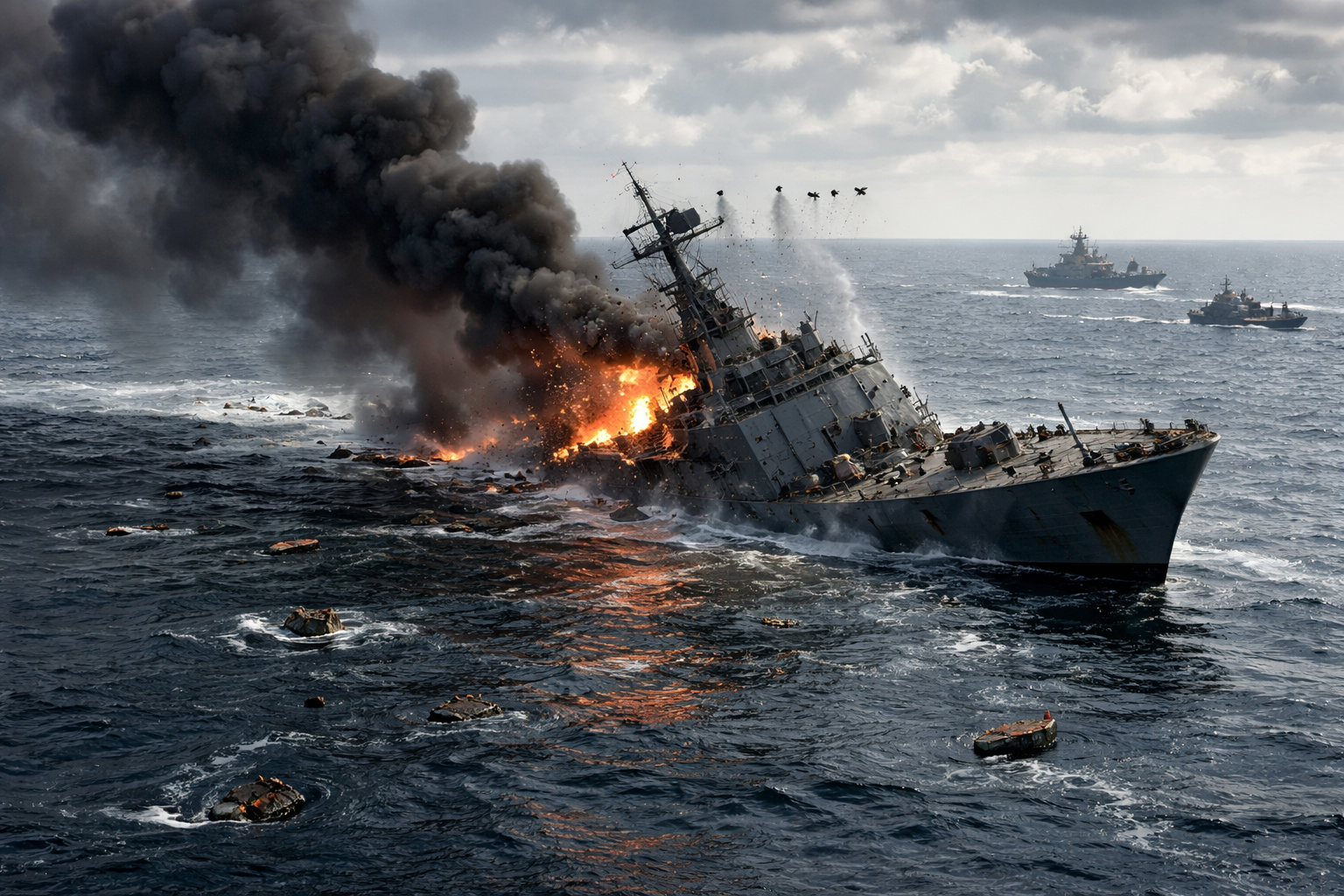
Iran War Expands as US Submarine Destroys Warship Near Sri Lanka
Torpedoes in the Indian Ocean: US Strike on Iranian Ship Kills Dozens
A U.S. submarine strike has sunk an Iranian warship in the Indian Ocean, leaving at least 80 people dead and many more missing. The incident occurred roughly 40 nautical miles south of Sri Lanka’s southern coast near the port city of Galle, dramatically widening the geography of the escalating Iran war.
The vessel, identified as the Iranian frigate IRIS Dena, reportedly carried about 180 crew members. Sri Lankan rescue teams have pulled 32 survivors from the water while search operations continue amid fears that more than 100 sailors remain unaccounted for.
Defense officials in Washington confirmed that a U.S. submarine fired torpedoes at the ship, marking one of the most consequential naval strikes of the conflict so far. The attack comes as Iranian forces expand retaliation across the region and threaten key oil shipping routes.
Yet the deeper significance may lie not in the casualties alone but in where the strike occurred: far from the Middle East’s traditional battle zones and along one of the world’s most important shipping corridors.
The story turns on whether the Iran war is now expanding into a global maritime conflict.
Key Points
A U.S. submarine torpedoed and sank the Iranian frigate IRIS Dena in the Indian Ocean near Sri Lanka, dramatically expanding the conflict’s geographic scope.
Reports indicate that at least 80 crew members have died, while over 100 remain unaccounted for from the vessel that housed approximately 180 sailors.
Sri Lankan naval and air forces launched rescue operations after receiving a distress call from the ship early Wednesday morning.
Thirty-two sailors have been rescued so far and transported to a hospital in Galle for treatment.
The attack occurred in international waters near Sri Lanka’s economic zone, placing a neutral country close to a rapidly escalating naval conflict.
The sinking marks one of the most significant naval losses for Iran in decades and could reshape maritime security across the Indian Ocean.
The war between the United States, Israel, and Iran escalated sharply in late February 2026 following coordinated strikes on Iranian military infrastructure and nuclear-related facilities. Iran responded with missile and drone attacks across the region and threats against shipping in strategic waterways.
The IRIS Dena, a Moudge-class frigate in Iran’s navy, had recently participated in multinational naval exercises near India before heading back toward Iranian waters.
Early on March 4, the ship transmitted a distress call after what crew members described as an explosion or strike. Sri Lankan naval forces dispatched rescue vessels and aircraft but arrived to find only survivors, debris, and an oil slick where the ship had sunk.
U.S. defense officials later confirmed that an American submarine had fired torpedoes at the vessel, sinking it during ongoing combat operations linked to the broader Iran conflict.
The strike is historically notable because U.S. submarines rarely destroy enemy warships in active combat. Naval historians note that such engagements are extremely uncommon in modern warfare.
Political and Geopolitical Dimensions
The strike introduces a powerful new layer to the conflict: the Indian Ocean theater.
Until now, most fighting had centered around Iran, Israel, and the Persian Gulf. By targeting an Iranian vessel thousands of kilometers away from those frontlines, Washington signals that Iranian naval assets are vulnerable almost anywhere.
Several geopolitical dynamics now collide:
First, neutral states like Sri Lanka suddenly find themselves close to major naval combat zones.
Second, regional powers, including India and China, depend heavily on the same sea lanes that now sit near the site of a major military strike.
Three broad scenarios are emerging:
Scenario 1: Maritime containment
The United States continues targeting Iranian naval vessels beyond the Persian Gulf to prevent them from threatening global shipping.
Signposts:
More submarine deployments in the Indian Ocean
Naval escorts for commercial vessels
Scenario 2: Iranian asymmetric retaliation
Iran could respond by attacking commercial shipping or deploying naval drones and mines.
Signposts:
Strikes on tankers or container ships
Expanded threats to the Strait of Hormuz
Scenario 3: Rapid diplomatic pressure
Countries dependent on Indian Ocean shipping routes push for de-escalation.
Signposts:
Emergency UN Security Council meetings
Calls for maritime ceasefire zones
Economic and Market Impact
The economic stakes are enormous.
The waters south of Sri Lanka sit along one of the busiest shipping lanes in the world, linking:
Middle Eastern oil exporters
Asian manufacturing hubs
European consumer markets
If naval conflict expands into this region, shipping insurance costs could surge overnight.
Oil prices would likely react quickly because tankers transporting Gulf crude often pass through nearby routes.
Shipping disruptions could also affect global supply chains already strained by geopolitical instability.
Technological and Security Implications
The strike also highlights the enduring strategic power of submarines.
Unlike aircraft or surface ships, submarines operate with near-complete stealth. They can track and destroy naval targets without warning, making them one of the most unpredictable weapons in modern warfare.
Reports indicate the Iranian frigate may have been hit by multiple torpedoes, overwhelming its defenses.
For naval planners worldwide, the message is clear: even medium-sized warships remain highly vulnerable to submarine warfare.
What Most Coverage Misses
Much of the immediate coverage focuses on casualties and escalation. But the deeper shift is geographic, not tactical.
The strike happened near Sri Lanka—thousands of kilometers from the Persian Gulf—placing the conflict along a major international trade artery.
That matters because wars that expand into global shipping lanes tend to have consequences far beyond the battlefield.
Insurance markets react first. Shipping companies reroute vessels. Freight costs rise. Governments deploy naval escorts.
The mechanism is simple: once insurers consider a region a “war risk zone,” shipping costs spike and trade slows.
If additional naval engagements occur in the Indian Ocean, the Iran war could quickly become a global maritime crisis, not just a regional conflict.
Why This Matters
In the short term, the strike increases the risk of retaliation against U.S. or allied naval forces.
The next 72 hours will be critical as Iran decides whether to respond directly at sea.
Key developments to watch:
Iranian naval deployments beyond the Persian Gulf
Security measures around oil tankers
Emergency diplomatic efforts from neutral countries
Longer term, the conflict may reshape maritime security across the Indian Ocean.
If opposing powers' warships operate in the same shipping corridors, they could increasingly militarize commercial trade routes.
Real-World Impact
A tanker captain sailing from the Gulf toward Asia now faces rising insurance premiums and the possibility of naval escorts through previously routine routes.
A logistics company planning shipments through the Indian Ocean must evaluate whether delays or rerouting could disrupt global supply chains.
A small port operator in South Asia suddenly finds their harbor potentially hosting rescue vessels, naval patrols, and international observers.
And for families of sailors aboard the sunken frigate, the search for survivors remains the most urgent reality of all.
The Indian Ocean Question
The sinking of an Iranian warship near Sri Lanka may mark the moment when a regional war spilled into global waters.
The key question now is whether the attack was a single strike or the opening move in a broader naval campaign.
If submarines begin targeting military vessels across the Indian Ocean, shipping routes that power the global economy could become the next battlefield.
History shows that once wars reach the sea lanes of global trade, their consequences rarely remain regional.
