Iran–U.S. Strikes Put the Gulf’s “Safe Zone” Under Pressure
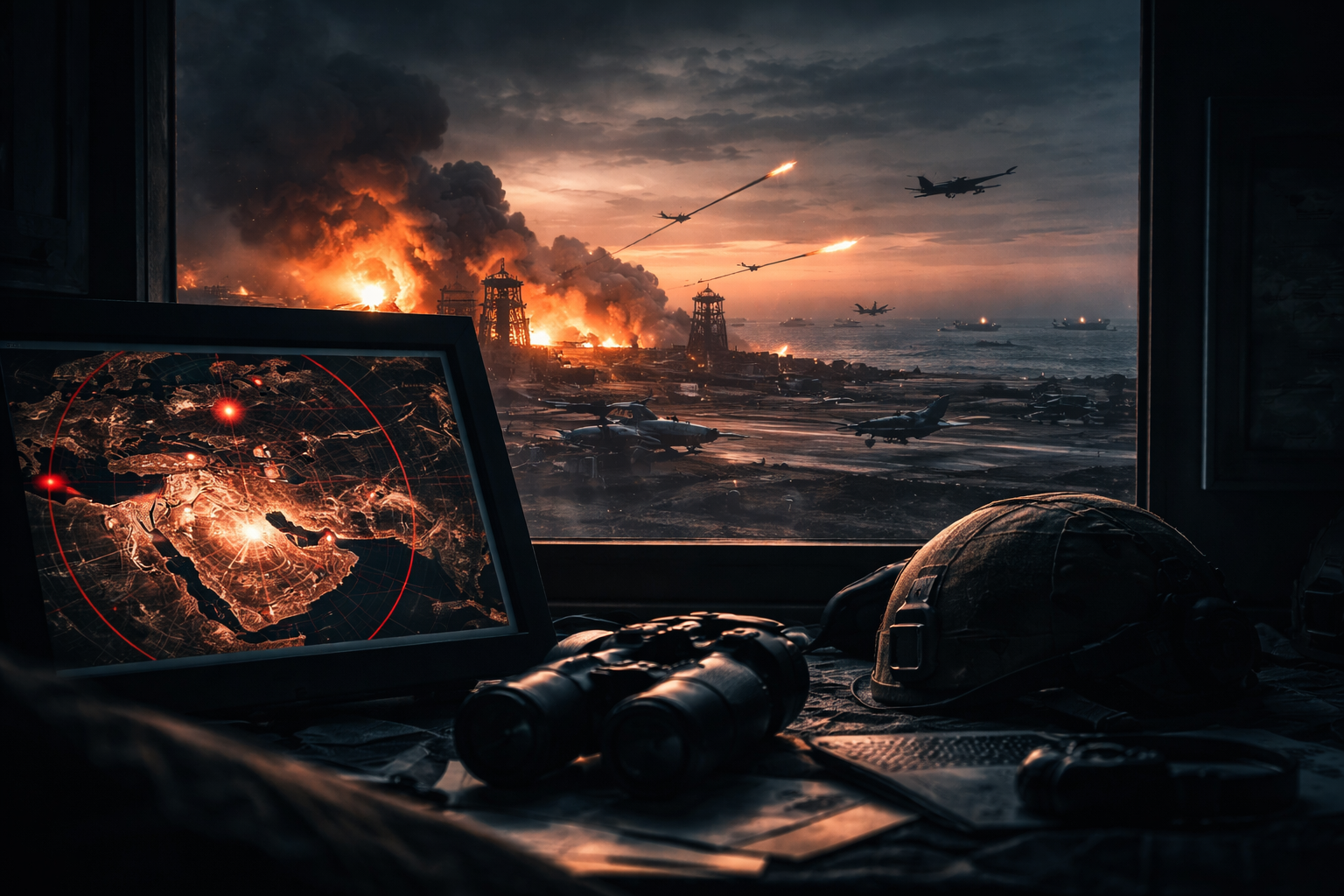
Iran–U.S. Strikes Aren’t Just About Missiles—They’re About the Region’s Connectivity
Iran–U.S. Strikes Raise a New Risk Boundary: Bases, Airspace, and Miscalculation
A coordinated U.S. and Israeli strike campaign hit targets inside Iran, and Iran answered with missile attacks aimed at Israel and multiple U.S. military sites across the region.
By Saturday, February 28, 2026, officials in several Gulf states were issuing urgent shelter guidance, and aviation authorities were shutting or restricting airspace. Airlines began rerouting at scale, and governments moved quickly to protect personnel and critical infrastructure.
The central tension is familiar: each side claims it is acting to restore deterrence, not start a wider war. The less-discussed danger is mechanical, not rhetorical—when airspace, shipping lanes, and communications degrade at once, the odds of misreading signals and escalating by accident rise sharply.
The story turns on whether leaders can reassert escalation control faster than disruption spreads.
Key Points
The United States and Israel launched major strikes inside Iran, with U.S. leadership describing the operation as “major combat operations” and framing it around missile, nuclear, and regional threats.
Iran retaliated with missile strikes that targeted Israel and bases hosting U.S. forces across parts of the Gulf, pulling multiple countries into the blast radius even if they did not choose the fight.
Several states moved to close or restrict airspace, and airlines began widespread cancellations and reroutes, a sign that the conflict is immediately reshaping regional connectivity.
Governments in parts of the Gulf issued shelter-in-place guidance for citizens and personnel, indicating that they are treating retaliation risk as active, not theoretical.
Markets and maritime security posture are tightening around the Strait of Hormuz and nearby corridors, where risk perception can move faster than physical damage.
The next signals to watch are strike tempo, targeting scope (especially infrastructure), and whether official channels restore predictability or further degrade.
Iran and the United States have spent years in a cycle of pressure and response: sanctions and diplomacy on one side, and regional proxy conflict and missile development on the other.
Israel treats Iran’s nuclear and missile capabilities as existential threats and has repeatedly signaled it will act preemptively if it believes thresholds are being crossed.
When a crisis turns kinetic, the region’s geography does the rest. U.S. forces are distributed across multiple bases and naval facilities. Gulf states host key U.S. assets while trying to preserve domestic stability and economic confidence. Iran’s leverage includes missiles, drones, maritime disruption, and allied armed groups in multiple theaters.
One constraint matters more than slogans: once strikes and retaliation begin, leaders face intense domestic and alliance pressure to demonstrate resolve, even if their private objective is to stop.
The first boundary crossed: Gulf basing is no longer “rear area."
Retaliation that reaches bases across the Gulf changes the map. It signals that Iran is willing to impose costs on the broader U.S. posture, not only on a single battlefield or a single opponent.
That creates immediate stakeholder conflict. Gulf governments want safety and predictability. The United States wants freedom of action and force protection. Iran wants to show it can impose pain without inviting total war. Those goals collide when missiles land near countries that did not initiate the strikes.
A key constraint is geography: bases are fixed targets, and air defenses have limits. Even a small number of successful strikes—or credible near-misses—can trigger further closures, evacuations, and political backlash.
Two stories governments are telling: “limited” versus “decisive”
In public messaging, leaders often try to hold two truths at once. They present strikes as decisive enough to matter but limited enough to remain controllable.
That messaging gap is not cosmetic; it shapes incentives. If the U.S. and Israel portray the operation as a major turning point, Iran faces pressure to answer in a way that looks equally serious. If Iran frames retaliation as region-wide and uncompromising, Washington faces pressure to demonstrate it can protect bases and allies.
The measurable test is whether each side can slow down. If strike tempo accelerates, restraint messaging collapses. If tempo pauses and diplomatic language reappears in official statements, containment becomes plausible.
The credibility trap: leaders can’t climb down easily
Once a strike campaign is branded as a major operation, leaders risk paying a political price for stopping short of visible outcomes. That is true in Washington, in Tehran, and in allied capitals.
This creates a trap with a hard limit: escalation becomes less about what is strategically necessary and more about what is politically survivable. The more each side promises, the narrower the off-ramp.
Watch for constraint signals: emergency cabinet meetings, public warnings about casualties, and heightened domestic security posture. Those moves often indicate leaders are preparing their publics for pain, which can widen the conflict’s runway.
The missing lever: disruption that multiplies mistakes
The most immediate effect is not only blast damage. It is friction.
Airspace closures and mass rerouting reduce civilian visibility and complicate military deconfliction. Maritime warnings and electronic interference risk—especially GPS jamming or spoofing—make shipping behave as if a blockade exists even if no formal blockade is declared. Reports of internet disruption inside Iran, if sustained, further degrade verification and crisis communication.
This matters because deterrence depends on clear signaling. Disruption blurs intent. When you cannot see clearly, you guess. And when armed forces guess under stress, they overreact.
The signal test: do flights, ships, and networks stay constrained
This crisis will be measured in systems as much as in sorties.
If airspace restrictions spread or persist, the region’s economic confidence takes a direct hit. If shipping risk pricing spikes and vessels avoid chokepoints, energy and insurance costs rise even without physical supply damage. If communications blackouts deepen, outside actors lose the ability to verify claims quickly, and rumor becomes operational.
Those signals will tell you whether this is moving toward a contained exchange or a broader regional fracture.
What Most Coverage Misses
The hinge is simple: connectivity disruption is not a side effect—it is a pressure tool that also increases miscalculation risk.
Mechanism-wise, when governments and firms treat airspace, shipping lanes, and communications as unsafe, they impose economic and operational costs immediately. That can create leverage without capturing territory. But it also compresses decision time, reduces transparency, and raises the chance that a defensive move is misread as preparation for escalation.
Two signposts would confirm this hinge fast. First, sustained multi-country airspace closures and long-duration rerouting that outlast the first exchange of strikes. Second, credible reports of persistent electronic interference or communications shutdowns that limit verification and coordination.
What Happens Next
In the next 24 to 72 hours, the key question is whether retaliation stays bounded or expands in target type. A narrow path exists if strikes focus on clearly military targets and if leaders signal a willingness to pause.
Over the following weeks, the risk shifts from immediate exchange to structural instability, because repeated disruption can harden into a new normal. That matters because global energy and shipping flows rely on routine confidence, not constant crisis posture.
The main consequence is escalation drift, because system disruption reduces the ability of leaders to send and receive clear signals, making it harder to stop once the cycle restarts.
Specific decisions to watch include emergency diplomatic activity at the United Nations, updated travel and shelter guidance from governments with personnel in the region, and any formal maritime security directives that redefine risk zones.
Real-World Impact
A logistics manager at a multinational firm wakes up to a cascade of alerts: flights rerouted, cargo delayed, and insurance clauses triggered. The cost increase is immediate even if inventory still moves.
A family with relatives working in Gulf cities faces rapidly changing shelter guidance, uncertain school schedules, and the quiet fear that “normal” areas are no longer insulated.
A small business reliant on imported components sees delivery windows slip without warning because aircraft and ships are taking longer routes and prioritizing safety over speed.
An investor monitoring energy and transport responds to uncertainty instead of ground-level facts, as disruption serves as a tradable signal.
The fork in the road: containment by discipline or drift by accident
This is now a contest between military capability and escalation discipline. Capability sets the ceiling of damage. Discipline determines whether the ceiling becomes the plan.
Containment requires choices that look weak in the short term: slowing strike tempo, tightening target selection, and using formal channels to communicate boundaries. Drift happens when leaders let disruption and domestic politics choose for them.
The concrete signposts are straightforward: whether airspace and maritime restrictions ease quickly, whether official statements shift from threats to conditions, and whether the next round targets infrastructure rather than forces.
History will remember this moment less for any single strike than for whether the region crossed into an era where disruption itself became the default weapon.
