

Is a New Space Race Between the USA and China Already Underway?
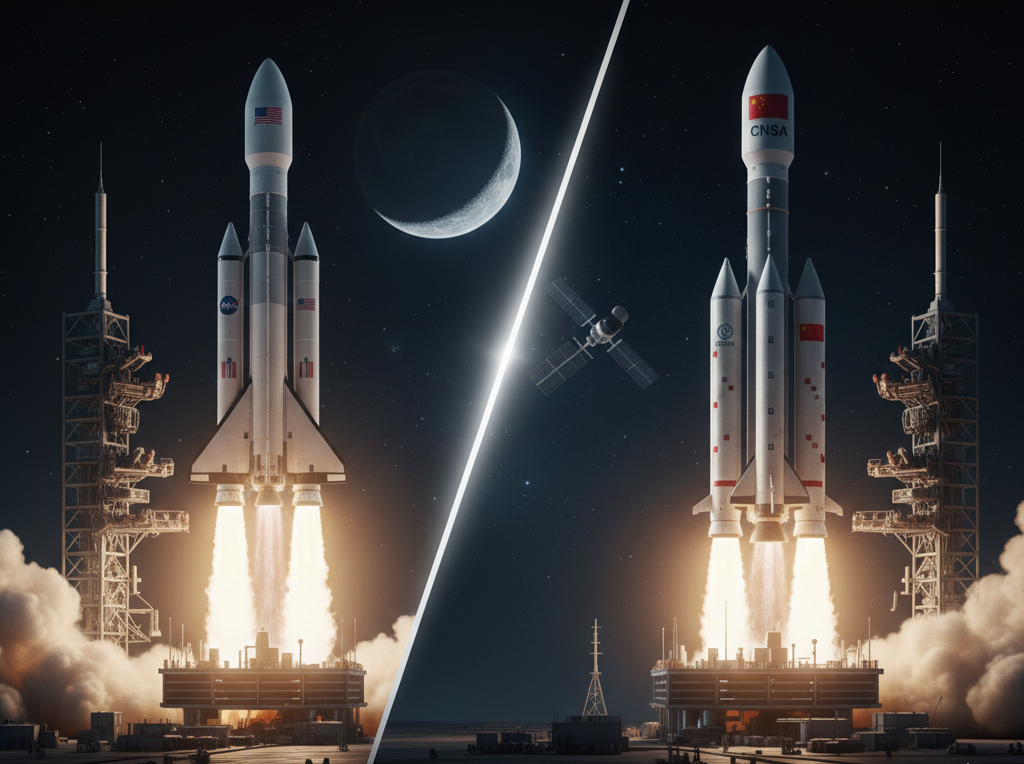
In Washington and Beijing, the language around space has shifted from cooperation to competition. In the past few days alone, US lawmakers and space officials have spoken openly about a “race” with China to return humans to the Moon and shape the next era of space power.
At the same time, NASA engineers have kicked off a new round of complex ground tests for its Artemis lunar lander systems, while fresh analyses warn that repeated delays could hand Beijing the symbolic prize of the first new crewed Moon landing in more than 50 years.
China, for its part, has reiterated that it is on track to put astronauts on the lunar surface by 2030, supported by ongoing work on a heavy-lift rocket, a crew capsule, a lunar lander, and a consistent record of robotic missions.
This piece looks at whether that amounts to a new space race between the USA and China, how it differs from the Cold War contest with the Soviet Union, and what is actually at stake: lunar resources, orbital economics, military security, and the rules that will govern space for decades.
By the end, the picture that emerges is less about a simple dash to plant a flag and more about who can build the most credible, durable ecosystem in and around the Moon.
The story turns on whether US–China rivalry in space stays a hard-edged but rule-bound competition, or slips into a destabilizing struggle for advantage beyond Earth.
Key Points
US and Chinese officials now openly frame lunar exploration as strategic competition, with both sides aiming for crewed Moon landings before or around 2030.
NASA’s Artemis program is advancing but faces schedule pressure and budget strain, while China’s plans appear steadier on paper.
Beyond prestige, the race is about who sets norms for lunar resources, cislunar traffic, and military behavior in space.
China already operates its own orbital station and is recruiting partners for a future International Lunar Research Station, while the US leans on commercial space firms and alliances.
The competition is unlikely to remain strictly bilateral; private firms and emerging space nations will shape the outcome.
The real danger lies not in who lands first but in whether accelerating competition undermines safety and crisis management in a fragile domain.
Background
The original space race between the United States and the Soviet Union was a binary contest for ideological and military dominance. It peaked with the Apollo Moon landings and later gave way to cooperation.
Today’s environment is more complex. The United States still leads in many space technologies and is pushing ahead with the Artemis program, which aims to return astronauts to the Moon and establish a long-term presence at the lunar south pole. Artemis II, a crewed fly-around mission, is scheduled for no earlier than early 2026, with a landing to follow later in the decade. Delays have already reshaped the timeline multiple times.
China has progressed steadily through its Chang’e robotic missions—landing on both the near and far side of the Moon, returning samples, and scouting polar regions. Upcoming missions are expected to prepare for a joint lunar research base in the 2030s.
In parallel, China is developing its crewed lunar architecture: the Long March 10 rocket, the Mengzhou spacecraft, and the Lanyue lander. Officials maintain that all major components remain on track for a crewed landing by 2030.
Low Earth orbit is another competitive frontier. The International Space Station is nearing retirement, while China’s Tiangong station is already in full operation with regular crew rotations. In Washington, there is rising concern that Tiangong could become the world’s primary orbital laboratory if commercial ISS successors fall behind schedule.
Strict export controls and security laws limit direct US–China cooperation, pushing each side to create separate ecosystems of partners, technologies, and legal frameworks. This fragmentation is one reason analysts see a “new space race” taking shape, even if it differs markedly from the one in the 1960s.
Analysis
Political and Geopolitical Dimensions
Space is now a stage for broader US–China rivalry. Senior US officials have warned that falling behind China at the Moon could shift geopolitical influence on Earth, reinforcing the idea that lunar progress signals national strength.
For Washington, stabilizing Artemis timelines is about more than symbolism. A Chinese landing first could give Beijing narrative and diplomatic leverage with developing nations, where space partnerships increasingly intersect with trade, infrastructure, and military cooperation. Congressional scrutiny has intensified around Artemis delays and budgets.
Beijing promotes its lunar plans as peaceful exploration but also emphasizes “space power” and offers foreign governments the chance to join its planned lunar research base. This directly competes with the US-led Artemis Accords. The two initiatives are becoming proxies for worldwide political alignment.
Seen through this lens, the race is already under way—not simply to reach the Moon, but to define the rules and alliances that govern space.
Economic and Market Impact
Space is morphing into a vast commercial domain. The Moon is part of this emerging economy, with long-term potential for mining water ice, producing fuel, constructing habitats, and deploying communications infrastructure.
The United States relies heavily on private companies to build this ecosystem. Commercial partnerships for landers, stations, and cargo services are designed to eventually create self-sustaining markets.
China’s model is more state-directed but still encourages commercial expansion. Its satellite constellations, sensors, and launch services are increasingly marketed overseas, especially to countries already linked to Chinese digital infrastructure.
If separate US and Chinese systems continue to diverge, firms and researchers worldwide may have to choose between competing standards, hardware, and regulatory environments. That tension is another form of “race”: competition to shape the foundations of the space economy.
Social and Cultural Fallout
Space achievements remain powerful symbols. A crewed landing at the lunar south pole would fuel narratives of national revival and technological excellence in both countries.
In China, high-profile launches and a steady cadence of lunar missions reinforce a national storyline of ascent. A successful crewed landing would be a landmark moment.
In the United States, memories of Apollo shape public expectations. The possibility of being overtaken at the Moon by a rising rival is often invoked in speeches to secure political and financial support. But this kind of rhetoric can also create rigid public deadlines that are difficult to adjust without backlash.
Technological and Security Implications
Space capability is inherently dual-use. The same rockets, sensors, and spacecraft used for exploration also have military value.
China has invested heavily in systems that could disrupt or disable satellites, as well as dense constellations for imaging, navigation, and communications. US officials worry that these capabilities could threaten essential satellite networks during a crisis.
The United States is developing more resilient constellations, better surveillance of the orbital environment, and diplomatic initiatives to discourage destructive anti-satellite testing. Both countries are experimenting with close-proximity operations that enable repairs and inspections but could also be used for interference.
If future infrastructure is built around the Moon—power stations, depots, research sites—it will acquire strategic significance. Even without open talk of lunar conflict, both sides are planning for an environment that requires vigilance.
What Most Coverage Misses
Most reporting focuses on who will land first. But the more important question is what happens afterward.
The deeper contest is over sustained presence: safe logistics, interoperable systems, predictable rules, and broad international support. A rushed landing without long-term planning would offer little strategic benefit.
Another overlooked factor is the role of third countries. Europe, Japan, India, and emerging space nations are already choosing which partnerships to prioritize, which standards to adopt, and how to balance scientific access with geopolitical alignment. Their decisions could soften or sharpen the rivalry.
Why This Matters
In the near term, competition affects satellite reliability—navigation, weather forecasting, climate monitoring, and communications. These services touch billions of lives daily.
Over the long term, the rivalry will shape access to lunar resources, rules for landing sites, and mechanisms to prevent dangerous incidents in crowded orbit.
Key upcoming signals include whether Artemis II launches in 2026 as planned, whether Artemis III can stay on track, and whether commercial space station projects mature before the ISS retires.
On China’s side, the next indicators include progress on its upcoming lunar probes, continued operation of Tiangong, and visible testing of its crewed lunar architecture ahead of the 2030 landing goal.
Budget choices in both capitals over the next few years will be decisive. Ambition can fade quickly if political focus shifts or economic pressures rise.
Real-World Impact
For a small satellite company in Europe, US–China competition shapes which launch providers are accessible, which orbits become crowded, and which regulations dominate the market.
For a coastal planner in Southeast Asia, the reliability of satellite data affects flood forecasting, storm tracking, and land-use planning. Tensions in space could disrupt these critical services.
For a university lab in Africa or Latin America, participation in future missions or access to lunar samples could depend on whether their government aligns with US-led or China-led frameworks.
For everyday citizens, many consequences will remain invisible until something breaks—a satellite outage, a debris incident, or a diplomatic confrontation triggered by a close approach in orbit.
Road Ahead
A new space race between the USA and China is already taking shape. Both powers are working toward crewed Moon landings, expanding orbital infrastructure, and courting international partners. But this is not a replay of the 1960s. It spans low Earth orbit, cislunar space, and the lunar surface, involving private companies, global alliances, and an intricate web of economic and security interests.
The core tension is simple: will this remain a competitive but managed environment, or will fragmentation and mistrust turn space into a zone of instability?
Over the next few years, the clearest signs will be whether Artemis schedules stabilize, whether China maintains its 2030 target, how countries align themselves, and whether new norms emerge for responsible behavior. These signals will reveal whether the race becomes a force for innovation—or a source of growing risk above our heads.
