Jalen Hurts Diagnosed With Blood Clots in Both Lungs as Eagles Face Lengthy Absence
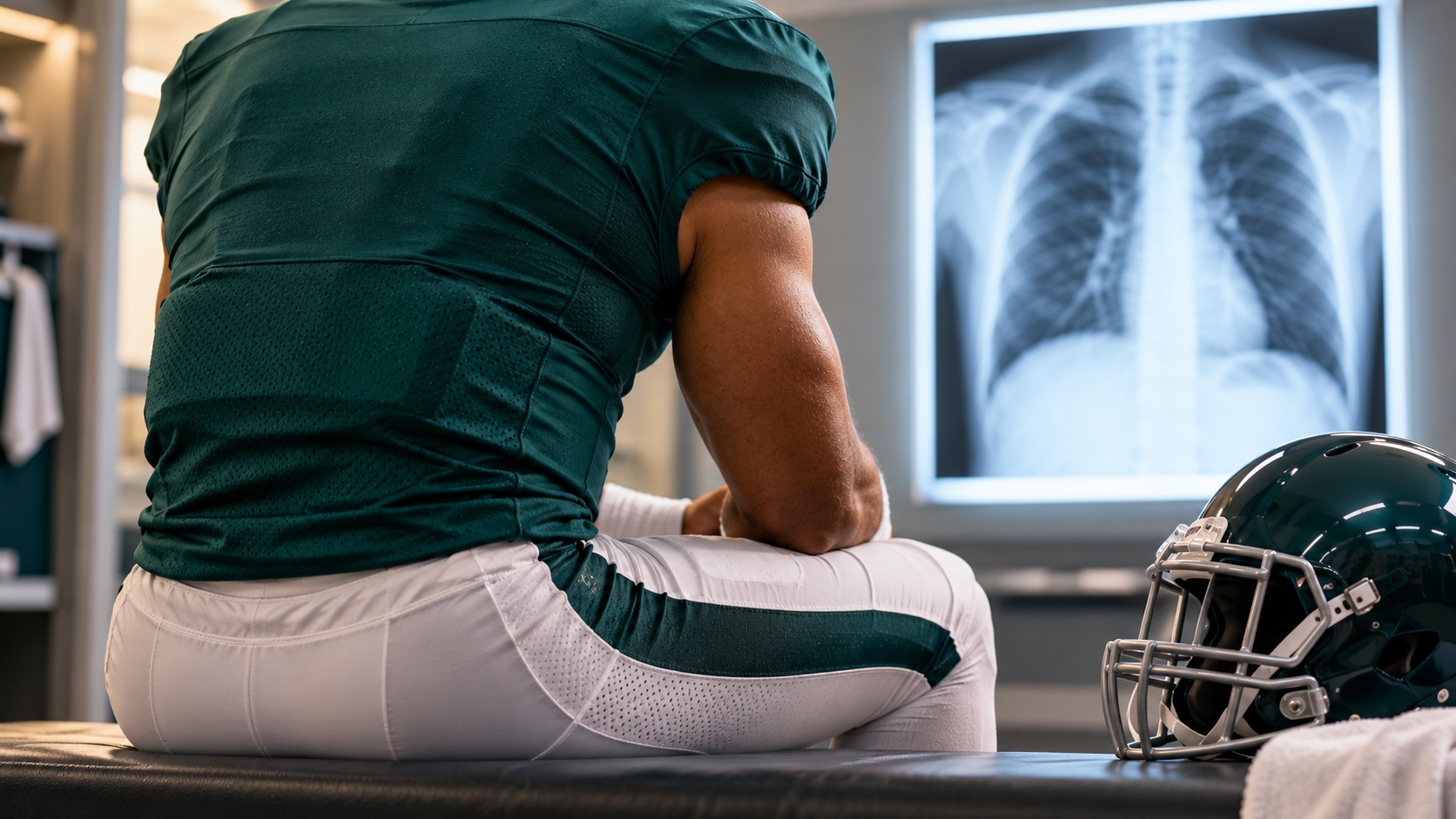
Eagles Confirm Jalen Hurts Lung Clots and Explain Treatment Plan
Why Blood Thinners Will Keep Jalen Hurts Away From Contact Football
The Philadelphia quarterback is clinically stable, but anticoagulant treatment prevents contact football and leaves his return dependent on medical clearance.
Jalen Hurts has been diagnosed with blood clots in both lungs, a serious development that takes the Philadelphia Eagles quarterback away from contact football while he receives treatment.
The Eagles and his agent, Nicole Lynn, confirmed on 19 October that further investigations had identified deep vein thrombosis and bilateral pulmonary emboli. They described his condition as stable and said they expected him to recover fully.
The immediate concern is his health. For Philadelphia, the sporting consequence is an absence whose length cannot be judged from how comfortable he looks or how eager he is to return. His treatment creates a medical restriction that training and determination cannot remove.
What Changed After the Calf Diagnosis
Specialists in London initially identified a clot in a superficial vein in Hurts’ left calf. Further testing and monitoring produced the more extensive diagnosis announced on Monday.
Superficial veins lie closer to the surface of the body. Deep vein thrombosis concerns a clot in a deeper vein. Pulmonary emboli are clots blocking blood vessels in the lungs; bilateral means both lungs are involved.
Those terms describe the location of the problem. They do not, on their own, reveal the size of each blockage or establish the effect on a particular patient’s circulation. It would be wrong to infer those details from the announcement.
The change in diagnosis is important, but the public record does not provide enough clinical information to reconstruct every stage of its development. An earlier description of a calf clot and a later lung diagnosis cannot by themselves establish when each clot formed or became detectable.
Why the Treatment Prevents Football
Hurts’ treatment is expected to involve anticoagulants, commonly called blood thinners. These medicines reduce clotting, helping prevent existing clots from growing and new ones from forming.
Their protective effect comes with an increased risk of bleeding. That matters in a sport built around collisions, tackles and falls. A player may feel capable of running or throwing while still facing an unacceptable risk from a heavy impact.
NHS guidance says people taking anticoagulants may be advised to avoid contact sports because of excessive bleeding. In Hurts’ case, the restriction has been made explicit: contact activities, including football, are prohibited during treatment.
This explains why an encouraging medical update does not automatically produce an early comeback. The question extends beyond whether he can perform the movements required of a quarterback. His doctors must also judge whether he can safely absorb the contact that comes with the position.
How Serious Are Clots in the Lungs?
A pulmonary embolism can be life-threatening without prompt treatment. It often occurs when part of a clot breaks away from a vein in the leg and travels to the lungs, where it causes an obstruction.
However, the seriousness of the condition in general should not replace the information released about Hurts himself. The announcement offers an encouraging prognosis rather than describing a deteriorating patient.
Public discussion needs to preserve that distinction. Identifying clots in both lungs warrants concern and treatment. It does not justify predicting permanent damage, the end of his career or an outcome his medical team has not forecast.
For readers, sudden breathlessness, chest pain that worsens with breathing and coughing up blood are recognised warning signs. NHS guidance advises calling 999 for severe difficulty breathing, chest or upper-back pain, a very fast heartbeat or collapse. These symptoms require urgent assessment rather than comparison with an athlete’s experience.
What Philadelphia Must Plan Around
The Eagles placed Hurts on injured reserve on 17 October. Tanner McKee started against the Carolina Panthers the following day, as Philadelphia began adjusting to its quarterback’s absence.
For an offence, a change at quarterback affects more than who receives the snap. Coaches must consider which plays suit the replacement, how protection is organised and how much responsibility to place on other players. Those are football decisions the team can make while the medical timetable remains outside its control.
Hurts’ absence also removes a player who led Philadelphia to victory over the Kansas City Chiefs in the February 2025 Super Bowl and earned the game’s Most Valuable Player award. Replacing that experience is a substantial challenge, even before questions about the length of his recovery are settled.
The wider fascination with sporting stars often centres on performance and commercial success, as the history of Michael Jordan’s Nike partnership illustrates. A diagnosis such as this shifts attention to the conditions that make participation possible at all.
What Determines His Return?
General treatment guidance cannot serve as a personalised countdown. The NHS says anticoagulant tablets are normally needed for at least three months after a pulmonary embolism, but Hurts’ own specialists must determine his course and review his progress.
The public statement does not fix a comeback date. It anticipates an opportunity to resume contact football after he is off anticoagulants, with continued involvement around the team and conditioning in the meantime.
That leaves a clear medical condition for the next stage of his career: treatment must progress far enough for his doctors to consider contact safe. Philadelphia can prepare its offence now. Clearance for Hurts must follow his recovery.
Sources
Philadelphia Eagles and Nicole Lynn — Update on QB Jalen Hurts — The 19 October announcement identifying the diagnosis, anticipated treatment, contact restriction and prognosis. The announcement was located in search; its wording was corroborated in contemporaneous coverage, as the full team page could not be retrieved directly.
Reuters — Eagles Quarterback Hurts Set to Miss Rest of Season Due to Blood Clots — Contemporary account of the joint statement, initial London diagnosis and Super Bowl background; its season-outlook reporting is distinct from a fixed return date in the statement.
NHS — Pulmonary Embolism — General explanation, warning symptoms, treatment and typical minimum anticoagulant duration. Contact-sport bleeding precautions were also checked against NHS anticoagulant guidance.
Next Reads
Michael Jordan Almost Rejected Nike. His Decision Created a $7 Billion Empire — A broader sporting feature on the career and commercial influence of an American superstar.
Merck’s $1.3 Billion Gene-Silencing Deal: The Medicines That Could Change Patients’ Lives — A separate medical explainer examining experimental treatments and cardiovascular risk; it does not concern Hurts’ care.
UEFA Demands Answers on FIFA’s Trump Dealings in 42-Question Letter — Further current sports coverage, focused on governance rather than player health.
