RAF Typhoons to Defend Saudi Arabia as Britain Expands Houthi Mission
From Refuelling to Fighter Missions
Britain’s Expanding Gulf Mission
British fighter aircraft will help protect Saudi cities and infrastructure, while the government excludes offensive strikes against the Houthis.
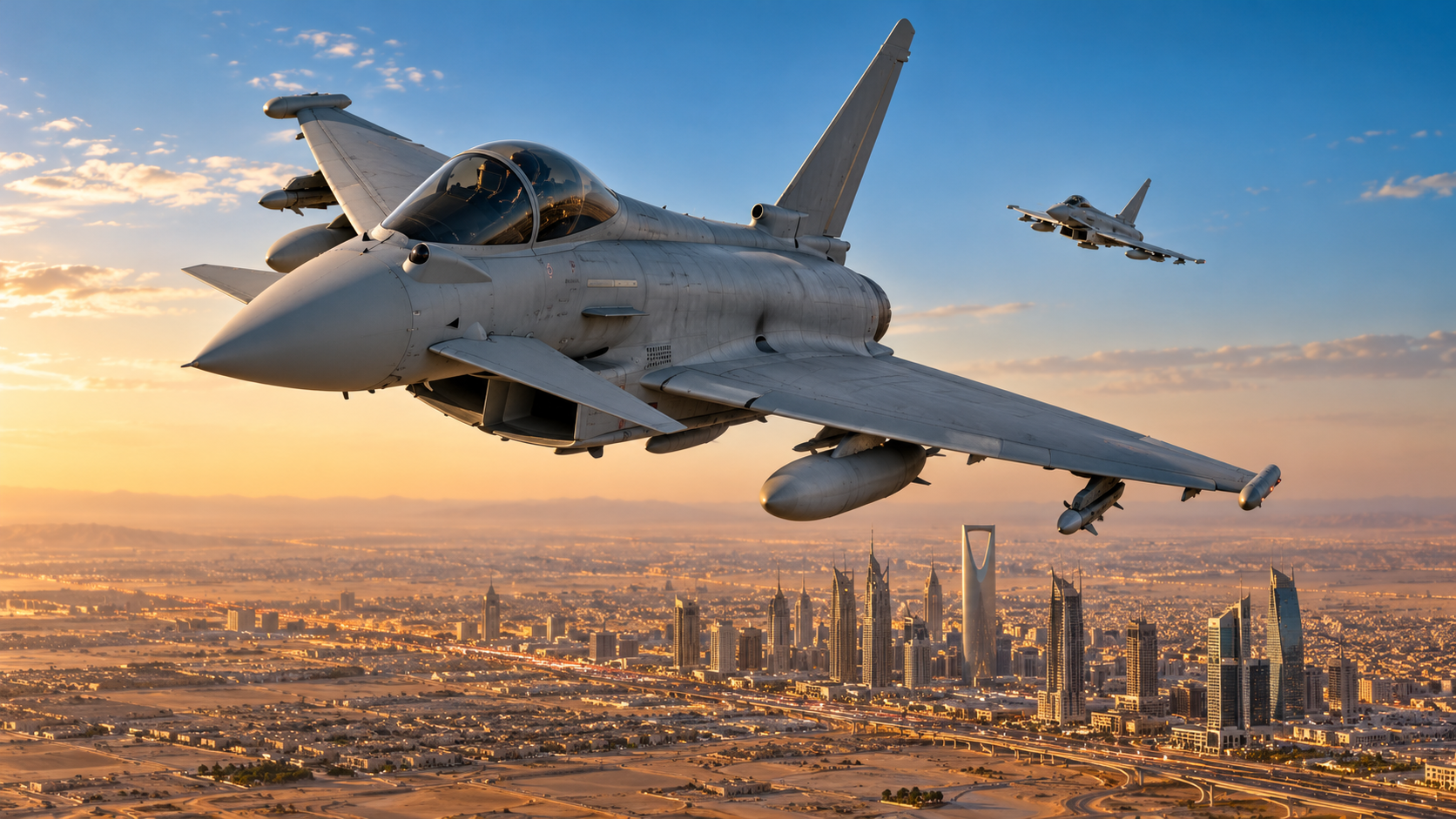
Britain has approved Royal Air Force Typhoon missions to help defend Saudi Arabia against Houthi aerial attacks, expanding its military support for the kingdom beyond the refuelling assistance announced in September.
The Ministry of Defence says the aircraft will undertake defensive counter-air missions to protect Saudi cities and critical national infrastructure. It has explicitly excluded offensive strikes against the Houthis from this commitment.
That decision gives British fighter pilots a more direct responsibility in Saudi air defence. The immediate task is protection from incoming weapons. The wider question is how Britain will sustain and define that responsibility as the conflict develops.
From Tanker Support to Fighter Missions
In September, Britain agreed to provide an RAF Voyager air-to-air refuelling aircraft following renewed Houthi attacks. A tanker helps compatible aircraft remain airborne longer, increasing the endurance and flexibility of defensive operations.
Typhoons perform a different function. They are combat aircraft equipped to detect, approach and engage airborne threats. Their inclusion moves the British contribution from enabling other aircraft towards carrying out protective missions themselves.
The distinction matters when assessing Britain’s support for Saudi Arabia against the Houthis. September’s commitment should no longer be treated as a complete description of the operation.
However, approval of a mission is not evidence that a particular interception has already occurred. The material checked for this article does not establish a first Typhoon engagement, the number of fighters assigned or a complete deployment timetable.
What Defensive Counter-Air Means
Defensive counter-air is the protection of territory, people or assets against airborne attack. In this case, the announced purpose concerns Saudi airspace and the threat from Houthi drones and missiles.
The RAF describes the Typhoon as a multirole aircraft with radar, infrared search equipment and several air-to-air weapon options. It also performs air policing and quick reaction alert duties.
Those capabilities explain why it can contribute to an air defence mission. They do not reveal which weapons these aircraft will carry on each sortie, or establish that a fighter can intercept every kind of incoming missile.
Aircraft capability and mission authority must also be kept separate. Typhoons can carry weapons for ground attack, but possessing that capability does not mean the government has authorised its use in this operation.
The practical assessment should therefore concern what pilots are tasked and permitted to do. An aircraft’s full weapons catalogue is not an operational order.
Why Airports and Infrastructure Matter
Saudi Arabia’s exposure reaches beyond military facilities. Airports connect residents, businesses and international travellers. Energy installations support domestic activity and exports. Protecting such sites has a civilian purpose as well as strategic importance.
The renewed confrontation between Saudi Arabia and the Houthis has returned cross-border security to the centre of the conflict. The Houthis operate from Yemen, Saudi Arabia’s southern neighbour, giving the confrontation a direct geographical dimension.
For an airport, an attack need not destroy a runway to impose costs. A security threat can interrupt operations, complicate travel decisions and force resources towards protection. The military objective of intercepting a weapon therefore has consequences for ordinary activity on the ground.
Britain’s stated interest also includes regional stability, trade and energy supplies. That is the government’s rationale for assistance, rather than proof that any particular deployment will reduce prices or restore commercial confidence.
Protection Without an Open-Ended Offensive Commitment
The exclusion of offensive strikes is the clearest public boundary around the new fighter role. It distinguishes defending Saudi territory from attacking launch sites or other targets in Yemen.
That boundary is significant, but it does not make the operation risk-free. Armed patrols require coordination, reliable identification and decisions about the use of force. Supporting personnel and aircraft also require protection and maintenance.
These are operational implications of the announced role, not evidence of an undisclosed plan to expand it. There is no sound basis for treating today’s decision as proof that a wider British bombing campaign is inevitable.
Equally, the word defensive should not end scrutiny. Public assessment can examine the mission’s geographical limits, command arrangements, duration and review process without demanding disclosure of sensitive patrol details.
The Test Will Be What the Mission Achieves
Interception and deterrence are different outcomes. Destroying an incoming weapon may prevent casualties without persuading the attacker to stop launching further weapons. A useful assessment needs to distinguish immediate protection from a lasting reduction in the threat.
It should also consider the resources required to maintain coverage. Aircraft availability, trained crews and the ability to sustain repeated missions matter alongside the performance of an individual fighter.
For civilians, the meaningful results are fewer people exposed to attack and less disruption to essential services. Sortie totals alone cannot establish those outcomes.
The next facts to establish are when the fighter missions begin, how long the commitment is intended to last and what conditions will trigger a review. Those details will show whether Britain has defined a manageable protective task or assumed a responsibility whose endpoint remains unclear.
Sources
LBC — RAF to Defend Saudi Arabia Against Aerial Attacks From Houthi Rebels — 20 October 2026; confirmation of fighter support and the government’s earlier rationale.
The Independent — UK Fighter Jets to Help Defend Saudi Arabia Against Attacks From Iran-Backed Houthis — 20 October 2026; the Ministry of Defence’s stated defensive role and exclusion of offensive strikes.
Royal Air Force — Typhoon FGR4 — Official description of the aircraft’s roles, sensors and weapons capabilities.
Next Reads
Who Are The Houthis And Why Is Britain Supporting Saudi Arabia Against Them? — Background on the movement and Britain’s September assistance.
Egypt Moves Towards Saudi Defence Role as Houthi Attacks Escalate — Explains Egypt’s conditional proposal as it stood on 17 October.
The Middle East Just Got Even More Dangerous As Saudi Arabia Comes Under Missile Attack — Context for the return of cross-border confrontation.
