

Iran unrest spreads to universities as government offers “dialogue”
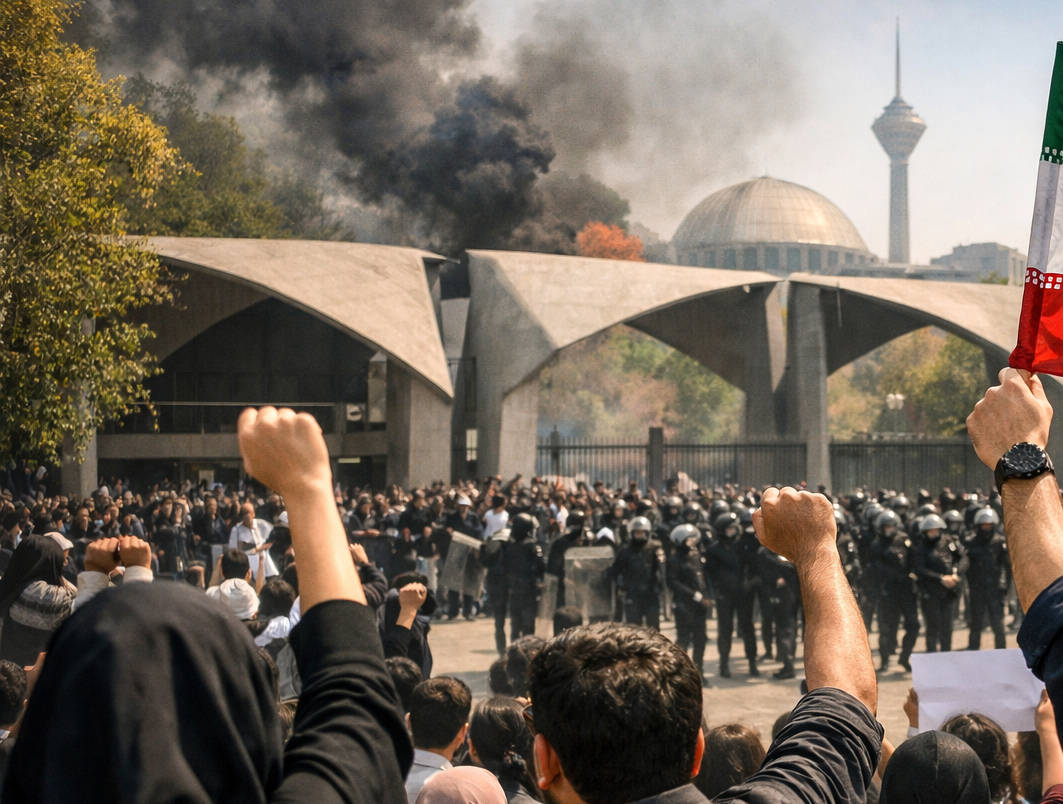
As of December 30, 2025, the Iranian unrest that began with strikes and street protests tied to a collapsing currency is now reported to be spreading to universities, bringing students into a movement that started with shopkeepers and bazaar merchants.
The government’s answer, at least on paper, is a mix of acknowledgement and outreach: officials have signaled a “dialogue mechanism” with protest representatives, alongside promises of monetary and banking reforms aimed at protecting purchasing power.
This matters now because the crisis is no longer only a market story. When campuses join streets and bazaars, the protest base can widen quickly, and the political stakes rise with it. At the same time, the state’s economic room to maneuver is narrow, and rushed fixes can make the currency problem worse.
This piece explains what changed this week, why universities matter in Iran’s protest dynamics, what the government is offering, and what signals would indicate whether tensions are cooling or escalating.
The story turns on whether the state can stabilize the currency and living costs fast enough to prevent a broader coalition from forming between merchants, students, and the wider public.
Key Points
Protests over inflation and the rial’s collapse are reported to have expanded from commercial districts into multiple universities, with students joining demonstrations in Tehran and other cities.
The government has acknowledged the economic pressure behind the unrest and says it will establish a dialogue mechanism to hear protest demands through representatives.
Officials have also promised monetary and banking reforms, but details remain limited and timelines are unclear.
A leadership shake-up at the central bank has added to a sense of urgency, but it also highlights how politically sensitive currency policy has become.
Energy and utility strains are compounding the economic mood, with temporary closures and disruptions adding to public frustration.
The near-term risk is miscalculation: a crackdown could broaden anger, while half-measures could fail to calm markets and households.
Background: Iran Unrest and the Currency Spiral
Iran’s economy has been under sustained pressure for years, with sanctions restricting access to foreign currency and limiting trade and investment. That pressure has been amplified by domestic constraints, including persistent inflation, periodic shortages, and a widening gap between the official exchange rate used by many businesses and the open-market rate used by ordinary citizens for daily financial survival.
In late December, the rial fell to new record lows on the open market, and the shock fed straight into prices. In an import-reliant economy, a weak currency shows up quickly in household staples and in the cost of inventory for traders who have to restock at higher and higher rates. When pricing becomes impossible, commerce slows, then stops. That is why closures and strikes in key commercial areas can be a leading indicator of broader unrest.
Shopkeepers and bazaar merchants in Tehran were the focal point of the early demonstrations, which later extended to other cities. What is new as of December 30 is the reported move into universities, with student protests and campus activity joining street-level economic anger.
The government’s public posture has also shifted in tone. Instead of treating the unrest purely as a security issue, senior officials have signalled their recognition of the economic roots of the protests and directed the interior ministry toward dialogue with protest representatives. The state has also floated monetary and banking reforms as a way to defend purchasing power, though there is still little clarity on what concrete measures will land first.
Analysis: Iran Unrest Meets a Narrow Policy Corridor
Political and Geopolitical Dimensions
Politically, the move from bazaar streets to university campuses changes the optics and the risk. Merchants can halt trade. Students can become a national symbol. Together, they can expand protests beyond a single grievance and into a broader legitimacy question, even if many participants begin with a narrow demand: currency stability and lower prices.
For the government, dialogue serves two immediate purposes. First, it buys time. Second, it tries to split the movement by offering a channel for “legitimate demands” while isolating calls for deeper political change. Whether that works depends on who is seen as representing the protests and whether any early concessions are real enough to shift sentiment.
Geopolitically, Iran is operating under heavy external pressure. Sanctions and the threat environment constrain options to raise hard currency quickly. That matters because the fastest way to calm a currency panic is credibility: the market has to believe authorities can supply dollars, enforce a stable mechanism, and keep policy consistent. In Iran’s case, credibility is not only economic. It is also political, and it is tangled up with security tensions and international isolation.
Economic and Market Impact
The currency slide is not just a headline number. It is a transmission mechanism. A weak rial pushes up import costs, compresses real wages, and accelerates hoarding behavior as households and traders try to protect savings in gold, dollars, or durable goods.
The resignation and expected replacement of the central bank chief is a signal that policymakers recognize the scale of the crisis. However, it also prompts the question: is the state altering its approach or merely shifting the message? Markets will look for concrete steps such as tighter fiscal discipline, credible exchange-rate management, and limits on money creation. Protesters will look for what hits their daily lives: food costs, rent pressure, and whether salaries keep pace.
The challenge is that many “reforms” bite before they heal. Unifying exchange rates, restricting access to foreign currency, or tightening credit can stabilize the macro picture but cause immediate pain for small businesses and households. Conversely, broad subsidies can calm streets but deepen structural imbalances if the state cannot fund them sustainably.
Social and Cultural Fallout
Universities carry a particular weight in Iran because they are concentrated hubs of organization, identity, and debate. They can mobilize quickly and communicate across cities through networks that are hard to fully contain. Even when protests are sparked by economics, campuses can broaden the narrative to include fairness, corruption, and the future prospects of a young population facing diminished purchasing power and job insecurity.
The joining of students and merchants also has historical resonance. In Iran’s modern history, moments when different social groups align can create momentum that is harder to defuse. That does not guarantee a single direction of travel, but it does raise the probability of wider participation if prices keep rising and the currency remains volatile.
One more accelerant is everyday disruption. Temporary closures, energy-saving measures, and shortages can make the state feel absent in daily life. When people cannot plan work, study, or basic logistics, anger becomes less about ideology and more about lived dysfunction.
Technological and Security Implications
If unrest widens, the state’s security toolkit becomes central. That includes policing strategy on streets, enforcement on campuses, and control of communication channels. In many countries, protest escalation is shaped by whether authorities use selective restraint, targeted arrests, or broad crackdowns. There are trade-offs associated with each path: restraint can sustain demonstrations, while crackdowns can intensify backlash.
Technology matters because modern protests depend on rapid coordination and documentation. Disruptions to connectivity, payment systems, or transport can change the protest tempo and the economic cost of participation. Iran’s authorities also have to think about second-order effects: aggressive control measures can further damage commerce, deepen the currency panic, and push more people toward informal markets.
Security decisions will therefore be judged not only by whether they restore order, but by whether they stop the economic slide that triggered the unrest in the first place.
What Most Coverage Misses
A key overlooked factor is how the split between the official economy and the open-market economy turns currency volatility into social anger faster than many outsiders expect. For millions of Iranians, the open-market rate is not a speculative number. It is the daily reference point for savings, remittances, rent expectations, and the true cost of imported goods. When that rate breaks, people experience it as a direct loss of control over their lives.
Another issue is that "dialogue" does not automatically de-escalate the situation. If a dialogue mechanism is announced without visible concessions, it can be read as stalling. If representatives are seen as handpicked, it can be read as manipulation. The credibility test is simple: does any announced reform change prices, access to essentials, or the ability to run a business within days and weeks, not months?
Finally, energy and utility disruptions are not background noise. They are a multiplier. When banks, schools, and businesses face closures or interruptions, it erodes routine. That routine is one of the state’s quiet sources of legitimacy. When routine breaks, protests become easier to join and harder to ignore.
Why This Matters
In the short term, the most affected groups are urban households on fixed incomes, small traders who rely on imports, and students whose daily costs are rising while their future earnings feel less secure. In the medium term, sustained currency instability can drive deeper shortages, widen inequality between those with access to restricted currency and those without, and pressure the government into either harsher security measures or more expensive economic interventions.
For the region, a destabilized Iran has knock-on effects. It can reshape domestic political calculations, affect cross-border trade, and heighten the risk of miscalculation in an already tense security environment. For global markets, the immediate direct impact depends on whether instability feeds into broader disruptions, but the larger relevance is geopolitical: pressure on Iran can reverberate through energy narratives, sanctions dynamics, and risk pricing.
Concrete signs to watch next include whether the dialogue mechanism becomes a real, named process; whether new central bank leadership announces a coherent currency plan; whether campuses remain active into early January; and whether security forces shift toward mass arrests or sustain a more restrained posture. Another practical indicator is whether authorities lean on temporary closures and energy-saving measures that further disrupt daily life.
Real-World Impact
A mobile phone retailer in central Tehran closes early because restocking has become guesswork. Inventory priced in the morning is unprofitable by afternoon. Customers argue. Suppliers demand payment in dollars or gold equivalents. The shopkeeper’s protest is as much about predictability as politics.
A university student in Tehran joins a campus gathering after watching family grocery costs rise week after week. Tuition and transport feel heavier. Part-time work pays less in real terms each month. The student’s fear is not only today’s prices, but a future that looks like permanent decline.
A small manufacturer in Isfahan that relies on imported components faces delayed shipments and volatile pricing. The manager considers layoffs, not because demand collapsed overnight, but because replacement parts have become too expensive to budget for.
An Iranian family in London sends money home and notices the exchange rate moving sharply. The remittance buys more rials on paper, but relatives report that prices are rising faster than the benefit. The family’s support becomes a lifeline, yet it cannot outrun inflation.
What’s Next?
Iran's leadership is attempting to maintain a delicate balance: acknowledging economic hardship without admitting political vulnerability, promoting dialogue without inciting additional protests, and promising monetary reform without inciting further market panic.
If officials can deliver quick, credible steps that stabilize the rial and ease pressure on essentials, campus unrest may fade back into lower-level dissent. If reforms stall, or if dialogue looks performative, the university dimension could widen the protest base and raise the chance of sustained nationwide demonstrations.
The next phase will be signaled by practical events, not rhetoric: whether shops keep closing, whether campuses stay active, whether currency volatility slows, and whether the state’s response remains measured or turns coercive. Those are the indicators that will show which way this story is breaking.
