Kremlin Warns Of Escalation As Lithuania Moves To Lift Nuclear Weapons Ban
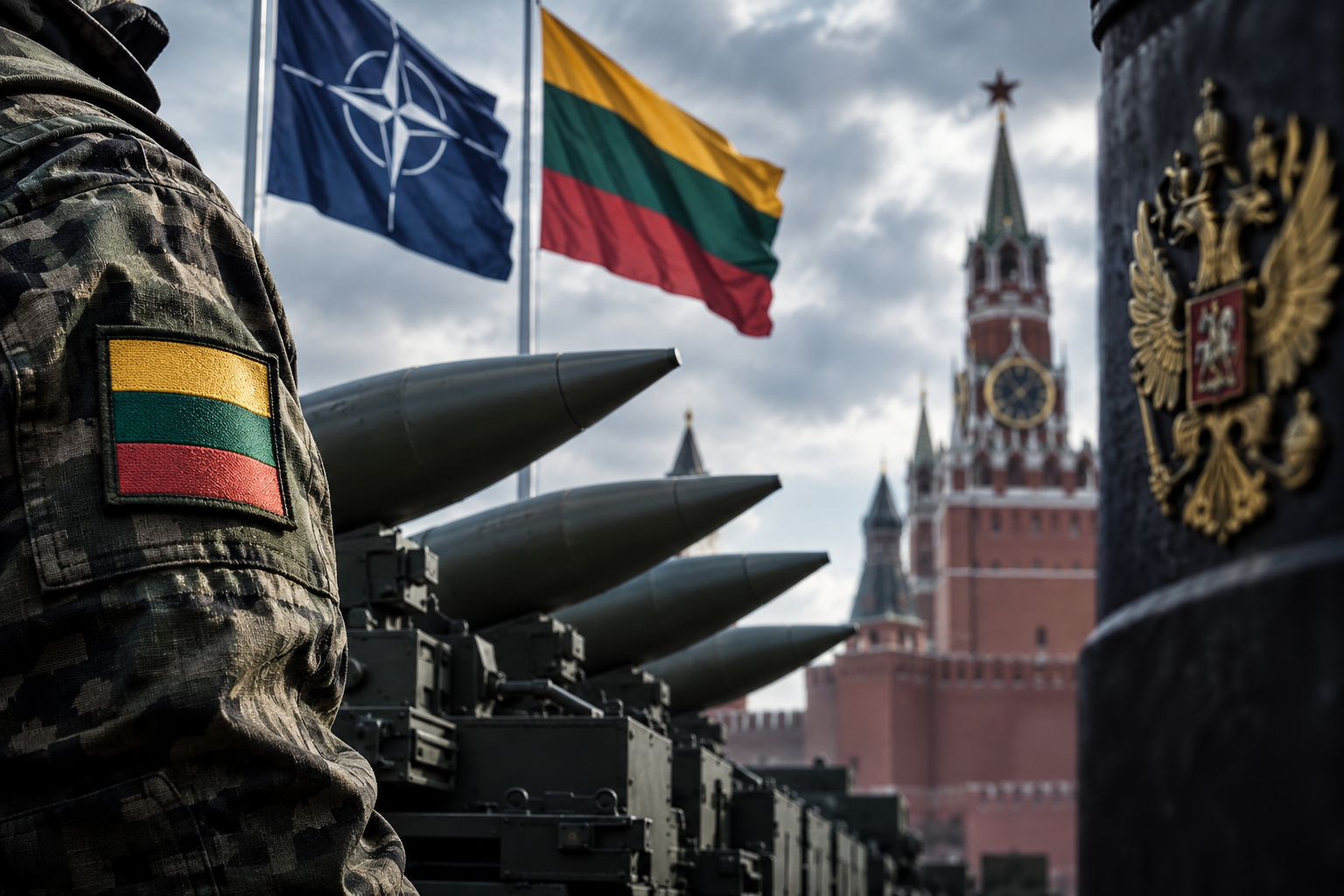
Nuclear Tensions Rise In The Baltics As Lithuania Rewrites Its Defence Rules
Nuclear Tensions Rise Over Lithuania
Lithuania has taken a preliminary step towards removing its ban on hosting nuclear weapons, but no deployment has been agreed — and Moscow says the shift could further destabilise an already tense Baltic region.
Lithuania is moving towards a defence policy that would have been politically unthinkable for much of the period since it regained independence from the Soviet Union.
Its parliament has given preliminary approval to removing a longstanding restriction preventing nuclear weapons from being based on Lithuanian territory. A further parliamentary vote is still required before the change can take effect.
That distinction matters. Lithuania has not announced that American, British or French nuclear weapons are coming. It has not agreed a nuclear deployment. What it is doing is removing a legal obstacle that could prevent future decisions if NATO’s security environment changes.
For the Kremlin, however, the direction of travel is enough to trigger a warning.
Moscow says the combination of potential nuclear access, deeper NATO military integration and discussion of a permanent American military base in Lithuania risks worsening the security situation in Europe.
The dispute now adds another nuclear dimension to one of the continent’s most sensitive regions.
Lithuania Is Removing A Restriction, Not Ordering Nuclear Weapons
The immediate change is legal.
Lithuania’s post-Soviet security arrangements included restrictions designed for a very different European order. At the time, the country was emerging from decades of Soviet rule and attempting to establish itself as an independent state.
More than three decades later, Lithuania’s strategic environment has changed almost beyond recognition.
It is now a member of NATO and the European Union. Russia has invaded Ukraine. Belarus has become one of Moscow’s closest military partners. Russian nuclear weapons have been stationed in Belarus, while Kaliningrad — the heavily militarised Russian exclave between Lithuania and Poland — remains immediately beside NATO territory.
Lithuania’s government has argued that rules written for the early 1990s should not permanently limit its defence choices in the 2020s.
The parliamentary process does not itself place a warhead on Lithuanian soil. It removes a prohibition so that a future government and NATO could, in theory, consider options that are currently unavailable.
That could mean nuclear-related infrastructure, participation in wider deterrence arrangements or, in a more significant future step, hosting weapons controlled by a nuclear-armed ally.
None of those outcomes is automatic.
Why The Kremlin Is Warning About Escalation
Russia views NATO’s military expansion towards its borders as a strategic threat.
Lithuania sits directly beside both Russia and Belarus. Its location gives any military development there significance far beyond the country’s physical size.
Kremlin spokesman Dmitry Peskov has argued that expanding American or NATO military infrastructure closer to Russia would not make Europe more stable. Moscow is also linking the nuclear debate to Lithuania’s effort to secure a permanent American military presence.
Lithuania has already hosted a rotating US armoured battalion of roughly 1,000 troops since 2019. Its government has now said it would be prepared to pay the cost of establishing a permanent American base if Washington agreed.
That would deepen a military relationship which Lithuania sees as deterrence and Russia sees as encroachment.
The disagreement follows a familiar pattern.
NATO’s eastern members argue that stronger allied forces are necessary because Russia has shown that it is willing to use military force against neighbouring states. Moscow then points to that stronger NATO presence as evidence that Russia faces a growing military threat.
Each side therefore presents its next defensive measure as a response to the other.
That cycle is one reason the Baltic has become one of the clearest potential routes towards a direct NATO-Russia confrontation.
Why Lithuania Matters So Much Strategically
Lithuania occupies an unusually exposed position.
To its east and south-east lies Belarus. To its south-west lies Kaliningrad, where Russia maintains significant military forces and missile systems. Poland lies beyond Lithuania’s southern border, while Latvia is to the north.
Between Poland and Lithuania sits the Suwałki Gap, a narrow land corridor connecting the Baltic states with the rest of NATO territory.
In a major European conflict, that geography would make Lithuania central to reinforcement, logistics, air defence and the defence of the Baltic states.
It is also why developments involving Kaliningrad carry such danger.
Russia has recently intensified warnings over any attempt to isolate or threaten the exclave, while NATO has reinforced its eastern defences. The region now combines conventional military forces, missile systems, air patrols, naval activity and nuclear signalling in a relatively confined space.
The danger is not simply that one side deliberately chooses a nuclear war.
It is that a crisis involving aircraft, drones, missiles, military bases or access to Kaliningrad could create a chain of decisions in which both sides fear that waiting will leave them strategically weaker.
That escalation dynamic is examined more broadly in the realistic pathways through which a NATO crisis could become a wider war.
What NATO Nuclear Sharing Actually Means
NATO is already a nuclear alliance.
The United States, Britain and France possess nuclear weapons. American nuclear weapons are also forward-deployed in Europe as part of NATO’s nuclear deterrence arrangements.
Those weapons remain under American custody and control.
Other allies can contribute aircraft, infrastructure, training, conventional support and political participation without independently controlling the weapons themselves.
That distinction matters when discussing Lithuania.
Removing Lithuania’s legal restriction would not turn the country into a nuclear weapons state. Lithuania remains a non-nuclear state under the Nuclear Non-Proliferation Treaty.
It would instead create more flexibility over how Lithuania could participate in NATO’s nuclear posture in future.
NATO says the purpose of its nuclear forces is deterrence: preventing an adversary from believing that aggression could succeed at an acceptable cost. The alliance also says the circumstances in which it might use nuclear weapons are extremely remote.
The logic behind NATO’s nuclear deterrence is therefore built around avoiding war rather than preparing to fight one routinely.
Russia disputes the idea that moving allied military infrastructure closer to its territory is stabilising.
That strategic disagreement is at the heart of the Lithuanian dispute.
A Permanent US Base Would Matter Too
The nuclear debate is only one part of Lithuania’s broader military shift.
Vilnius has also pushed for a permanent American military base.
Lithuania’s government has said it would be willing to finance such a facility if the United States made the political decision to establish one. President Donald Trump has indicated he would consider Lithuania’s request.
A permanent base would not itself imply a nuclear deployment.
It would, however, make the American military commitment to Lithuania more visible and physically entrenched.
That could strengthen deterrence by making any attack on Lithuania far more likely to involve American forces from the beginning.
It could also sharpen Moscow’s perception that NATO military infrastructure is moving closer to strategically important Russian territory.
This is the central security paradox in the Baltic.
The same measure Lithuania sees as reducing the chance of Russian aggression can be described by Russia as increasing the military pressure it faces.
The Kaliningrad Factor Makes The Nuclear Question More Dangerous
The timing of Lithuania’s parliamentary move is especially sensitive because Kaliningrad has returned to the centre of European nuclear rhetoric.
Russia has warned that it could consider nuclear options if NATO attempted to cut off or seriously threaten the exclave.
Kaliningrad is not an isolated military outpost. It is sovereign Russian territory, populated by hundreds of thousands of people and positioned between Poland and Lithuania.
It is also heavily militarised.
Any future crisis involving Lithuania would therefore unfold beside territory Moscow considers vital to its national defence.
That makes the Baltic different from many other parts of NATO.
A conventional confrontation there could immediately involve Russian territory, NATO territory, American forces and military systems capable of carrying nuclear weapons.
The probability of deliberate nuclear war remains far lower than the probability of continued conventional deterrence and political confrontation.
But the consequences of miscalculation are unusually severe.
That is why the history of previous nuclear near-misses remains relevant. Nuclear crises do not always begin with leaders wanting to cross the threshold. They can develop when warning systems, military movements and political assumptions interact faster than diplomacy can contain them.
What Happens Next
Lithuania still has another parliamentary stage to complete before the legal change is final.
Even if the ban is removed, there would still be a large political distance between creating the legal possibility of hosting nuclear weapons and actually agreeing to station them.
Any future deployment would require decisions involving Lithuania, NATO and the nuclear-armed ally concerned.
For now, the most important change is strategic flexibility.
Lithuania wants fewer legal restrictions on the choices available if European security deteriorates further.
Russia wants NATO’s military and nuclear infrastructure kept farther from its borders.
Those positions are moving in opposite directions.
That does not make a nuclear deployment inevitable.
It does mean that the Baltic security argument is no longer only about soldiers, tanks, drones and air defence. The question of where NATO could one day place nuclear weapons is moving closer to the centre of the dispute.
Sources
Reuters — Kremlin warns Lithuania that its move to lift a nuclear arms ban risks further escalation — Supports the Kremlin warning, preliminary parliamentary vote, US troop presence and the connection with Lithuania’s proposed permanent US base.
Reuters — Lithuania moves to end nuclear weapon ban as ‘situation getting worse’ — Supports the origins of the legal change, Lithuania’s security rationale, parliamentary requirements and the absence of an immediate deployment plan.
NATO — NATO’s Nuclear Deterrence Policy And Forces — Supports NATO’s nuclear-sharing structure, US custody of forward-deployed weapons, alliance nuclear policy and deterrence principles.
Next Reads
Could NATO Article 5 Start World War III? The Escalation Timeline Explained — Explains how a direct Russia-NATO confrontation could escalate from a conventional crisis into a nuclear one.
NATO Explained: How Article 5 Works And Why The Alliance Still Matters — Explains NATO’s deterrence structure, Article 5 and the nuclear element of collective defence.
The Closest Humanity Has Come To Nuclear War — Every Major Crisis Ranked — Shows how miscalculation, incomplete information and escalation have repeatedly brought nuclear-armed states close to catastrophe.
