

Maduro Custody Claims and the “Proof” Problem: Venezuela’s 72-Hour Power Audit Begins
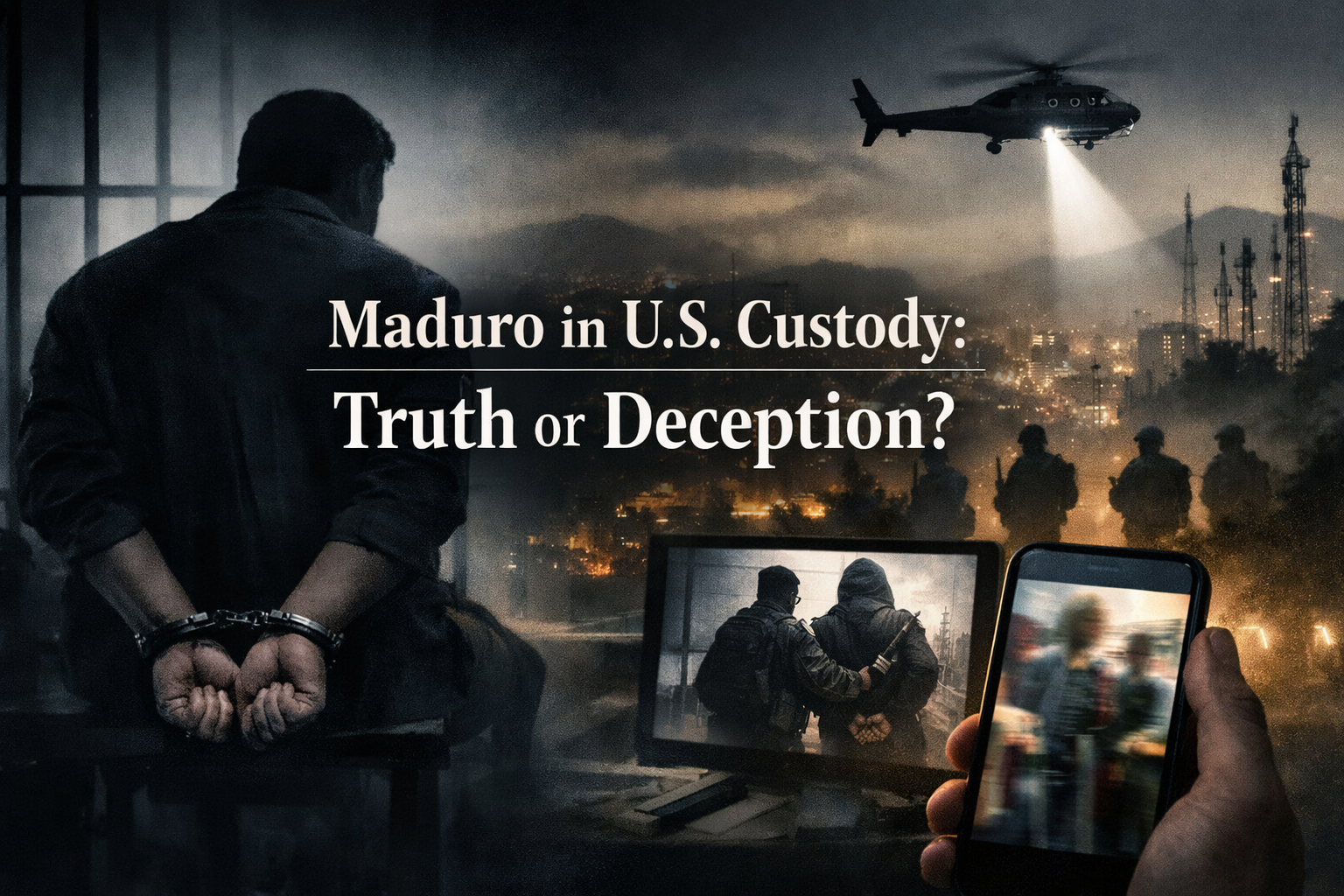
Maduro custody claims after U.S. strikes have triggered a “proof” crisis. Here’s the 72-hour power audit and scenario tree for Venezuela’s next 30 days.
As of January 4, 2026, the United States says Venezuelan President Nicolás Maduro and his wife, Cilia Flores, were seized during overnight strikes and are now in U.S. custody. U.S. officials say Maduro is being held in New York ahead of a court appearance expected on Monday.
Venezuela’s leadership rejects the U.S. account, calls the seizure a kidnapping, and demands proof of life. Meanwhile, a fast-moving stream of images and “minutes-ago” updates is flooding social feeds—some posted by official channels, others circulating without clear provenance.
That information churn is not a side show. It is part of the battlefield. But the event’s real gravity is not the photo cycle. It is the first 72 hours of state control: who holds force, who controls cash, and who can command communications inside Venezuela.
This piece separates what is confirmed from what is disputed and what is still unknowable, then builds a scenario tree for the next 48 hours, seven days, and 30 days—because in a leadership removal shock, outcomes are decided by mechanisms, not statements.
“The story turns on whether Venezuela’s power network consolidates under a successor—or fractures into competing centres of force, cash, and communications.”
Key Points
The U.S. says Nicolás Maduro and Cilia Flores were captured during strikes and transferred to U.S. custody, with U.S. court proceedings expected to begin quickly.
Venezuela’s top officials reject the legality and legitimacy of the seizure, framing it as kidnapping and insisting Maduro remains the country’s president.
Visual “proof” is now a central vulnerability: official imagery, alleged leaks, and manipulated content are colliding in the same feed, accelerating confusion and mistrust.
The decisive question is not rhetoric but control: security forces, oil and revenue systems, and national communications infrastructure in the first 72 hours.
Oil markets and regional governments face whiplash: the risk is short-term disruption and escalation, while longer-term scenarios include a contested transition or a drawn-out power struggle.
The next key markers will be institutional loyalty signals, financial control moves, and who controls broadcast and internet access—not press conferences.
Background
Maduro has ruled Venezuela for more than a decade, inheriting the presidency after Hugo Chávez and presiding over years of economic collapse, sanctions pressure, and deep political polarization. His government has maintained power through tight control over state institutions and security services, while opposition movements have struggled to convert protest energy and electoral claims into an enforceable transfer of authority.
The U.S. has long treated Venezuela as a sanctions and security problem, tying pressure campaigns to allegations of corruption, repression, and alleged criminal networks. That pressure has ebbed and surged across administrations. What is different now is the scale of the claimed action: a direct operation to remove the sitting head of state, paired with a stated intention by Washington to shape what follows.
For Venezuela, the immediate question is not ideology. It is a chain-of-command reality: whether orders still flow smoothly through the armed forces, police, intelligence services, and the state oil apparatus—or whether those systems splinter into rival command nodes.
Analysis
Political and Geopolitical Dimensions
If Maduro is physically removed but his loyalists retain the levers of state inside Venezuela, the country enters a dangerous split-screen reality: one narrative in U.S. courts and international diplomacy, another on the streets and inside ministries. That gap is where miscalculation thrives.
Internationally, the precedent risk is immediate. Even governments that see Maduro as illegitimate face a stark dilemma: endorsing forced capture undermines sovereignty norms; condemning it can look like tacit support for a leader they have criticised for years. That tension will dominate multilateral forums in the coming days, especially any emergency diplomacy involving the United Nations.
Regionally, Latin American governments are likely to fracture along ideological lines and domestic political incentives. Neighbours must now plan for spillover: refugee surges, border instability, and potential retaliatory actions by armed groups or splinter security units. The strategic question is whether external pressure forces an orderly transition—or hardens a siege mentality that keeps the old network intact, just angrier and more paranoid.
Economic and Market Impact
Venezuela’s economy still revolves around oil, even after years of decay and sanctions. Any leadership shock immediately raises three practical market questions: can crude keep moving, who can sign and enforce contracts, and how quickly the U.S. (or any external actor) could actually restore damaged production capacity?
In the short run, traders price uncertainty: potential port disruption, payment disruptions, and insurance risk around shipping. In the medium run, optimists will talk about “unlocking” reserves, but the operational reality is slower—oil infrastructure is physical, degraded, and deeply entangled with politics and patronage. Even in a best-case scenario, rebuilding output is measured in years, not news cycles.
There is also a second-order economic risk inside Venezuela: cash flow control. Whoever controls the central bank functions, customs receipts, fuel distribution, and the oil company’s operational chain controls daily life. If those systems seize up, the crisis becomes a scarcity story fast—fuel lines, food pricing spikes, and a renewed wave of outward migration.
Social and Cultural Fallout
Inside Venezuela, uncertainty is its own form of violence. In moments like this, households shift into contingency mode: stocking essentials, limiting movement, and watching for signals of which uniforms are on which streets. That behavioural change can paralyse a city before any formal curfew is declared.
Diaspora communities, by contrast, often experience these shocks as an emotional release—celebration for some, dread for others who fear retaliation against relatives back home. That split matters because diaspora networks are also information networks: they amplify claims, circulate images, and shape how global audiences interpret legitimacy.
The risk is that a contested transition produces a social blame spiral. If daily life worsens, competing factions will weaponize hardship narratives—either blaming “foreign occupation” or blaming “the regime’s sabotage.” That contest will influence whether people comply with new authorities, resist them, or simply try to disappear from politics altogether.
Technological and Security Implications
This is a security crisis and an information crisis at the same time. The speed of image circulation has created a new standard of “proof”: if people do not see it, they doubt it; if they do see it, they may be seeing a fabrication. That dynamic is now a strategic vulnerability for every actor involved.
Operationally, the 72-hour window is when command-and-control is most fragile. The key security question is whether the armed forces remain unified under a single leadership node or fragment into competing chains. Fragmentation can be subtle at first: delayed orders, “protective deployments” that look defensive, or unexplained outages that conveniently disrupt coordination.
Communications infrastructure becomes a lever. Control of state television, radio, mobile networks, and internet choke points can decide whether a rival authority can even speak to the public. Blackouts—whether caused by damage, sabotage, or precautionary shutdowns—also change the informational terrain, pushing populations toward rumours and forcing officials to rely on less reliable channels.
Confirmed, Disputed, Unknown: The Ledger That Matters
Confirmed is what multiple parties with real capacity behave as if it is true. In this moment, that includes the U.S. position that Maduro is in its custody and moving through an American legal process, alongside visible diplomatic shockwaves and emergency responses across capitals.
Disputed is where incentives collide. Venezuela’s senior leadership disputes the legality and legitimacy of the seizure and maintains institutional continuity claims. Visual evidence sits inside this disputed zone too: official posts, alleged leaks, and viral images are being treated as ammunition by different audiences.
Unknown is the real risk surface. The status of Venezuela’s internal command hierarchy, the true cohesion of military and security leadership, the integrity of oil operations and payments, and the likelihood of further strikes or retaliatory actions all remain uncertain. Those unknowns will resolve through actions—deployments, arrests, financial controls, outages—before they resolve through words.
Scenario Tree: 48 Hours, 7 Days, 30 Days
Over the next 48 hours, the most plausible fork is between consolidation and contestation. Consolidation looks like rapid public alignment by key security leaders, stable utility and communications, and a visible successor authority that can issue orders and have them obeyed. Contestation looks like mixed messaging, selective shutdowns, localized violence, or competing claims over ministries and broadcast channels.
Over the next seven days, a controlled transition scenario requires mechanisms: a credible interim authority with some internal buy-in, a pathway to elections or a negotiated settlement, and enough stability to keep oil, food logistics, and banking functions running. A deterioration scenario involves arrests, street clashes, emergency decrees, and escalating external pressure that makes compromise politically impossible for whoever holds the guns.
Over the next 30 days, the range broadens. One path is negotiated reconfiguration: a new governing arrangement backed by parts of the old state, with external guarantees and a gradual reopening of economic channels. Another is durable stalemate: Maduro removed but the governing network still functioning inside Venezuela, producing a long legitimacy war. The worst path is fragmentation: rival armed or institutional blocs turning the state into competing fiefdoms, with oil infrastructure and ports becoming strategic prizes.
Why This Matters
For Venezuela, this is about daily life and survivability: security, fuel, food, salaries, and the ability to move safely. The first-order stakes are stability and whether a leadership rupture becomes a governance rupture.
For the region, the stakes are spillover. Migration patterns can shift quickly. Border politics harden. Armed groups exploit gaps. Neighbouring governments face domestic pressure either to condemn external force or to celebrate the removal of a long-hated leader—sometimes both at once.
For the global system, the stakes are precedent and escalation. If a major power openly removes a head of state and claims administrative control, it pressures the international rules that constrain cross-border force. Even if the target is widely criticized, the method reshapes what others may attempt elsewhere.
The next dates to watch are immediate: any scheduled U.N. diplomacy, the first U.S. court steps, and the first visible institutional loyalty moves inside Venezuela. Those moments will clarify whether this becomes a short, brutal shock—or the opening chapter of a longer struggle.
Real-World Impact
In Caracas, a family that normally shops day-to-day changes habits overnight. They buy staples, keep phones charged, and avoid main roads. Their real question is not politics. It is whether the next morning brings buses, open markets, and electricity.
In an oil city, a plant worker watches for signs of disruption: security checkpoints, management disappearances, delayed shipments, or sudden changes in who authorizes operations. Even rumours can slow work if insurers, shippers, or local commanders start making their own rules.
In Brooklyn, Venezuelan expatriates gather outside detention facilities and public squares, treating the moment as vindication. At the same time, many are quietly calling home, trying to confirm whether relatives are safe and whether local officials are retaliating against perceived opponents.
In Havana, households already rationing power fear losing Venezuelan supply links. When energy systems are fragile, small supply shocks cascade quickly into blackouts, closed businesses, and a harsher daily grind.
What’s Next
The core question now is whether this event produces a functioning transition or a contested vacuum. Removing a leader is not the same as governing a country, and it does not automatically dissolve the networks that kept that leader in power.
The near-term path depends on whether Venezuela’s security apparatus remains unified, whether financial and oil systems keep operating, and whether communications channels stay open enough for any authority to demonstrate control. Those are the measurable indicators that cut through the fog of claims.
In the next few days, watch for three signposts: who appears publicly with security leadership, who controls the country’s broadcast and internet narrative, and whether oil and payments continue without interruption. Those signals will reveal whether this shock becomes a transition—or a prolonged fight over the state itself
