

Venezuela Strikes and the Claim of Maduro’s Capture: What Happens Next, and Who Holds Power
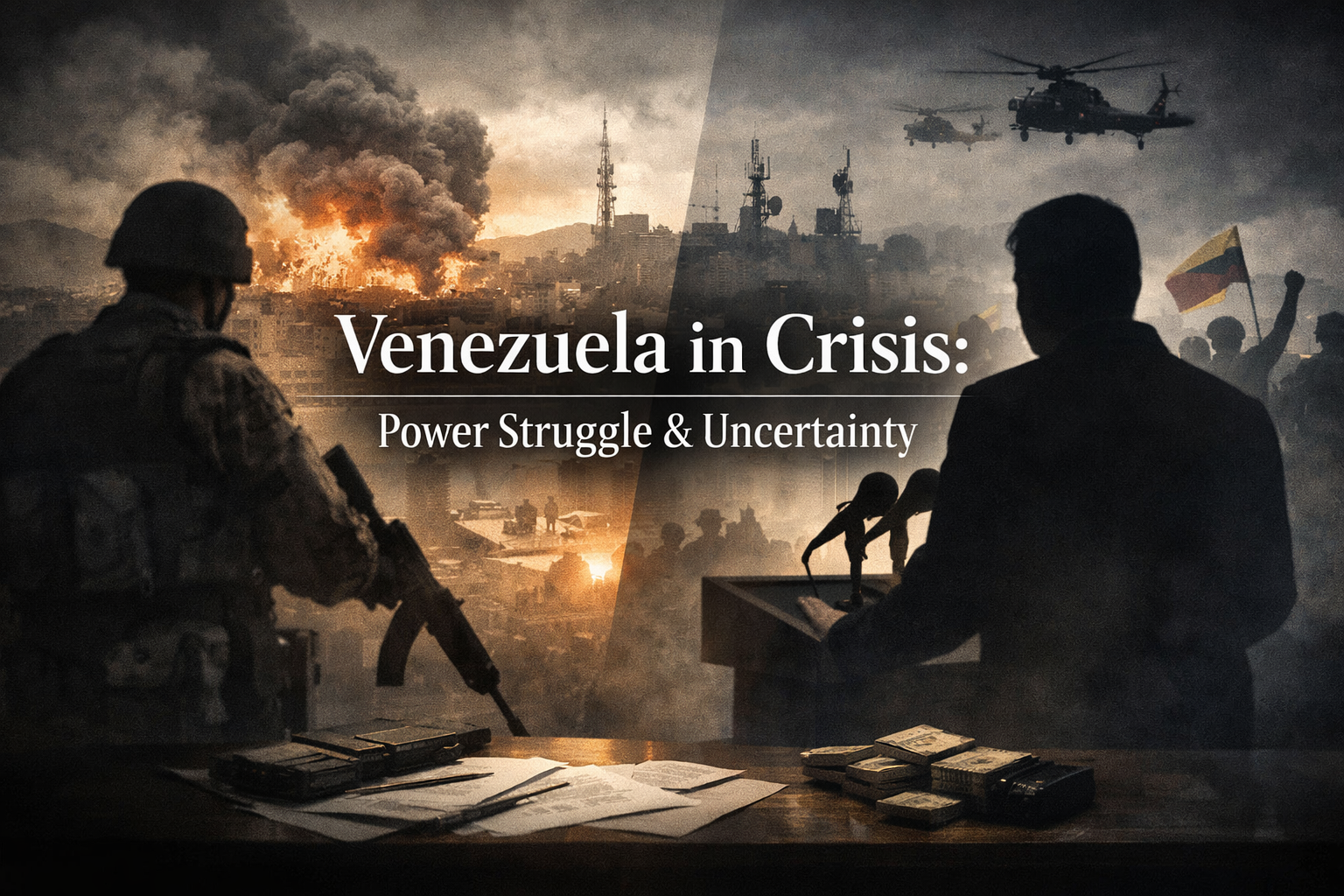
As of January 3, 2026, the United States says it carried out strikes in Venezuela and that President Nicolás Maduro and his wife, Cilia Flores, were captured and flown out of the country. Venezuela’s government has said it does not know where Maduro is and has demanded proof of life.
If that claim is true, it is a once-a-decade geopolitical shock. But the biggest risk is not the headline. It is the “day after” mechanics: who controls guns, money, files, and broadcast signals in the first 72 hours, and whether the system splinters or rewires around a new centre of gravity.
This piece explains what is known, what is disputed, and what is still unknowable. It then maps the near-term scenario tree across 48 hours, 7 days, and 30 days, focusing on the challenging levers that decide outcomes in sudden leadership vacuums.
“The story turns on whether Venezuela’s power network consolidates into a recognisable successor—or fractures into competing armed and political claims.”
Key Points
The United States says Nicolás Maduro and Cilia Flores were captured and flown out of Venezuela after strikes; Venezuela’s government says Maduro’s whereabouts are unknown and demands proof of life.
The decisive question in the first 72 hours is control: senior commands inside the armed forces, intelligence, police, and the communications spine that reaches state TV, radio, and mobile networks.
A “clean transfer” is unlikely without a deal inside the regime’s security coalition; the more common outcomes are a managed successor, a junta-style caretaker, or violent fragmentation.
International reactions will shape the runway: allies condemning the operation, neighbours fearing spillover, and markets pricing oil disruption risk and sanction uncertainty.
Watch for three concrete signals: who appears on state television with the armed forces behind them, who signs and executes orders, and whether units in key bases and cities remain aligned.
Background
Nicolás Maduro has led Venezuela for more than a decade, presiding over a state built around tight political control, a security apparatus designed to prevent elite defections, and an economy heavily shaped by oil and sanctions.
On January 3, 2026, President Donald Trump said U.S. forces captured Maduro and Flores and flew them out of the country following strikes in and around Caracas. The U.S. has also signalled that more details will be made public.
Venezuelan officials, including the vice president, have asserted that the government lacks knowledge of Maduro's location and has requested proof of his life. That creates an unusual limbo: a state can function during a crisis, but legitimacy becomes contested if the head of state cannot be seen, cannot speak, and cannot be verified.
In most authoritarian systems, formal titles matter less than real control. The state survives shocks when a small group can keep three things intact: armed cohesion, payroll and patronage, and a single narrative channel that tells the country who is in charge.
Analysis
Political and Geopolitical Dimensions
The political fight is immediate: who has the right to speak for the Venezuelan state, and who can enforce that claim?
If Maduro is truly in U.S. custody, Venezuela’s leadership circle faces a brutal choice. One path is denial and resistance: frame it as an illegal kidnapping, rally loyalists, and test whether the security forces will hold. Another path is quiet internal bargaining: pick a successor, lock down the chain of command, and try to stop panic and defections.
Opposition forces face their own dilemma. Such a moment has the potential to create opportunities, but it also carries the risk of inciting a backlash. If opposition leaders appear too close to the operation, it can harden nationalist resistance. If they stay too distant, they may miss the only window when the regime’s internal discipline is weakest.
Internationally, the event forces governments to pick a language fast: sovereignty versus accountability, law versus power, and stability versus rupture. Neighbouring states will focus on spillover risk—refugees, border security, and armed groups—while major powers will read it as precedent: if a leader can be removed by force, who is next?
Economic and Market Impact
Venezuela’s oil footprint matters less for sheer volume than for disruption risk. The market question is not just “How much oil can Venezuela export?” but “What happens to flows, insurance, ports, and payment channels if the state’s command structure becomes uncertain.”
In the short term, the most likely economic shock is logistical: confusion in ministries, uncertainty at state firms, and delays at ports and refineries if signatures and security guarantees become contested. A second shock is sanctions and enforcement: if Washington tightens controls, or if other actors retaliate, the payment and shipping maze can harden overnight.
For ordinary Venezuelans, the risk is familiar: currency volatility, fuel distribution problems, and a surge in scarcity if transport and policing become unpredictable. Even if fighting does not spread, uncertainty alone can freeze commerce.
Social and Cultural Fallout
In a crisis like this, the street is less a driver than a sensor. The first crowds do not tell you who will win; they tell you who believes the state still has teeth.
Expect competing demonstrations: loyalists rallying around sovereignty and resistance, and opponents reading the moment as the beginning of an end. The state’s choice of response matters. If security forces police protests with discipline and consistency, it signals command unity. If responses vary by city or unit, it signals fragmentation.
Information becomes a battlefield. Rumours move faster than verified facts, and the public will look for one simple proof: a voice, a video, or a live appearance. In the absence of that, people will start believing whichever side controls the loudest channel.
Technological and Security Implications
The first 72 hours will be about infrastructure control as much as weapons control. Broadcast studios, telecom hubs, and the internal systems that issue orders and pay salaries become strategic terrain.
A regime under pressure often does three things: tightens control of state media, raises the cost of dissent, and tries to keep elite networks loyal through access and protection. In a state of uncertainty, the effectiveness of these tools can be compromised. If the command is unclear, local commanders may act independently, and “security” becomes unpredictable.
Cyber and communications disruption is also a risk vector. Even limited outages can amplify panic and conspiracy thinking. The side that can keep a basic, consistent information signal—without obvious fabrication—gains an edge.
What Most Coverage Misses
The headline asks whether Maduro was captured. The harder, more decisive question is whether the security coalition that kept him in power is intact.
In systems like Venezuela’s, the leader is often the broker among armed, intelligence, and economic factions. Remove the broker, but the network may remain. You create a bargaining crisis inside it. If the factions can agree on a successor and keep the chain of command coherent, the state can survive the shock and even become more brutal.
The second overlooked factor is “proof of command,”, not just proof of life. Even if Maduro appears in a statement, the critical test is who is signing orders inside Venezuela and whether those orders are being executed uniformly across key units and cities.
Why This Matters
The short-term stakes are control and restraint: whether Venezuela undergoes a managed transition, a hardline consolidation, or violent fragmentation.
For the region, the risks are refugee flows, cross-border armed activity, and economic disruption. For the United States and its allies, it is about precedent and blowback: what this kind of action triggers diplomatically, legally, and politically.
For global markets, the immediate concern is energy risk pricing and shipping uncertainty. Even rumours of port disruption or escalation can affect prices, insurance costs, and risk appetite.
Key signposts to watch over the coming days include:
Whether a senior Venezuelan figure appears publicly with visible backing from top military leadership.
Whether state television, major telecoms, and public order policing operate under one consistent command line.
Whether there are credible reports of elite defections, internal arrests, or competing command announcements.
Whether Washington releases verifiable details about custody, legal process, and next steps.
Real-World Impact
A small importer in Miami pauses new orders from suppliers linked to Venezuela, worried that payments could get stuck or flagged as rules change mid-transfer.
A family in western Venezuela queues early for fuel, not because fuel has vanished, but because they expect distribution to become chaotic if local commanders start freelancing.
A shipping broker in the Caribbean tells clients to assume higher insurance costs for routes near Venezuelan ports until it is clear who controls coastal security.
A Venezuelan community group in Madrid scrambles to verify relatives’ safety, as rumours and short videos race through messaging apps faster than any official statement.
Where Things Stand Now
The world has a claim, not clarity. If Maduro is truly out of the country, Venezuela is facing a rare moment when the system must either produce a successor fast or start tearing at its own seams.
The next phase will not be decided by speeches. It will be decided by appearances with force behind them, by orders that are obeyed, and by whether the security coalition stays unified when the broker is gone.
The first real test is simple: within days, Venezuela will either present one believable centre of authority—or reveal that there is no single hand on the wheel.
