How Did Manchester United Fall To 19th Place In The Premier League?
Could Manchester United Really Be Relegated After Their 4–0 Liverpool Humiliation?
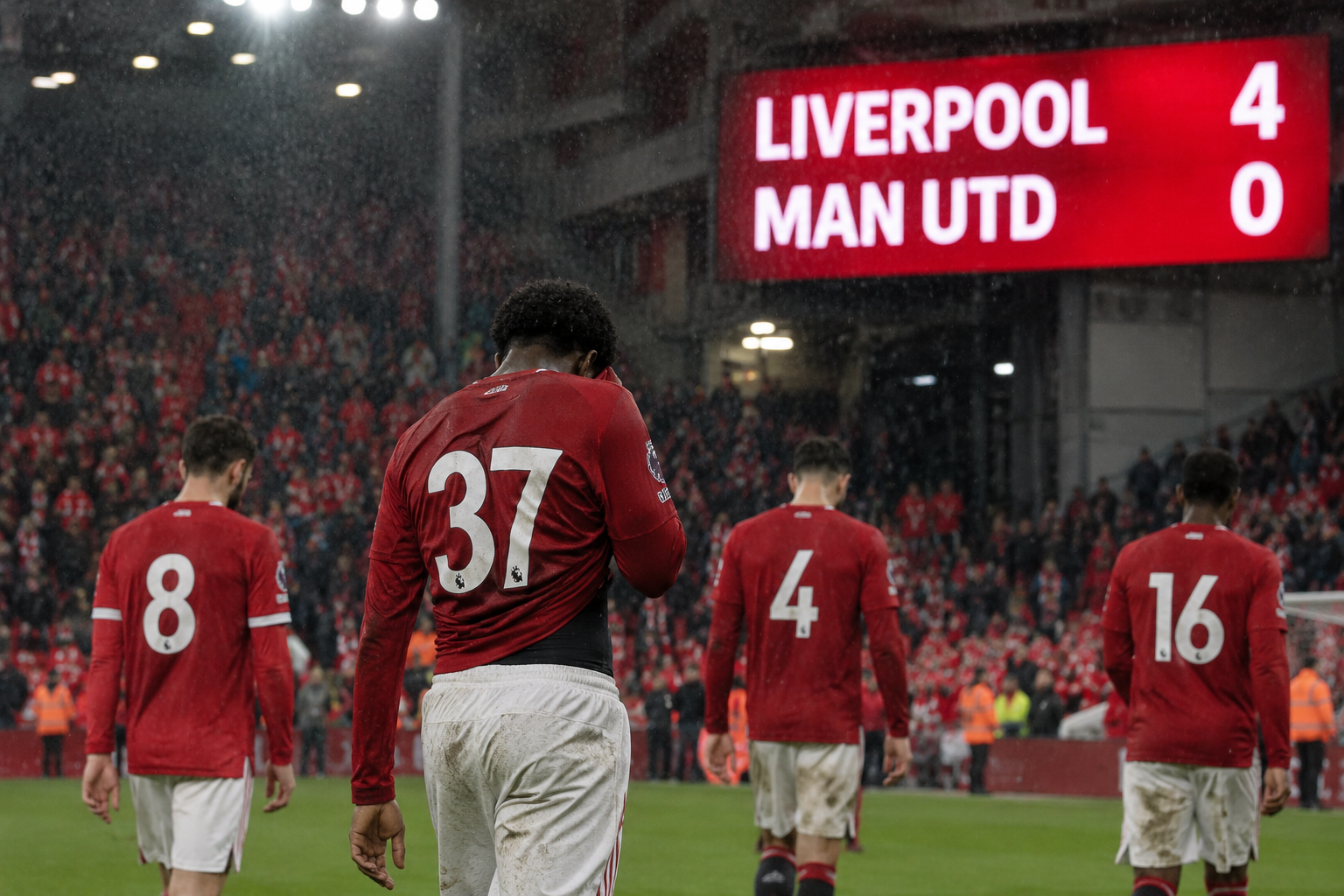
Manchester United's 4–0 defeat at Anfield on Sunday, 22 November 2026, has left one of English football's biggest clubs in 19th place in the Premier League, with just eight points from 11 matches. Mauricio Pochettino's first afternoon in charge ended in humiliation, a red card and another damaging blow to a team already fighting near the bottom of the table.
The result raises a question that would have seemed almost unthinkable a generation ago: could Manchester United genuinely be relegated from the Premier League?
The answer is yes. Relegation is now a credible danger, although it is far from inevitable.
United have won just once in their opening 11 league matches. Their current points return is consistent with a relegation season, and the arrival of another manager has yet to produce the transformation supporters desperately need.
The difficulty for Pochettino is that he must rebuild a struggling side while accumulating enough points to avoid a historic catastrophe.
Liverpool 4–0 Manchester United: How The Humiliation Unfolded
Pochettino could hardly have faced a more difficult introduction to life at Old Trafford.
His first opponents were Liverpool, away at Anfield, in a fixture that already carries enormous emotional significance for both sets of supporters.
The match effectively escaped United's control within 13 minutes.
In the eighth minute, Leny Yoro brought down Alexander Isak just outside the penalty area after the Liverpool striker broke through the defensive line.
The referee dismissed Yoro for denying an obvious goalscoring opportunity, leaving United with ten men for almost the entire match.
Dominik Szoboszlai scored directly from the resulting free-kick in the tenth minute.
Three minutes later, Florian Wirtz doubled Liverpool's advantage with an acrobatic finish following a move involving Isak and Rio Ngumoha.
United were already facing a formidable challenge. Now they were two goals behind with virtually an entire match remaining.
Pochettino responded by introducing Harry Maguire in place of Bryan Mbeumo and reorganising his defence.
The change helped United survive until half-time without conceding again, but Liverpool remained in control.
Rio Ngumoha added a third goal in the 66th minute, finishing Bradley Barcola's delivery.
Víctor Muñoz completed the scoring in the 82nd minute, taking advantage of another defensive mistake to make it 4–0.
The four Liverpool goals came from four different players:
Dominik Szoboszlai — 10th minute
Florian Wirtz — 13th minute
Rio Ngumoha — 66th minute
Víctor Muñoz — 82nd minute
For Pochettino, there could scarcely have been a more demoralising beginning.
Yet the most important feature of the result was not simply the margin of defeat. United entered the afternoon in the relegation zone and finished it there.
Manchester United Are 19th: The Numbers Behind Their Relegation Crisis
Following the Anfield defeat, Manchester United have eight points from 11 Premier League matches.
Their league record stands at one victory, five draws and five defeats.
That represents an average of approximately 0.73 points per match.
If United maintained that rate across the entire 38-match season, they would finish with approximately 28 points.
Such a total would usually leave a Premier League club facing relegation.
The arithmetic makes the scale of the challenge clear.
If United's survival target were 38 points, they would need another 30 points from their remaining 27 matches.
That would require an average of approximately 1.11 points per game from now until the end of the season.
A more conservative target of 40 points would require 32 additional points, or approximately 1.19 points per game.
Neither target is beyond United's capabilities. However, both demand a substantial improvement on their performances and results so far.
MeasureAfter Liverpool DefeatPremier League position19thMatches played11Wins1Draws5Defeats5Points8Points per game0.73Projected full-season points at current rateApproximately 28
It would be misleading to treat that projection as a forecast of United's final position.
Football seasons are rarely linear. Managers change tactics, players regain form, injuries heal and transfer windows provide opportunities for reinforcements.
But the projection does establish one important fact: continuing as United have started would be dangerous.
The badge on the shirt provides no protection against the league table.
Why Manchester United's Problems Go Beyond One Heavy Defeat
An early red card can distort almost any football match.
Playing more than 80 minutes against Liverpool with ten men is difficult even for an organised, confident team.
Pochettino can therefore reasonably argue that the result provides limited evidence about what his own tactical approach might achieve with a full-strength side.
However, the dismissal cannot explain United's entire season.
The club had already lost 3–0 at home to Bournemouth in October and 2–0 away to Chelsea.
They followed those defeats with a remarkable 4–4 home draw against Aston Villa before the international break.
That sequence illustrates the challenge facing the new manager.
United have demonstrated that they possess players capable of scoring goals, but they have repeatedly struggled to combine attacking ambition with defensive control.
The mistakes preceding Yoro's dismissal at Anfield were especially concerning.
Matthijs de Ligt misjudged a ball played forward, allowing Isak to escape behind United's defence.
Yoro was then forced into a desperate challenge.
There were two separate problems: the initial defensive error and the decision that resulted in the dismissal.
Teams competing for survival cannot afford repeated episodes in which ordinary defensive situations become match-changing emergencies.
Pochettino's task is therefore not simply to improve results. He must make United more difficult to beat, less vulnerable to transitions and more reliable when protecting possession.
That may require sacrificing some attacking freedom in the short term.
Is Mauricio Pochettino Already Under Pressure?
Pochettino was appointed to provide a fresh direction after Manchester United's difficult start to the campaign.
His arrival was intended to offer a new beginning.
Instead, the first match immediately exposed the scale of the rebuilding job.
But blaming the new manager for the entire Liverpool defeat would be premature.
He inherited a team already sitting near the bottom of the Premier League. He had little preparation time before travelling to Anfield, and his opening tactical plan was disrupted by a dismissal after eight minutes.
The more revealing tests will come against opponents United can reasonably expect to compete with over 90 minutes.
Pochettino must establish a defensive structure, make decisions about his strongest starting eleven and restore confidence without allowing the league position to deteriorate further.
His reputation and experience may buy him some patience. They cannot guarantee it.
Modern football places enormous pressure on managers when results remain poor, particularly at clubs where financial expectations and public scrutiny are unusually high.
There is also a wider institutional question.
If United continue changing managers without addressing weaknesses in squad construction, recruitment and organisation, each appointment risks becoming another attempt to solve structural problems through one individual.
Pochettino's success will depend partly on decisions made above him.
How Manchester United Fans Are Likely To React
The 4–0 defeat is particularly painful because of the opposition.
Losing heavily to Liverpool carries an emotional cost that extends beyond the three points.
For many United supporters, the club's rivalry with Liverpool is inseparable from its identity and history.
Anfield supporters were already mocking Pochettino and singing about United's relegation during the opening stages.
Reports from the match also described travelling United fans leaving before full-time.
The result is likely to intensify several overlapping arguments among United supporters.
1. Anger towards the club's leadership
Supporters may increasingly question whether changes in ownership influence, recruitment policy and football operations have produced meaningful progress.
When different managers encounter similar problems, attention naturally turns towards the people responsible for building and running the squad.
2. Frustration with defensive errors and individual performances
Yoro's dismissal and the mistakes preceding it will inevitably attract criticism.
However, supporters may be more concerned by the recurring nature of United's defensive problems than by any one player's performance.
3. Genuine fear of relegation
The prospect is no longer purely an insult used by rival supporters.
United are 19th after 11 matches. Their current points rate would leave them in serious danger if maintained.
That makes relegation a legitimate subject of football analysis.
4. Demands for January reinforcements
Supporters are likely to scrutinise whether the existing squad contains the balance, depth and defensive quality necessary to recover.
The January transfer window offers a possible intervention, although recruitment is rarely an immediate solution to problems involving organisation and confidence.
5. Calls to give Pochettino time
A substantial section of the fanbase may argue that another managerial dismissal would deepen the instability.
Pochettino has had one match. Assessing him entirely on a game transformed by an early red card would be unreasonable.
These are plausible reactions rather than measured percentages of the fanbase. Supporters will disagree about where responsibility lies and what should happen next.
Could Manchester United Actually Play In The Championship?
Manchester United have never been relegated from the Premier League since its creation in 1992.
Their last relegation from England's top flight came in 1974.
That historical distance is one reason the present situation feels so extraordinary.
United remain one of the world's best-known football clubs, with significant commercial resources, a large international following and players recruited at substantial expense.
Yet none of those advantages directly generates points.
A club stays in the Premier League by finishing above the relegation places, regardless of its revenues, trophies or history.
The strongest argument against United going down is their capacity to improve.
They have considerably more resources than many of the clubs around them. Their squad contains established internationals, and there are still 27 league matches remaining.
Even a relatively modest improvement could move them away from danger because the teams immediately above them are also dropping points.
The strongest argument for taking the threat seriously is that eleven matches provide more evidence than an isolated bad weekend.
United's problems have persisted across different opponents and circumstances.
A single win would lift morale, but it would not automatically resolve the weaknesses that have left them near the bottom.
What Would Relegation Mean Financially?
Relegation would represent an enormous sporting and commercial shock.
Premier League membership brings substantial domestic and international broadcasting distributions, commercial exposure and sponsorship opportunities.
Championship clubs operate in a very different financial environment.
For United, relegation could affect broadcasting income, sponsorship negotiations, player retention, wage planning and the ability to recruit leading talent.
The precise financial consequences would depend on the club's contractual arrangements, existing liabilities, broadcasting distributions and any parachute payments for which it qualified.
It would be irresponsible to attach one definitive loss figure without examining those details.
Some commercial contracts may include protections or adjustments linked to league participation.
Other revenues could prove more resilient because of Manchester United's enormous global following.
That distinction matters.
Relegation would not necessarily threaten the club's existence, but it could force painful decisions about spending, player contracts and the speed of any rebuilding programme.
There would also be a sporting consequence that money could not instantly reverse.
Promotion from the Championship is not guaranteed, even for a club arriving with greater financial resources than its competitors.
United would need to adapt to an unfamiliar competition and overcome opponents for whom defeating them would become an exceptional occasion.
What Must Pochettino Change To Save Manchester United?
United's immediate priority is to accumulate points.
That sounds obvious, but it has tactical consequences.
A club struggling in 19th position may need to make different decisions from one chasing Champions League qualification.
Pochettino will need to determine which combinations of defenders offer the greatest security, whether his midfield provides enough protection and how aggressively United can press without exposing themselves.
Set pieces, defensive concentration and avoiding unnecessary dismissals could become as important as attacking creativity.
The most effective approach may involve making United more predictable defensively before attempting a more expansive style.
This does not mean abandoning the club's attacking traditions permanently.
It means recognising the reality of the league table.
A well-organised 1–0 victory could be more valuable to United's immediate recovery than a spectacular performance that ends in another chaotic draw.
The challenge is psychological as well as tactical.
Repeated defeats can make players hesitant. Defenders become reluctant to take risks, midfielders stop demanding possession and attackers attempt to force opportunities rather than building them patiently.
Confidence usually improves through successful actions and results, rather than speeches alone.
Pochettino must therefore create conditions in which United can recover their composure while the pressure remains intense.
Manchester United's Next Fixtures Could Define Their Season
United's immediate league schedule offers a clearer test of their survival prospects.
They face Brentford at Old Trafford on 28 November before travelling to Newcastle United on 2 December.
A home fixture against Coventry City follows on 5 December, with a trip to Crystal Palace scheduled for 13 December.
These matches matter because United cannot afford to treat every difficult fixture as an acceptable defeat.
If their current position persists into December, the pressure will become more intense.
Taking seven or eight points from the next four league matches would provide tangible evidence of recovery.
Taking one or two would leave United at risk of becoming increasingly detached from the teams above them.
The Crystal Palace fixture could prove particularly significant if both clubs remain in the relegation positions.
Matches against direct rivals can influence more than confidence: points gained by one struggling team are points denied to another.
Has Manchester United's Decline Reached Its Lowest Point?
Football history is filled with clubs that seemed too powerful, wealthy or established to experience dramatic decline.
Manchester United themselves were relegated in 1974, just six years after winning the European Cup.
Their modern circumstances are very different, but the historical lesson remains relevant: past success cannot substitute for present performance.
United have more than enough time to avoid relegation in 2026–27.
What they no longer have is the luxury of dismissing the danger as absurd.
Eight points from 11 games is the record of a team facing a survival battle. The 4–0 defeat at Liverpool has made that reality impossible to ignore.
Pochettino should not be judged solely on an afternoon transformed by Yoro's dismissal.
He should, however, be judged on whether United begin improving quickly enough to escape the bottom three.
The next month may establish whether Anfield was merely an awful first chapter in a successful recovery or another warning of a season heading towards a historic disaster.
For Manchester United, the immediate objective is no longer to reclaim their place among English football's elite.
It is to make certain that they remain in the Premier League.
Sources
Manchester United — Confirmed: Pochettino's Team To Play Liverpool — Confirms the managerial debut, starting selection and context of the match.
The Guardian — Liverpool v Manchester United: Premier League Live — Match chronology, goals and Yoro's dismissal.
Football Web Pages — Premier League Table 2026–27 — League positions, points and the wider relegation picture.
