Mass Shooting At Canadian High School: What’s Confirmed, What Isn’t, and the Timeline That Matters
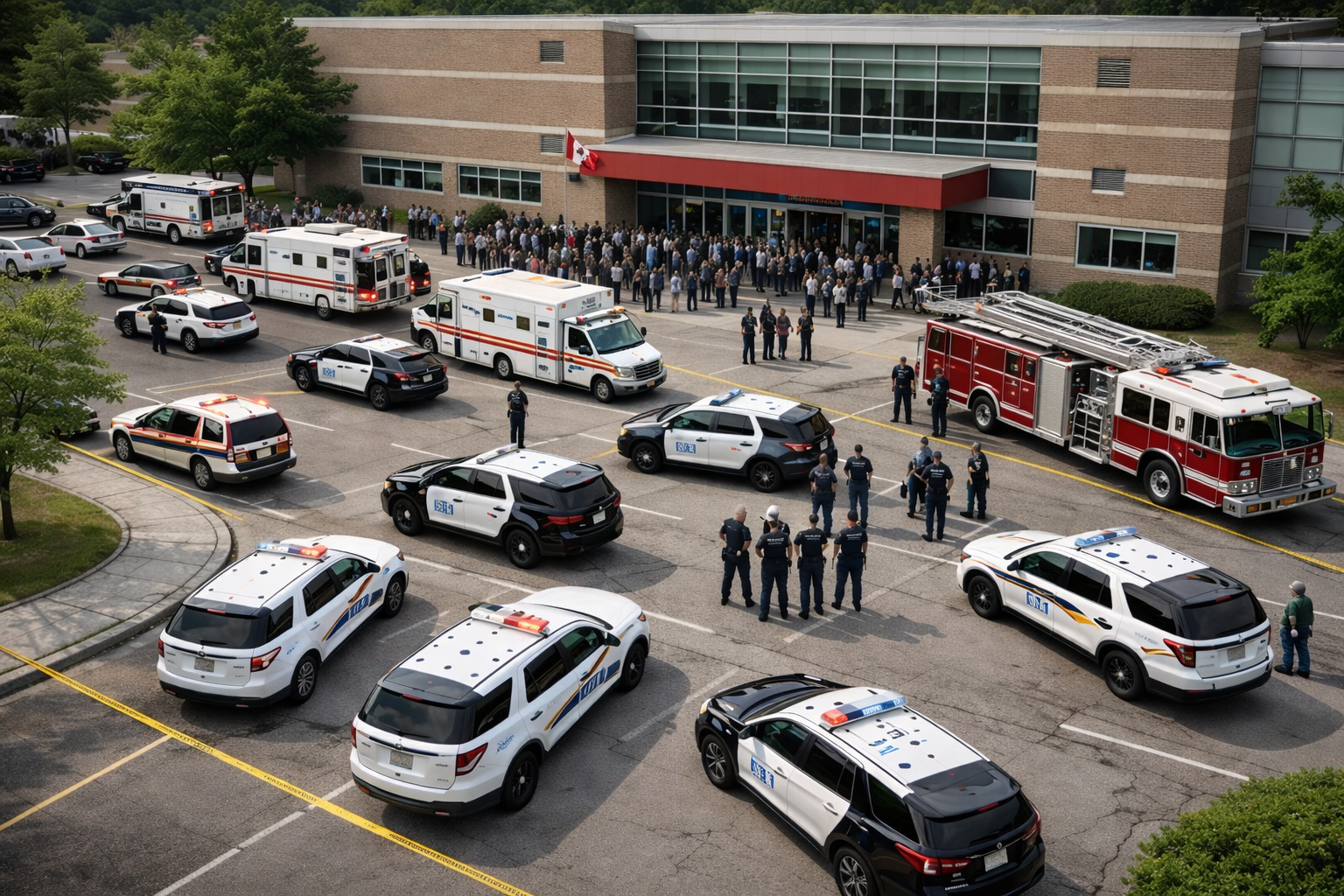
British Columbia High School Shooting: Verified Timeline, What’s Confirmed
Update: 15:17 GMT
Suspect status: police say the suspect was found dead from what “appeared to be” a self-inflicted injury.
Evacuation detail: About 100 students and staff remaining in the school were safely evacuated.
Schools closed: coverage continues to state schools in the area are closed for the rest of the week while support services are arranged.
Casualty framing is tightening: several live desks are now presenting the injuries as 25 injured, though treat this as “latest reported” pending an RCMP consolidated breakdown.
Broader confirmation of the core line: Central framing of 10 dead, including the shooter, tied to the high school incident.
Update 14:23 GMT
New/newly solidified details
RCMP superintendent Ken Floyd says investigators have identified the suspect but will not release the name yet, and motive remains unclear.
Police say more than 25 people were injured, including two airlifted to hospital with life-threatening injuries.
School closure: reporting now consistently says the school will remain closed for the rest of the week.
What’s still fluid (but bounded)
The injured count is still being described as “more than 25”/mid-20s across outlets; treat any exact number as provisional until RCMP publishes a consolidated breakdown.
Multiple reports now state two people were airlifted with life-threatening injuries.
Newly reported detail: evacuation scale
Reporting from the RCMP briefing says around 100 students and staff were evacuated from the school.
Newly reported detail: suspect identified, but name withheld
RCMP briefing coverage says investigators have identified the suspect but are not releasing the name yet, and the motive remains unclear.
Schools closed for the week
Multiple outlets report schools in Tumbler Ridge are closed for the week with support/counseling efforts underway.
What’s stable vs still fluid
Stable core facts (consistent across major reporting)
10 total dead, including the suspect, is the dominant line in ongoing coverage.
Two linked scenes: the secondary school and a connected residence.
Police say they do not believe there’s an ongoing threat/additional suspects.
Still moving/needs consolidation
The injured count is still being reported in the mid-20s but varies by outlet and update time (triage categories differ).
Update: 14:02 GMT
The RCMP says the suspect has been identified, but details are being withheld for now, and police are not yet in a position to explain motive.
Evacuation scale: Reporting from the RCMP briefing says around 100 students and staff were evacuated from the school.
School closure: reporting says the school will remain closed for the week, with counselling/support being arranged.
Medical transport detail (reported): multiple reports mention airlifts for the most critical casualties (wording varies), reinforcing the rural-capacity “response chain” angle.
Update: 13:57 GMT
Confirmed / disputed / unknown
CONFIRMED
Two linked scenes: school and connected residence.
STILL SETTLING
Injured count (mid-20s range in reporting; category definitions differ).
UNKNOWN (not responsibly answerable yet)
Names/ages of victims, motive, and weapon details (RCMP has not publicly released these).
Verified status
Fatalities: Police reporting has stabilized around 10 dead (including the suspect).
Injuries: Reporting varies by outlet and update time (mid-20s), with at least two described as serious/life-threatening in multiple reports. Treat the exact injured count as fluid until RCMP publishes a consolidated figure.
Threat: Police say they do not believe there’s an ongoing threat/additional suspects.
Locations: Confirmed links to Tumbler Ridge Secondary School and a connected residence
Gunfire tore through a small-town secondary school in British Columbia, leaving at least 10 people dead and dozens more injured—an event that Canadian police say also involved a second, connected location.
Officials say the suspected shooter is dead and that there is no ongoing threat. But the most important details—who the victims were, how the attacker accessed weapons, and the precise sequence inside the building—remain deliberately withheld while investigators secure scenes, notify families, and lock down evidence.
One underappreciated hinge is not political. It’s operational: this happened in a remote community with a small police detachment, limited local medical capacity, and long distances between “first call,” “first contact,” and “definitive care.” That response chain will shape what comes next—legally, medically, and in school security policy.
The story turns on whether the investigation confirms a contained, single-actor event—or reveals a broader pre-incident footprint across locations, timelines, and access points.
Key Points
Police say at least 10 people are dead, including the suspected shooter; multiple others were injured, including at least two with serious or life-threatening wounds.
The incident is tied to Tumbler Ridge Secondary School and a second connected location described as a residence; police say the connection is still being established.
Authorities have said they do not believe there are additional suspects or an ongoing threat, and the emergency alert was later canceled.
Police have not said how many victims were minors, have not released a name, and have not provided weapon details.
The timeline includes an initial “active shooter” call at 1:20 p.m. PT, a mid-afternoon police update, and the cancellation of the emergency alert around 5:45–5:46 p.m. PT.
Immediate implications are not limited to the gun law debate: rural emergency response capacity, school reunification procedures, and cross-jurisdiction alerting are now front and center.
Background
Tumbler Ridge is a remote municipality in northern British Columbia, with a population around 2,400. The secondary school serves roughly grades 7–12 (early teens through late teens), with reported enrollment in the low hundreds.
Police have described the suspect as female and said the suspect was found dead from what appeared to be a self-inflicted injury. The casualty count includes deaths at the school, a victim who died en route to the hospital, and deaths at a connected residence.
Because this is an active, multi-scene investigation with mass casualties, the information environment predictably splits into three layers:
The official layer: confirmed figures and narrow statements meant to be resilient in court.
The eyewitness layer: vivid but partial accounts from inside lockdown and reunification.
The rumor layer: fast-moving claims about identities, motives, and “how many shooters,” which officials have not supported.
The distinction matters: early inaccuracies can harden into public “truth,” distort policy reactions, and complicate prosecutions.
Analysis
The response chain is the real clock, not social media
In shootings, people tend to obsess over “when the first shots were heard.” Investigators obsess over different timestamps: first call received, first officers on scene, first entry/search, first victims located, first life-saving interventions, first evacuation, first scene security, and first reliable casualty count.
Here, officials have highlighted that the local detachment responded within minutes. But “minutes to scene” does not automatically mean “minutes to medical stabilization,” especially in remote settings where
the nearest advanced trauma care can be far away.
airlift decisions become triage decisions,
and reunification sites may be the only place families get verified information.
That lag is not a detail. It’s part of the outcome.
What the two-location pattern suggests—and what it doesn’t
Police have confirmed fatalities at the school and at a residence believed to be connected.
Two-location events often trigger speculation: accomplices, coordinated attacks, and escape routes. None of that is confirmed here. A simpler, more common investigative frame is a pre-incident or post-incident location tied to the suspect (home, vehicle, family residence), which can clarify the following:
access to weapons,
intent and planning,
and whether threats existed before the first shots at the school.
The key is what investigators recover at the residence: documents, digital devices, ammunition, or signs of prior violence. That is the evidentiary bridge between “a terrible event” and “a prosecutable narrative,” even if the suspect is dead.
Casualty numbers are fluid for reasons that matter
The public wants one number. Investigators and medical teams work through categories:
confirmed dead at scene,
dead on arrival or en route,
hospitalized critical,
hospitalized, serious
treated and released,
treated on site.
Early reporting can mix these categories. Here, officials have referenced roughly two dozen with non-life-threatening injuries and at least two with serious or life-threatening injuries, with assessments continuing as scenes were stabilized.
Expect the “injured” number to wobble as people present later with shock injuries, minor wounds, or delayed symptoms.
The policy fight will split into three lanes
This story will be argued in three parallel lanes:
Weapons and licensing: Canada’s tighter framework versus perceived gaps.
School security: access controls, drills, and on-site prevention.
Emergency management: alerts, rural response staffing, and medical surge capacity.
Lane 3 is the one most likely to produce concrete near-term changes, because it is the least ideologically trapped and the easiest to justify as “public safety modernization.”
What Most Coverage Misses
The hinge is rural state capacity: in remote communities, the limiting factor is often not awareness of danger but the speed of coordinated response across policing, EMS, air support, and hospital capacity.
The mechanism is simple: long distances and limited local resources force hard choices—how fast officers can search, how quickly victims can be triaged, and how reliably families can be reunited and notified. Those constraints shape causality outcomes, investigative sequencing, and the political appetite for specific reforms.
Watch for two signposts in the coming days: (1) whether officials announce new regional response staffing or emergency-alert protocol changes, and (2) whether investigators describe the residence as central to planning (weapons access, intent, digital trail) rather than incidental to the incident.
What Happens Next
In the next 24–72 hours, the public will see a familiar pattern: tighter official communication, more precise casualty reporting, and a widening gap between what police know and what they can responsibly say.
Who is most affected is obvious—families, students, staff, and first responders—but a secondary group is about to carry heavy weight: local health services and school district crisis support teams, because counseling access, leave policies, and long-term safeguarding decisions will set the tone for recovery.
The main consequence is that policy action will move fastest on emergency readiness because it can be justified quickly and funded locally and because it can be framed as capability improvement rather than culture war.
Watch for:
a clearer accounting of where victims were located (without identities),
formal statements on school closure duration and reunification support,
and any disclosure on weapon type and acquisition pathway once investigators secure chain-of-custody.
Real-World Impact
A parent refreshes a phone for hours, not for rumors, but for a single verified message: where to go, whether reunification has started, or whether their child is accounted for.
A teacher replays the sound of a locked door and the weight of desks pushed against it, then returns to an empty classroom that no longer feels neutral.
A small clinic goes into surge mode, triaging dozens of people with minor wounds and shock while waiting for airlift decisions on the worst cases.
A local employer quietly resets shifts for weeks because staff are grieving, supporting family, or simply unable to return to “normal” routines.
The Investigation’s Next Hard Line
The public will demand names, motive, and “how.” Police will prioritize something else: evidence that stands up after grief turns into litigation.
If investigators confirm the event was contained to one actor with a discoverable access pathway, the debate will narrow to prevention and hardening. If they surface a wider pre-incident footprint—warnings missed, threats shared, weapons stored, or gaps in reporting—the story becomes a systems failure with a longer tale.
Either way, the dates and timestamps will matter more than hot takes because the timeline is where accountability either locks in or dissolves.
