

Multiple Merchant Ships Hit by Disabling Fire as Gulf Conflict Spills Into Vital Shipping Lanes
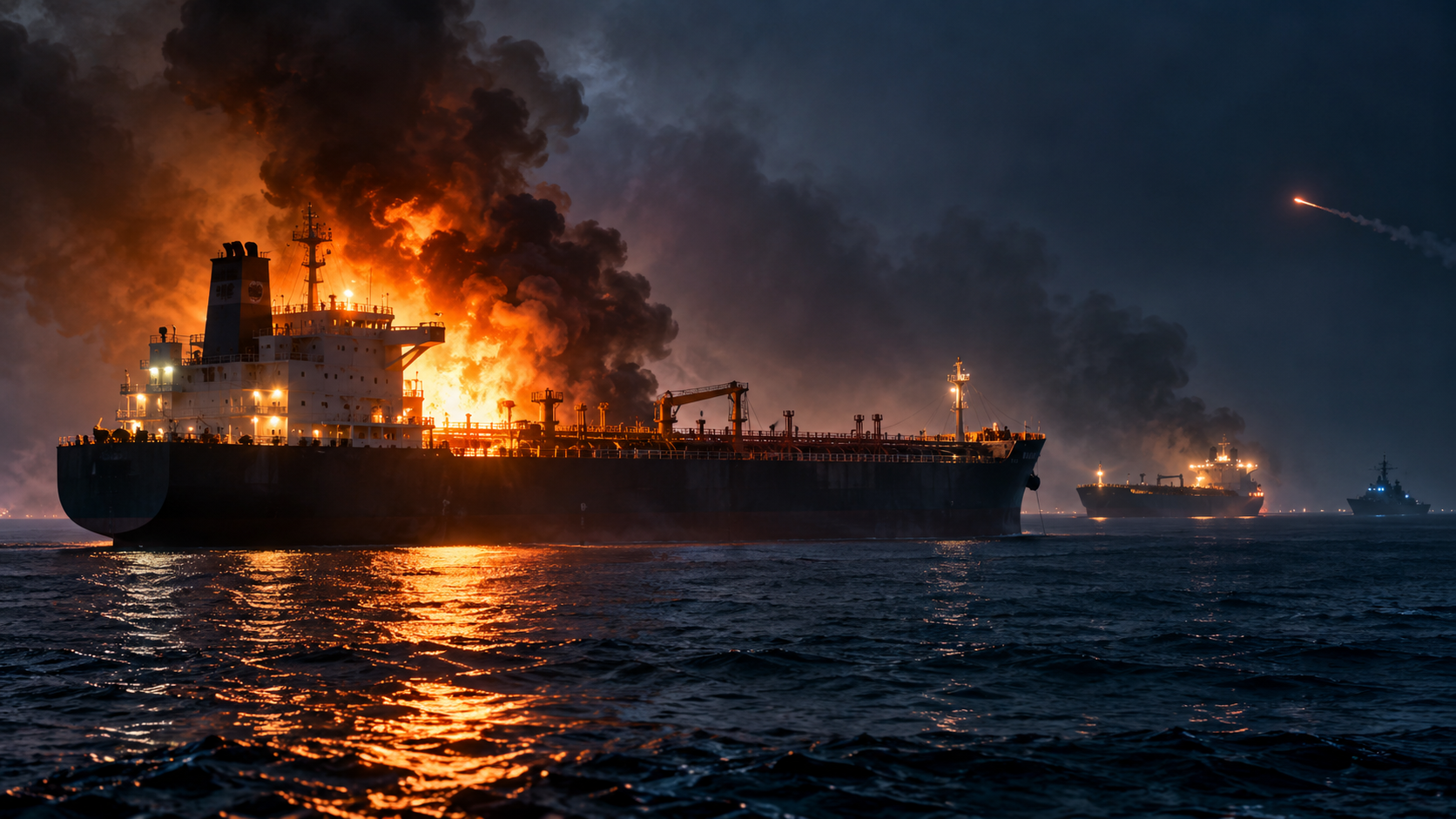
Iran Claims It Targeted Eight Tankers and Two US Vessels
Gulf Shipping Under Fire
Several merchant vessels have been hit by disabling fire in the northern Gulf and Gulf of Oman as the region's escalating military confrontation moves deeper into some of the world's most important commercial shipping routes. The United Kingdom Maritime Trade Operations centre said the incidents involved several merchant ships during ongoing military activity, with the extent of casualties and environmental damage still unclear.
The warning matters far beyond the individual vessels. Commercial ships are now operating through waters where military strikes, missiles, drones, damaged tankers and heavily armed naval forces are increasingly overlapping, raising the danger that the Gulf conflict could disrupt trade even when merchant crews and cargoes are not intended targets.
Multiple Merchant Ships Are Reported Disabled
UKMTO said reports indicated that several merchant vessels in the northern Arabian Gulf and Gulf of Oman had been subjected to "disabling fire" as part of military activity in the region. The organisation had not confirmed casualties or environmental consequences when its advisory was issued.
That wording is significant. A vessel does not need to sink for an attack or military encounter to transform the risk calculus for shipping companies: disabling propulsion, steering or other critical systems can leave a large commercial ship exposed in congested waters while crews attempt to control fires, flooding or secondary damage.
The threat was reinforced by another incident roughly 24 nautical miles from Port Rashid in the United Arab Emirates. A vessel was sighted listing while at anchor, and initial information indicated that it may have taken on water following an attack by an unknown projectile, although the precise cause had not been established.
The Gulf's Military Fight Is Moving Closer to Civilian Shipping
The incidents come amid an escalating cycle of attacks involving the United States and Iran. US Central Command has already confirmed direct strikes against Iranian crude carriers during the current confrontation, including an operation on September 5 in which it said three tankers linked to Iran's Islamic Revolutionary Guard Corps were permanently disabled or destroyed after ballistic missiles were launched towards two US Navy warships.
CENTCOM said an American aircraft carrier and guided-missile destroyer evaded those missile attacks without American casualties. It then targeted M/T Downy near Kharg Island, M/T Stark 1 near Jask and the unladen M/T Kylo in the Gulf of Oman, explicitly presenting the operation as an attempt to impose an economic cost on Iran.
The latest merchant-vessel incidents therefore sit inside a confrontation in which tankers and maritime infrastructure are no longer merely adjacent to military operations. Ships themselves have become increasingly central to the pressure being applied by both sides.
Iran Claims It Struck Eight Tankers and Two US Vessels
Iran's Revolutionary Guards claimed on Wednesday that they had attacked two American vessels and eight oil tankers in the Gulf in retaliation for US attacks on Iranian tankers. The Guards said those vessels had attempted to cross an area of the Strait of Hormuz that Iran described as prohibited and unsafe. Independent confirmation of the full Iranian claim remained incomplete at the time of writing.
That distinction is critical. The confirmed UKMTO reports establish that several merchant vessels have been caught in damaging military activity, but they do not by themselves prove that every vessel cited in Iran's wider claim was struck or establish responsibility for every incident.
What is clear is that maritime security warnings have become increasingly severe. A current US Maritime Administration advisory warns that commercial vessels in the Persian Gulf, Strait of Hormuz and Gulf of Oman face a high risk of Iranian attack, including threats from missiles, armed drones and unmanned surface vessels.
The Strait of Hormuz Is Already Severely Disrupted
The military danger is colliding with one of the most economically sensitive pieces of geography on Earth. Before the present conflict, the Strait of Hormuz routinely carried enormous volumes of crude oil, petroleum products and liquefied natural gas between the Gulf and global markets.
US Energy Information Administration data shows how dramatically those flows have already changed. Oil moving through Hormuz averaged approximately 21.6 million barrels per day in the fourth quarter of 2025, but only around 4.9 million barrels per day in the second quarter of 2026 as the conflict restricted shipping.
That historical baseline explains why even a relatively small number of disabled merchant vessels can have consequences beyond their individual cargoes. Shipowners must consider crew safety, insurance costs, naval activity, navigational interference and the possibility that a normal commercial transit could suddenly become part of a military confrontation.
The US maritime advisory also warns of significant satellite-navigation interference, including spoofing and jamming. Mariners have been advised to rely more heavily on radar, visual bearings and secondary navigation systems because positional information can be degraded across the region.
Oil Has Returned Above $100
Markets are already responding to the renewed pressure. Brent crude moved above $100 a barrel as attacks on vessels and energy infrastructure increased fears that an already constrained regional supply system could suffer further disruption.
The danger is not simply that Hormuz could suddenly be completely closed. A prolonged environment in which crews face missile strikes, projectiles, drones, military interceptions and navigational interference could reduce effective shipping capacity without a formal blockade ever being declared.
That can produce its own economic shock. Fewer available vessels, higher insurance premiums, longer diversions and increased risk charges can raise the cost of moving oil and other cargo long before physical supplies disappear.
Commercial Shipping Is Becoming Part of the Battlefield
This is what makes the latest incidents particularly dangerous. The dividing line between military confrontation and civilian maritime commerce is becoming harder to maintain.
The Persian Gulf and Gulf of Oman contain warships, oil tankers, bulk carriers, container ships and other commercial traffic operating inside a relatively confined strategic environment. Once opposing militaries begin targeting ships as instruments of economic warfare, misidentification and unintended escalation become more serious risks.
A projectile intended for one vessel can hit another. A disabled ship can obstruct navigation. A fire can become an environmental disaster. A misread radar return or navigation signal can place a civilian vessel inside an area treated by military forces as hostile.
None of those outcomes requires either Washington or Tehran to deliberately decide to attack neutral international commerce. They require only a battlefield dense enough for mistakes and unintended consequences to become increasingly difficult to contain.
What Happens Next Could Be More Important Than Who Fired First
The immediate questions are whether casualties emerge from the newly reported incidents, whether the damaged ships can be identified, whether any cargo has entered the water and whether investigators can determine what weapons caused the damage.
But the larger test is whether attacks on maritime targets now accelerate. The danger would rise sharply if commercial carriers begin avoiding the region in greater numbers, if Iran attempts to enforce wider restrictions around Hormuz, or if US forces answer further attacks with another wave of strikes against Iranian shipping.
The Gulf does not need to be formally closed for the global economy to feel the consequences. Several merchant ships being disabled during military operations is already a warning that one of the world's most strategically important maritime corridors is becoming increasingly difficult to separate from the war surrounding it.
