NATO Fighter Jet Shoots Down Mystery Drone Inside Latvian Airspace
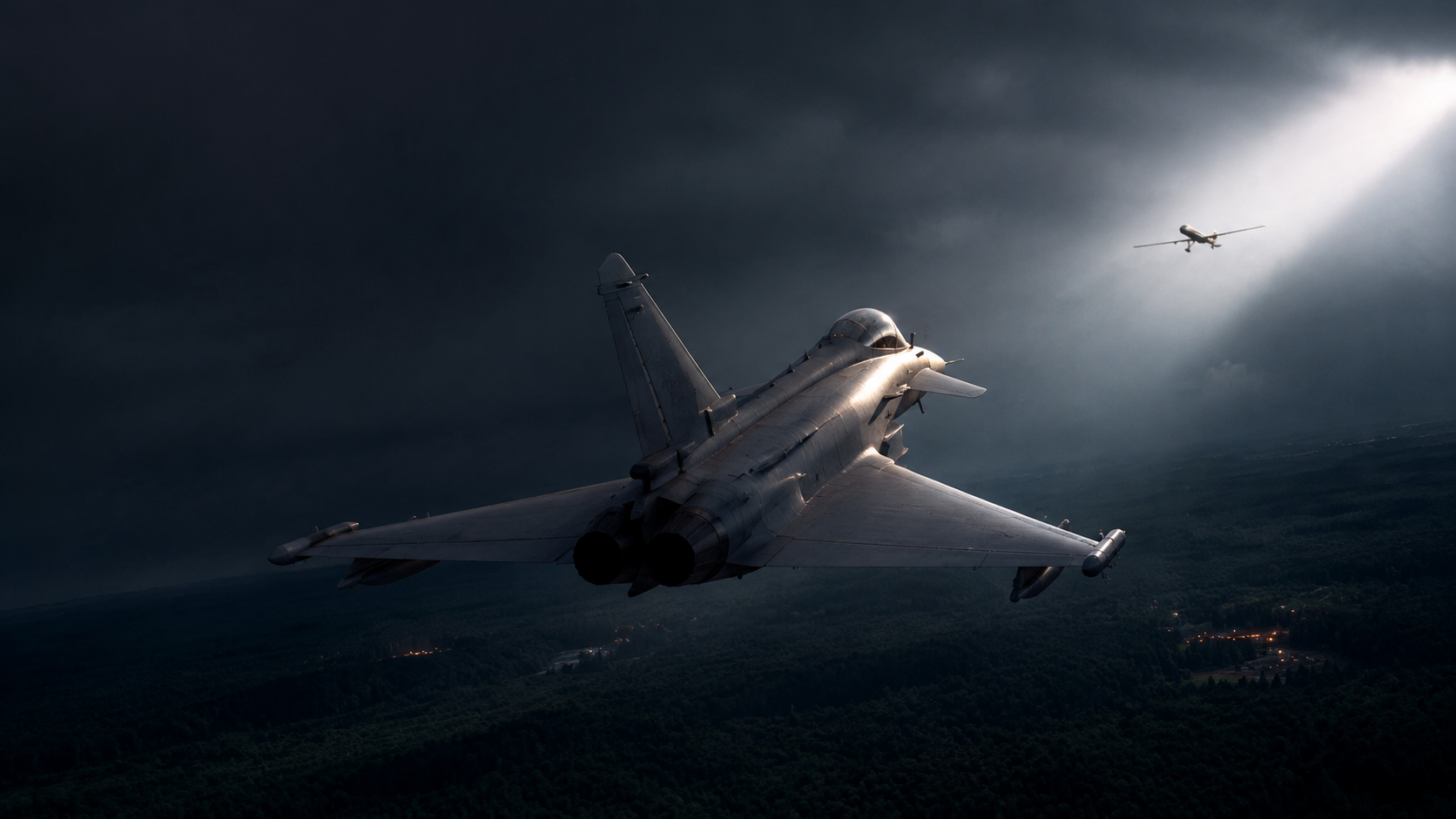
NATO Jets Scramble As Drone Breaches Latvian Airspace
Mystery Drone Shot Down Near Russia–Latvia Border
A NATO fighter jet has shot down an unidentified drone inside Latvian airspace, turning another Baltic incursion into a live military interception near Russia’s border. The aircraft’s origin remains unconfirmed, but the incident shows how rapidly the Ukraine war’s expanding drone battle can force NATO pilots into potentially consequential decisions.
Two Italian Eurofighters launched from Lithuania after the drone was detected over Latvia during the early hours of Friday, 14 August. Two Turkish F-16s were also scrambled from Estonia, with one of the Italian aircraft ultimately identifying and destroying the drone under NATO command.
The Drone Was Destroyed Near The Russian Border
The interception occurred over Balvi Municipality in north-eastern Latvia. Latvian personnel subsequently began searching woodland near Rugāji, approximately 35 kilometres from the Russian border, after the area was identified as a possible location for the wreckage.
The drone was reportedly destroyed at a considerable altitude, meaning fragments may have been dispersed across a wide area of forest, bog and sparsely populated countryside. Latvian authorities asked residents to contact the emergency services if they discovered suspicious debris rather than approaching or handling it.
An air-threat warning had been activated across five municipalities while the drone remained inside Latvian airspace. The alert was lifted at approximately 4.50am after Latvia’s armed forces announced that the threat had ended and the unmanned aircraft had been successfully destroyed.
Italian And Turkish Jets Joined The Response
The interception demonstrated the multinational structure behind NATO’s defence of the Baltic states. Italy’s Eurofighters were operating from Šiauliai Air Base in Lithuania, while the Turkish F-16s launched from Estonia.
Latvia does not maintain the fighter force required to patrol its skies alone. Since Estonia, Latvia and Lithuania joined NATO in 2004, allied countries have rotated aircraft through the Baltic Air Policing mission, maintaining jets capable of responding to unidentified, unsafe or hostile activity.
NATO said every aircraft involved in Friday’s operation was under alliance command. It also stressed that its forces remain capable of reacting to potential threats around the clock, while confirming that an investigation was being conducted alongside Latvian authorities.
The Drone’s Origin Has Not Been Established
The most important unanswered question is who launched the drone. Latvian officials had not identified its operator, model, intended target or precise flight path while military personnel continued searching for debris.
The timing may eventually help investigators reconstruct what happened. Ukrainian drones were attacking Russian port facilities near St Petersburg overnight, including targets in the wider region surrounding Ust-Luga. However, proximity to those operations does not prove that the aircraft destroyed over Latvia was Ukrainian.
Latvia’s military has linked repeated regional incursions to Russian electronic-warfare activity. Powerful jamming and navigation-spoofing systems can disrupt satellite-guided aircraft, potentially forcing drones away from their programmed routes and across international borders.
That explanation remains an assessment rather than proof of this drone’s identity. Investigators will need wreckage, electronic components, explosive material and any recoverable navigation data before reaching a reliable conclusion.
NATO’s Eastern Flank Is Becoming A Drone Front
Friday’s interception was not an isolated event. A French fighter destroyed another drone over Latvia in June, while other NATO countries bordering Russia, Belarus and Ukraine have experienced repeated incursions, crashes and emergency scrambles.
These incidents are transforming the alliance’s eastern frontier. NATO air policing was traditionally associated with identifying military aircraft, escorting planes and responding to conventional airspace violations. It must now confront relatively small unmanned aircraft that can fly low, carry explosives and become difficult to attribute after electronic interference.
The consequences are also economically uneven. A comparatively inexpensive drone can trigger fighter launches, surveillance operations, emergency alerts and the expenditure of a costly air-to-air weapon. Repeated incursions could therefore strain readiness and interceptor supplies even when they cause no casualties or physical damage.
The latest shootdown also follows warnings that Russia could exploit a Ukrainian-made or captured drone to create a false-flag crisis. That possibility makes disciplined attribution essential: wreckage showing Ukrainian manufacture would not necessarily establish who controlled the aircraft or why it crossed the border.
Why This Does Not Automatically Trigger Article 5
A drone entering NATO territory does not automatically activate collective defence. Article 5 concerns an armed attack, and NATO governments would first need to assess attribution, intent, damage and the wider circumstances before considering such a response.
No casualties or property damage had been reported from Friday’s interception. There was also no confirmed evidence that Latvia was deliberately targeted, meaning the immediate response remained an air-defence operation and investigation rather than a declaration of direct hostilities.
Nevertheless, repeated incidents raise the probability of miscalculation. A drone could strike a populated area, hit critical infrastructure or force an interceptor to operate above civilians before investigators have established whether the intrusion was accidental, manipulated or intentional.
The Wreckage Could Decide What Happens Next
Latvian forces must now locate enough debris to identify the aircraft and reconstruct its journey. That evidence could establish whether the drone carried explosives, whether its navigation system had been disrupted and whether it was connected to the overnight attacks around Russia’s Baltic coast.
Finland temporarily restricted aviation and maritime activity in parts of the eastern Gulf of Finland as a precaution during the wider regional threat. The parallel measures illustrate how a single wave of drone activity can affect several NATO countries without any government initially knowing where each aircraft is heading.
For NATO, the successful interception proves that its Baltic alert system can detect, track and destroy an intruder. The more troubling lesson is that allied pilots are increasingly being required to make those decisions in real time, while the identity and intentions behind the aircraft may remain hidden until long after the missile has been fired.
