Putin Rejects Peace as Russia Deploys a Dangerous New Drone Weapon
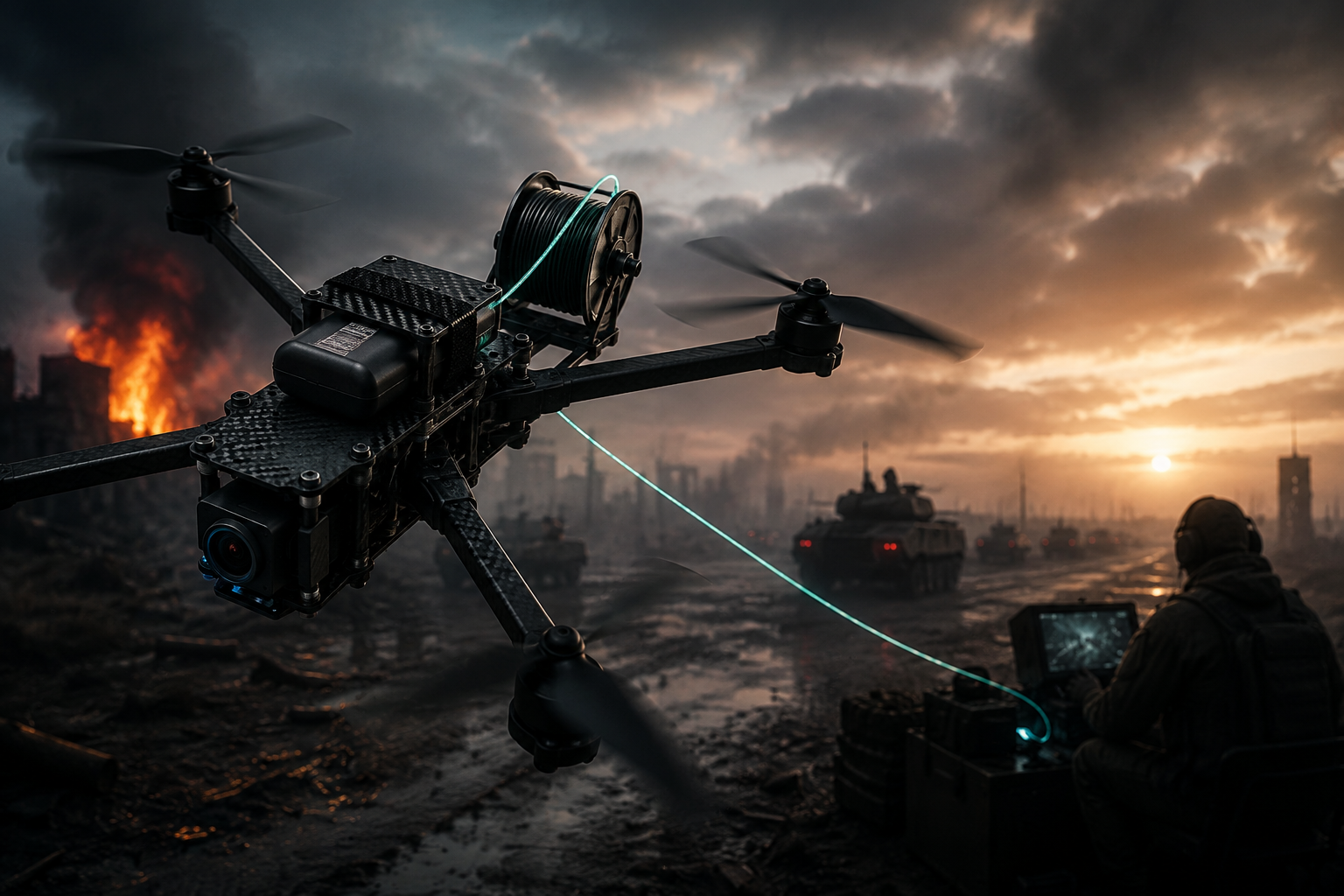
Putin's New 'Unjammable' Drones Could Change the Ukraine War Forever
Trump Wants Peace. Putin Appears Ready for a Major Escalation
Donald Trump’s latest attempt to negotiate an end to the Ukraine war appears to be colliding with Vladimir Putin’s determination to extract further gains on the battlefield. Despite Trump publicly arguing that a settlement is moving closer, people familiar with Kremlin thinking reportedly believe Putin is preparing to intensify military operations rather than accept an immediate ceasefire.
At the same time, Russia is expanding the deployment of small fibre-optic drones that are frequently described as “unjammable”. These weapons do not make Russia invincible, but they threaten to undermine one of Ukraine’s principal defensive tools and could make roads, supply routes, defensive positions and even areas close to major cities considerably more dangerous.
Why Putin May Escalate Instead of Negotiate
Putin’s immediate objective appears to remain the seizure of the Ukrainian-held parts of the Donbas. Russia already controls most of Luhansk and significant territory in Donetsk, but taking the remaining fortified Ukrainian positions would require more time, troops and ammunition.
This creates a direct conflict between Trump’s political timetable and Putin’s military calculations. Trump wants a visible diplomatic breakthrough that demonstrates American leverage and ends a costly European war. Putin appears to believe that Russia can still improve its negotiating position by continuing to attack.
Recent Ukrainian strikes against Russian oil infrastructure, military assets and shipping may have strengthened that calculation. Ukraine has increasingly used long-range drones to impose economic and military costs deep inside Russia, while Russian forces have responded with intensified missile and drone attacks against Ukrainian cities and infrastructure.
Putin may therefore see a ceasefire now as an unnecessary restriction. A pause could allow Ukraine to reinforce defensive lines, expand its drone industry, receive new Western systems and reorganise exhausted formations. Continuing the war, by contrast, gives Russia another opportunity to exploit its larger manpower pool and weapons production.
The problem for Moscow is that Russian progress remains costly and incremental. Escalation does not necessarily mean a dramatic armoured breakthrough. It is more likely to involve heavier aerial bombardment, greater use of drones, intensified pressure across several fronts and attempts to isolate Ukrainian positions by cutting their supply routes.
The New ‘Unjammable’ Drone Technology
The drones causing particular concern are small first-person-view attack aircraft controlled through extremely thin fibre-optic cables. Conventional FPV drones normally receive commands and transmit video through radio signals. Electronic-warfare systems can interfere with those signals, sever the operator’s control or disrupt the live video feed.
A fibre-optic drone carries a spool of cable that unwinds behind it during flight. Commands travel physically through that cable rather than through a radio link. This means normal radio-frequency jammers cannot break the connection between the operator and the aircraft.
Calling these drones completely “unjammable” is technically misleading. They are highly resistant to conventional electronic warfare, but they remain vulnerable to physical interception, small-arms fire, netting, obstacles, poor visibility and the limitations imposed by their cables. The fibre can snag on trees, buildings, wires or damaged infrastructure, while the added spool reduces the payload or endurance that the drone can carry.
Their tactical advantage is nevertheless substantial. Operators receive a stable video feed even in areas saturated with electronic interference. They can fly close to the ground, wait in concealed positions and attack vehicles or troops that believe they are protected by jamming equipment.
Russia first demonstrated the value of fibre-optic FPV drones on a significant scale around the Kursk front, where Ukrainian forces depended on narrow logistical corridors. The technology allowed Russian operators to target vehicles moving along those routes despite Ukrainian electronic countermeasures. Both Russia and Ukraine have since expanded their use of fibre-guided systems.
This is not a futuristic wonder weapon. It is dangerous precisely because it combines cheap components, precision control and mass production. A relatively inexpensive drone can destroy a vehicle worth hundreds of thousands or millions of pounds, immobilise an evacuation route or force troops to abandon a position.
How Much of an Escalation Is This?
The technology represents a serious tactical escalation, but not yet a decisive strategic breakthrough. Fibre-optic drones cannot conquer territory independently. Russia still requires infantry, artillery, engineering units, logistics and armoured vehicles to occupy and hold ground.
Their greater significance lies in how they reshape the space behind the front line. Areas once regarded as relatively protected from ordinary FPV drones may become exposed. Ambulances, supply trucks, artillery crews and command posts can be targeted even where powerful jammers are operating.
Russia can use these drones to create narrow zones of persistent surveillance and attack. Roads may need to be covered with anti-drone netting, movements restricted to darkness or bad weather, and supply vehicles dispersed rather than sent in predictable convoys. Ukraine has already been forced to consider protective netting on routes threatened by fibre-optic drones near Kharkiv.
The psychological effect also matters. Soldiers accustomed to listening for drones or relying on electronic-warning equipment may receive less notice before an attack. A fibre-optic drone does not produce the same radio emissions as a conventional remotely controlled aircraft, making electronic detection more difficult.
If Russia can manufacture them in very large numbers, the result could be a gradual tightening of pressure rather than one spectacular event. Ukrainian troops would face greater difficulty rotating units, evacuating casualties and maintaining defensive positions. That could help Russia advance even without achieving conventional air superiority.
The Geopolitical Implications
The emerging drone threat reinforces a broader lesson from Ukraine: expensive Western military platforms are increasingly being challenged by adaptable, mass-produced systems. NATO forces have traditionally invested heavily in sophisticated aircraft, missiles and electronic warfare. Russia’s fibre-optic drones demonstrate that a battlefield saturated with jamming does not necessarily stop cheap unmanned weapons; it instead encourages engineers to bypass the electromagnetic spectrum entirely.
European governments will now face pressure to accelerate layered counter-drone defences. These will need to combine electronic warfare with kinetic interception, automated detection, protective nets, mobile weapons and systems capable of identifying low-flying drones visually or acoustically.
The proliferation risk extends beyond Ukraine. Fibre-controlled drones could eventually be used by other states, proxy forces or armed groups. Unlike advanced missiles, many of the underlying components are commercially available. The battlefield knowledge required to assemble and operate them is also spreading rapidly.
For Trump, Putin’s apparent rejection of an early compromise presents a political test. Trump has repeatedly presented himself as uniquely capable of ending the conflict, and he said after recent discussions with Putin and Volodymyr Zelensky that a resolution was getting closer.
If Russia escalates immediately after those contacts, Trump risks appearing unable to influence Putin through personal diplomacy alone. That could push Washington towards a more coercive approach, particularly if the White House concludes that Moscow is using negotiations to delay further Western support for Ukraine.
The Most Likely Western Response
The first response is likely to be increased pressure rather than direct NATO intervention. Washington could strengthen sanctions on Russian energy exports, financial networks and companies supplying military components. It could also expand intelligence assistance and permit Ukraine greater freedom to strike Russian military and logistical targets.
Trump has already backed deeper air-defence cooperation, including arrangements connected to Ukrainian production of Patriot systems. The Kremlin has criticised the continued expansion of US military support while arguing that Ukrainian long-range strikes will force Russia to widen its claimed security buffer.
Ukraine will need more than traditional jammers to counter fibre-optic drones. Likely responses include interceptor drones, anti-drone netting, rapid-fire guns, shotguns for close defence, improved optical sensors and small mobile teams assigned specifically to protect roads and logistics.
Ukraine will also try to attack the supply chain. Fibre production, drone assembly facilities, launch positions and operator teams are all potential targets. Russia has reportedly become more dependent on imported optical fibre after disruption to domestic production, illustrating that even cheap systems can have vulnerable industrial bottlenecks.
The most dangerous possibility is a cycle in which diplomacy and battlefield escalation proceed simultaneously. Putin may intensify attacks to force better terms. Trump may respond by giving Ukraine more weapons and freedom of action. Ukraine may then increase strikes inside Russia, reinforcing the Kremlin’s argument that it requires more territory as a protective buffer.
That does not make a wider NATO-Russia war inevitable. Putin has repeatedly applied pressure while trying to remain below the threshold that would trigger direct alliance intervention. However, the combination of deep strikes, drone proliferation, contested borders and disappointed diplomacy increases the risk of miscalculation.
The central significance is therefore not that Russia has invented an unstoppable drone. It is that Putin may believe new battlefield tools, sustained manpower and continued Western hesitation give him more to gain from escalation than peace. Trump’s diplomatic effort will succeed only if Russia concludes that continuing the war will leave it weaker, not stronger. Until that calculation changes, the new peace push may become another phase of the conflict rather than its conclusion.
