China’s New Rocket Recovery Could Change the Space Race Forever
The Rocket Catch That Could Redefine Military Power in Space
The Chinese Rocket Test That Could Reshape Future Warfare
China has successfully recovered the booster of an orbital-class rocket on an offshore platform, crossing a technological threshold that only a small number of space powers have reached. The immediate achievement is commercial: recovering and eventually reusing rockets could make Chinese launches cheaper, faster and more frequent. The deeper strategic consequence is that China may gain the ability to replace satellites rapidly during a crisis, expand its surveillance networks and reduce one of the United States’ largest advantages in space.
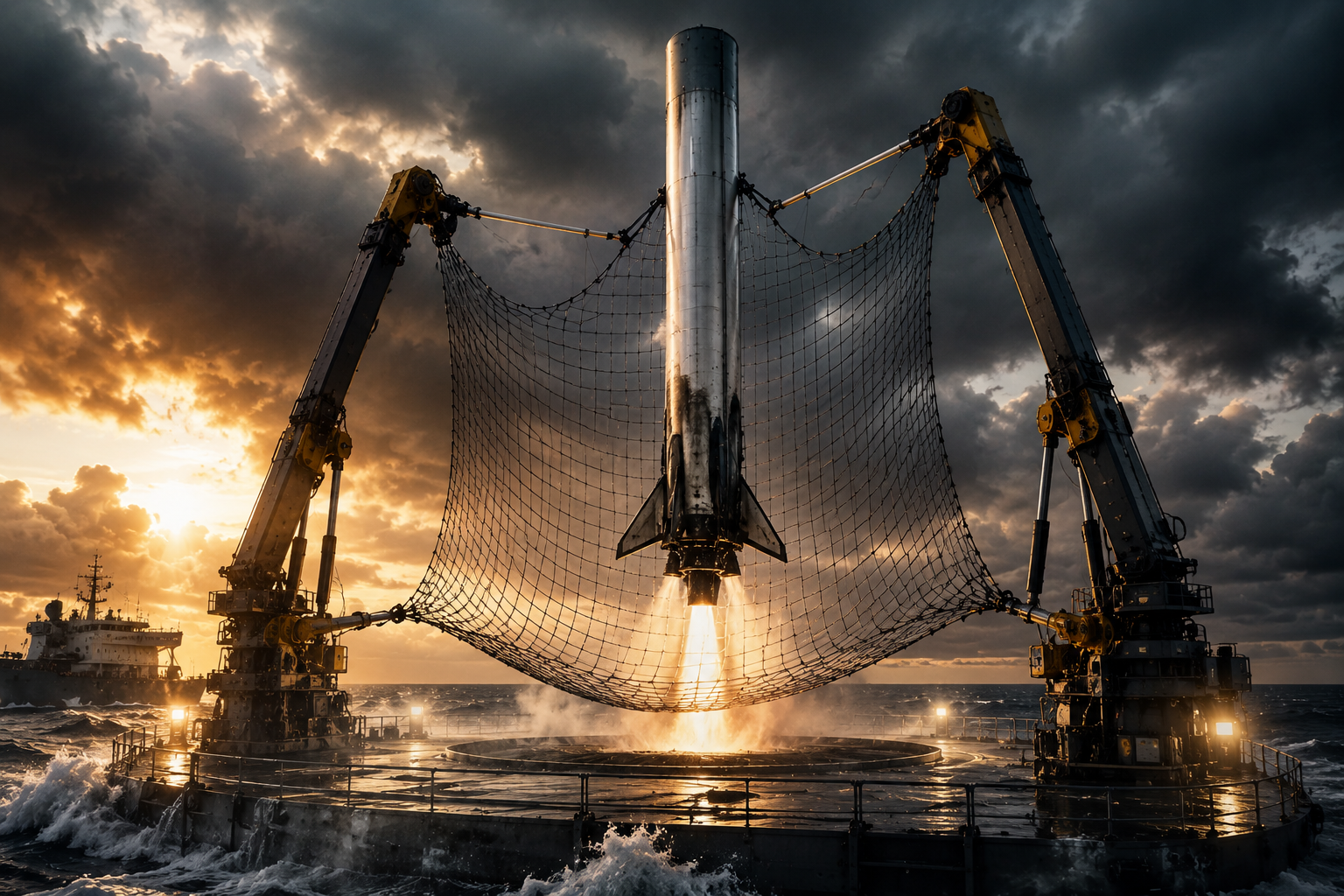
The Long March 10B lifted off from the Hainan commercial space launch site on 10 July 2026. Roughly six minutes after separating from the upper stage, its booster descended vertically and was captured by a net-and-hook mechanism mounted on a platform at sea. It was China’s first successful controlled recovery of an orbital-class booster rather than merely retrieving hardware after an ocean splashdown.
How Significant Is the Development?
This is a major engineering milestone, but it is not yet proof that China has created a fully operational rival to SpaceX. Recovering a booster is only the first stage of true reusability. Engineers must now inspect the vehicle, establish how much refurbishment it requires, demonstrate that its engines and structure can survive repeated flights, and launch the same booster again safely.
China reportedly intends to attempt another flight using the recovered stage before the end of 2026. That next step may be more important than the landing itself because the economic value comes from repeated reuse rather than recovery alone. A booster that can be recovered but requires months of rebuilding would offer far less advantage than one capable of returning to service quickly.
The test nevertheless represents a sharp improvement after Chinese recovery failures in December 2025. Both the state-backed Long March 12A and the privately developed Zhuque-3 reached orbit but failed to land their first stages successfully. The latest test suggests that China has absorbed data from those setbacks and is beginning to close the gap in guidance, engine throttling, aerodynamic control and precision landing.
The unusual net system may also remove the weight of conventional landing legs from the booster. Every kilogram saved on recovery equipment can potentially be used for fuel or payload, although dependence on a specialised platform creates its own operational risks. Rough seas, platform movement, weather and the narrow margin for capture could make the system harder to operate consistently than a landing-leg design.
Do Other Nations Have This Capability?
The United States remains far ahead. SpaceX’s Falcon 9 became the first orbital-class rocket capable of repeated flight and has turned booster recovery into a routine industrial process. Its first stages land either onshore or on autonomous ships using deployable legs, while the most expensive components can be inspected and flown again. NASA says this reduces launch costs by allowing the most valuable parts of the rocket to be reused.
Blue Origin has also recovered an orbital-class New Glenn booster, while its smaller New Shepard system has conducted repeated vertical landings on suborbital missions. New Glenn’s first stage is designed for at least 25 flights, although the programme has not yet approached Falcon 9’s launch frequency or operational record.
Rocket Lab, based in the United States and New Zealand, has pursued recovery of its smaller Electron rocket and is developing the larger reusable Neutron system. Europe is working on reusable demonstrators, and India, Japan and Russia have examined or developed related concepts, but none currently operates a Falcon 9-style reusable orbital fleet at comparable scale.
China therefore has not taken the lead. It has moved from being an ambitious follower with several competing programmes to becoming a credible future competitor. Its advantage is the combination of state funding, commercial investment, a large domestic satellite programme and the ability to sustain long-term industrial planning.
What Damage Could the Technology Cause?
The rocket itself is not a weapon, and the recovery test caused no reported military damage. The danger lies in what cheaper and more responsive launches could place into orbit.
Modern military forces depend on satellites for navigation, missile warning, encrypted communications, reconnaissance, targeting and weather monitoring. A reusable launch system could allow China to deploy more imaging satellites, replenish damaged constellations, replace satellites destroyed during conflict and launch new capabilities with less warning. The US Space Force already describes reusable launch vehicles as important to China’s plans for proliferated low-Earth-orbit satellite networks.
More frequent launches could strengthen the People’s Liberation Army’s ability to track aircraft carriers, map troop movements and maintain communications across the western Pacific. China’s growing space-based surveillance architecture could improve the accuracy of long-range missiles by helping locate targets and update targeting data.
The most serious scenario would be a conflict in which both sides attacked or disrupted space systems. China has developed anti-satellite missiles, electronic warfare systems, cyber capabilities and spacecraft capable of close manoeuvres around other satellites. American assessments indicate that Beijing views counterspace operations as a method of deterring or limiting US intervention in a regional conflict.
Reusable rockets would not make those weapons inherently more destructive. They could, however, make China’s space architecture harder to suppress. Destroying or disabling several satellites becomes less decisive if Beijing can replace them rapidly.
There is also an escalation risk. A sudden rocket launch during a Taiwan crisis could be carrying communications satellites, reconnaissance equipment or peaceful commercial payloads. An adversary might not immediately know which. That uncertainty could produce pressure for pre-emptive action, particularly if space launches were occurring alongside missile deployments and naval mobilisation.
Is This Preparation for an Attack on Taiwan?
There is no public evidence that this specific test was conducted as direct preparation for an invasion of Taiwan. The Long March 10B programme has clear civilian and commercial purposes, including satellite launches, lower-cost access to orbit and support for China’s planned crewed lunar missions before 2030.
It would therefore be misleading to describe the recovery as a disguised Taiwan weapon test. A reusable space launcher and a ballistic missile may share technologies such as propulsion, guidance and high-stress materials, but their missions, flight profiles and operational requirements are different.
The Taiwan implications are indirect but important. Any large operation against the island would depend on continuous surveillance, secure communications, navigation and targeting. China would also expect the United States and its allies to interfere with those systems. A higher launch cadence would give Beijing greater resilience before, during and after a confrontation.
American defence officials have separately warned that Chinese military activity around Taiwan has increasingly resembled rehearsal rather than ordinary training. That broader pattern makes every improvement in Chinese intelligence, communications and launch resilience strategically relevant, even where no direct connection to an invasion plan has been demonstrated.
The fairest judgement is that the test supports China’s general ability to prepare for a Taiwan contingency, but does not prove that Beijing has taken a decision to attack.
Trump’s Likely Response
President Donald Trump is unlikely to answer one Chinese rocket recovery with an immediate military action or a major public threat. Washington already possesses the superior reusable launch ecosystem, led by SpaceX, and may present the Chinese achievement as evidence that the United States must move faster rather than as a sudden strategic defeat.
The most likely response is accelerated competition. Trump’s December 2025 space order declared American space superiority a national economic and security objective, called for stronger protection against threats to US space interests and set targets for returning Americans to the Moon by 2028. His administration has also moved to speed commercial launch and re-entry approvals by reducing regulatory barriers.
China’s test strengthens the case for further support for SpaceX, Blue Origin and defence launch providers. The administration could seek more responsive military launch contracts, larger satellite constellations, additional launch facilities and faster licensing. It may also tighten restrictions on aerospace components, advanced machine tools, semiconductors and technical cooperation that could assist Chinese launch development.
Trump could frame the event in transactional terms: China is attempting to erode an American industrial advantage, so the United States must remove domestic obstacles and force allies to contribute more to collective space security. Direct sanctions are possible if Washington identifies military-linked companies or technology transfers, but the test alone is unlikely to trigger a dramatic new sanctions package.
The Wider Geopolitical Implications
The first consequence is greater pressure on the US commercial space sector. SpaceX remains dominant, but China is building several reusable rockets simultaneously through state-owned and private companies. Even if some programmes fail, the parallel approach increases the chance that at least one becomes commercially reliable.
The second consequence is competition over satellite internet. Lower launch costs could help China deploy large constellations capable of competing with Starlink in parts of Asia, Africa, Latin America and the Middle East. Those networks would provide commercial connectivity but could also give Beijing greater influence over communications infrastructure, technical standards and access to data.
The third consequence is a more dangerous military space environment. The United States, China and their partners will increasingly build constellations designed to survive attack, while developing systems capable of disabling the other side’s satellites. Reusability makes orbital replacement easier, but it may also encourage both sides to assume that space losses can be absorbed during war.
The fourth consequence concerns the Moon. China’s reusable launch work forms part of a wider programme that includes a planned crewed lunar landing before 2030. Washington has made its own return to the Moon a geopolitical priority. The competition is no longer only symbolic: lunar communications, navigation, resource access and operating standards could shape power beyond Earth for decades.
China has not overtaken the United States with one successful recovery. It has demonstrated that a capability once treated as a unique American advantage is becoming reproducible. The real test will come when the recovered booster flies again, when refurbishment times are disclosed and when China begins conducting launches at sustained frequency.
The strategic danger is not that the offshore platform can directly attack Taiwan. It is that a mature reusable launch system could give Beijing more satellites, faster replacement capacity and a stronger position in any confrontation where control of information becomes as important as control of the sea. That makes the test a genuine development in the balance of power, even though its full military value remains several successful reflights away.
