

Romania’s Nuclear Lifeline Now Depends on Explosives and Sunken Barges
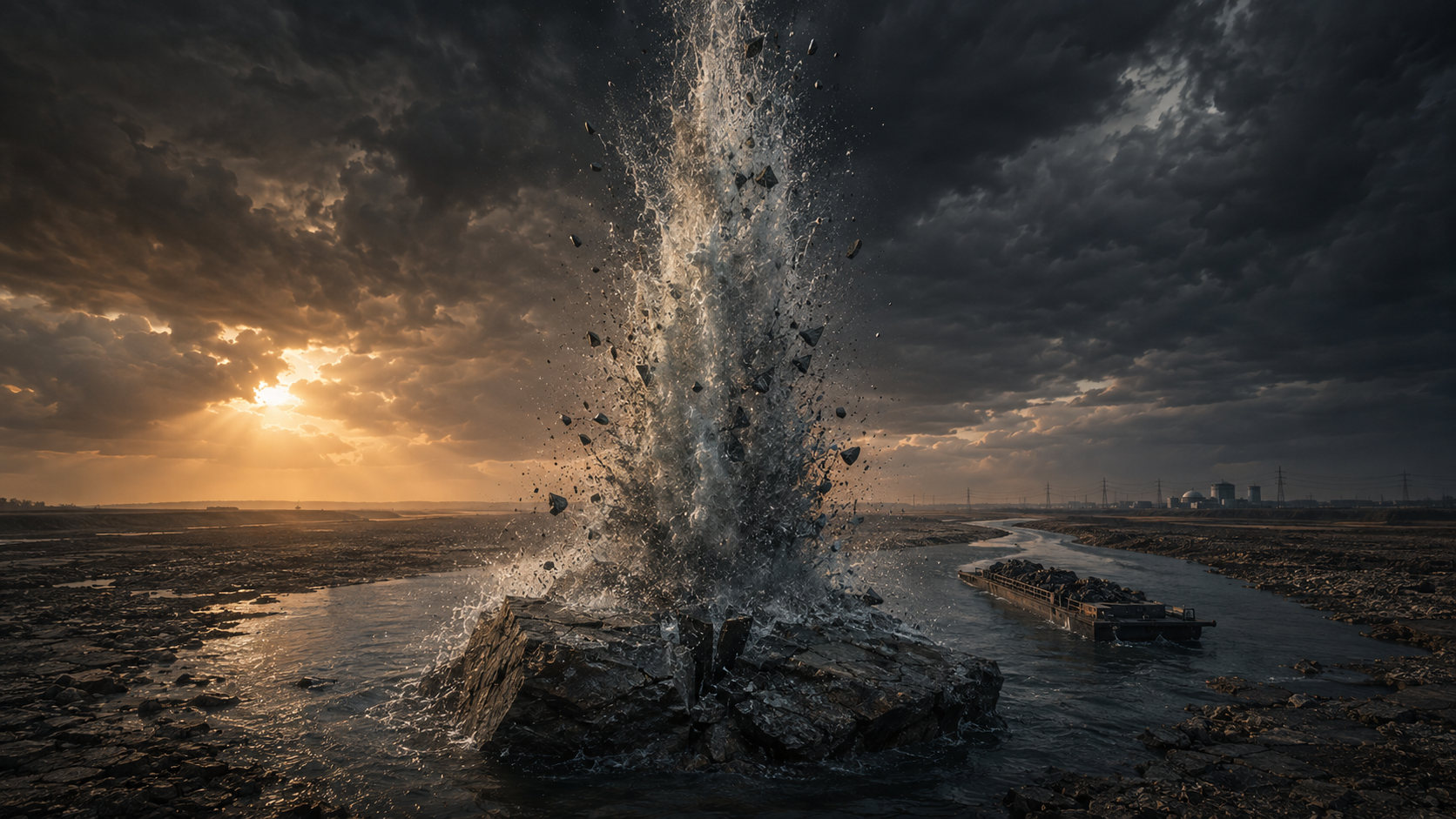
Romania Blew Up the Danube Because Its Energy System Is Running Out of Water
Romania Is Blasting the Danube Apart to Keep Nuclear Power Flowing
Romania has detonated 180 kilograms of explosives beneath the Danube in a desperate attempt to keep its remaining nuclear reactor operating. The controlled blast removed the Pârjoaia rock formation near the Bala branch, clearing the way for emergency engineering works designed to force more water towards the Cernavodă nuclear power station.
This was not a nuclear accident. One reactor has already been shut down safely and preventively because the river can no longer provide dependable cooling-water conditions, while the second is operating close to its permitted limits. The real emergency is that one of Romania’s most important sources of electricity has become dependent on explosives, dredgers and barges deliberately sunk into Europe’s second-longest river.
Why Romania Is Blasting the Danube
The operation is more precise than the extraordinary images suggest. Romania is not attempting to destroy or permanently reroute the entire Danube; military engineers have dislodged a rock formation so that crews can complete a temporary structure near the entrance to the Bala branch.
The river divides around this point. The Bala branch pulls water away from the Old Danube, while Cernavodă receives its cooling supply from the Old Danube through the first section of the Danube–Black Sea Canal. During normal conditions there is enough water for both channels, but severe drought has turned that division into an energy-security problem.
Interim defence minister Radu Miruță said the Bala branch was taking roughly 85 per cent of the available flow at the bifurcation, leaving around 15 per cent heading towards Cernavodă. Authorities therefore want to restrict part of the flow entering Bala and push a greater share back towards the Old Danube.
The blast cleared the Pârjoaia formation, but it is only one part of the intervention. Barges carrying approximately 500 tonnes of stone are being sunk at carefully measured positions to form a temporary obstruction, while dredging crews deepen sections of the Old Danube and the route towards Cernavodă.
Officials expect the immediate works to be completed by Wednesday. Whether they provide enough additional water to protect the remaining reactor for days, weeks or longer will depend on the Danube’s continuing decline and how effectively the temporary structures redistribute its flow.
The River Is Approaching Its Limit
The Danube’s flow into Romania has fallen to around 1,500 cubic metres per second, less than one-third of its normal July average of approximately 4,700 cubic metres. Officials have warned that the water level near Cernavodă has been falling by two to three centimetres each day.
That decline has already forced Nuclearelectrica to shut down Cernavodă Unit 1. Unit 2, the country’s last operating reactor, has remained connected to the grid, but authorities warned before the intervention that it could have reached its operating limit within days.
Cernavodă’s two CANDU reactors normally provide roughly one-fifth of Romania’s electricity. Losing one immediately removes around 700 megawatts of dependable generation; losing both would turn an already difficult summer supply problem into a deeper national emergency.
Romania has declared a nationwide energy state of alert for August. The country is relying more heavily on imported electricity at the same moment that heat is raising demand for air conditioning and drought is also weakening hydropower production across the region.
Dacia and Ford have temporarily stopped production at Romanian plants until 19 August, removing around 200 megawatts of industrial demand. That may ease pressure on the grid, but it also reveals the economic cost of the crisis: Romania is effectively exchanging factory output for electricity security.
This Crisis Was Decades in the Making
The most damaging part of the story is that the underlying problem was already known. Technical studies have warned for years that the Bala branch was capturing an increasing share of the Danube’s flow while the Old Danube became shallower and more vulnerable to sediment accumulation.
The problem is especially severe during drought. When the river falls, water is drawn more aggressively into the deeper Bala route, while the channel supplying Cernavodă loses both flow and depth. Navigation, irrigation, drinking-water users and the nuclear plant are then forced to compete for a shrinking resource.
Romanian engineers had proposed permanent works to rebalance the two branches, including riverbed structures, dredging and measures to preserve navigation. Miruță has now claimed that a project capable of reducing the present danger had been stalled inside the transport system for approximately three and a half years.
That allegation requires documentary scrutiny, but the physical weakness is not new. A technical paper published in 2009 explicitly warned that the changing distribution of the Danube created problems for navigation and the water supply to Cernavodă. Emergency explosives are now being used against a vulnerability identified long before the current drought.
This is the deeper scandal. Romania is not improvising because nobody could have imagined a low Danube. It is improvising because a foreseeable hydrological risk became an active energy crisis before the permanent solution was delivered.
Why the Nuclear Plant Needs So Much Water
A nuclear reactor does not generate electricity by sending radioactive material directly into the grid. Fission creates heat, that heat produces steam, and the steam drives turbines. Large volumes of water are then required to remove excess heat and condense the steam so it can circulate through the system again.
Low river levels do not automatically create a nuclear emergency. Plants operate within strict limits and can be reduced or shut down before inadequate water conditions threaten equipment. That is what happened to Unit 1, which was placed in a safe condition without any reported impact on workers, the public or the environment.
The cost is lost electricity. Nuclear power is valuable partly because it can provide large volumes of stable generation regardless of whether the wind blows or the sun shines. Yet a river-cooled reactor still depends on the physical environment around it.
That contradiction matters as governments place nuclear energy back at the centre of national strategy. Reactors can strengthen energy independence and reduce reliance on fossil fuels, but that promise weakens if cooling systems, water intakes and surrounding river infrastructure are not designed for a hotter and less predictable climate.
The Environmental Trade-Off
Forcing more water towards Cernavodă may protect nuclear generation, navigation and other downstream users, but changing the distribution of a major river carries its own risks. The Bala area supports aquatic habitats and migration routes, including those used by threatened sturgeon species.
Earlier engineering assessments treated fish migration, habitats and the surrounding Natura 2000 areas as essential constraints on any permanent solution. They also warned against completely cutting off the Bala branch because that could damage downstream floodplains and alter sediment movement.
There is no confirmed evidence that the controlled blast itself has caused significant ecological damage. However, the urgency of the intervention cannot be allowed to erase the difference between a temporary crisis measure and a properly assessed long-term redesign of the river.
Dredging must also be controlled. Romanian water authorities have said operations near Cernavodă should stop if they produce excessive turbidity around the plant’s intake, because disturbed sediment could create another problem for the pumps the work is intended to protect.
Europe’s Climate Paradox
The Danube crisis exposes a wider weakness across Europe. Drought does not only reduce hydropower. It can simultaneously restrict nuclear and conventional thermal generation, disrupt shipping, damage agriculture and increase demand for electricity as households turn up air conditioning.
The European Commission estimates that cooling for electricity generation accounts for nearly one-third of annual freshwater withdrawals within the European Union. Previous droughts have already reduced hydroelectric, thermoelectric and nuclear output across the bloc.
Romania is experiencing several of those shocks at once. Its hydropower system is weakened, one nuclear reactor is offline, industrial production is being curtailed and more electricity must be imported from neighbouring markets facing their own heat and water pressures.
The crisis also challenges the idea that energy resilience can be achieved simply by building more generating capacity. A reactor is only as dependable as its cooling-water access. A hydroelectric dam is only as useful as the water reaching it. An interconnector is only as valuable as the electricity available on the other side.
The same principle applies to Europe’s increasingly interconnected power grid. Connections can spread resilience, but simultaneous regional shortages can also spread higher prices and leave several countries competing for the same emergency imports.
What Happens Next
The first test will come when the temporary barrier and dredging work are completed. Engineers will measure whether enough water has been redirected towards the Old Danube and whether the decline at Cernavodă has slowed sufficiently to keep Unit 2 operating.
Officials will then have to decide when conditions permit Unit 1 to reconnect safely. Rainfall could provide relief, but a short recovery would not solve the underlying problem if the river remains vulnerable during future droughts.
The government must also explain why the permanent Bala project was delayed and whether Romania’s planned expansion of Cernavodă has been designed around more severe water shortages. Adding Units 3 and 4 without first securing the site’s long-term cooling-water resilience would multiply the strategic importance of the same exposed river system.
Romania’s military may have bought the country valuable time. It has not removed the warning. When a modern European state must blast rock, sink barges and stop factories to preserve nuclear generation, the emergency is no longer just the drought—it is the infrastructure that was never ready for it.
