Russia Downs 170 Ukrainian Drones in Four-Hour Blitz Toward Moscow
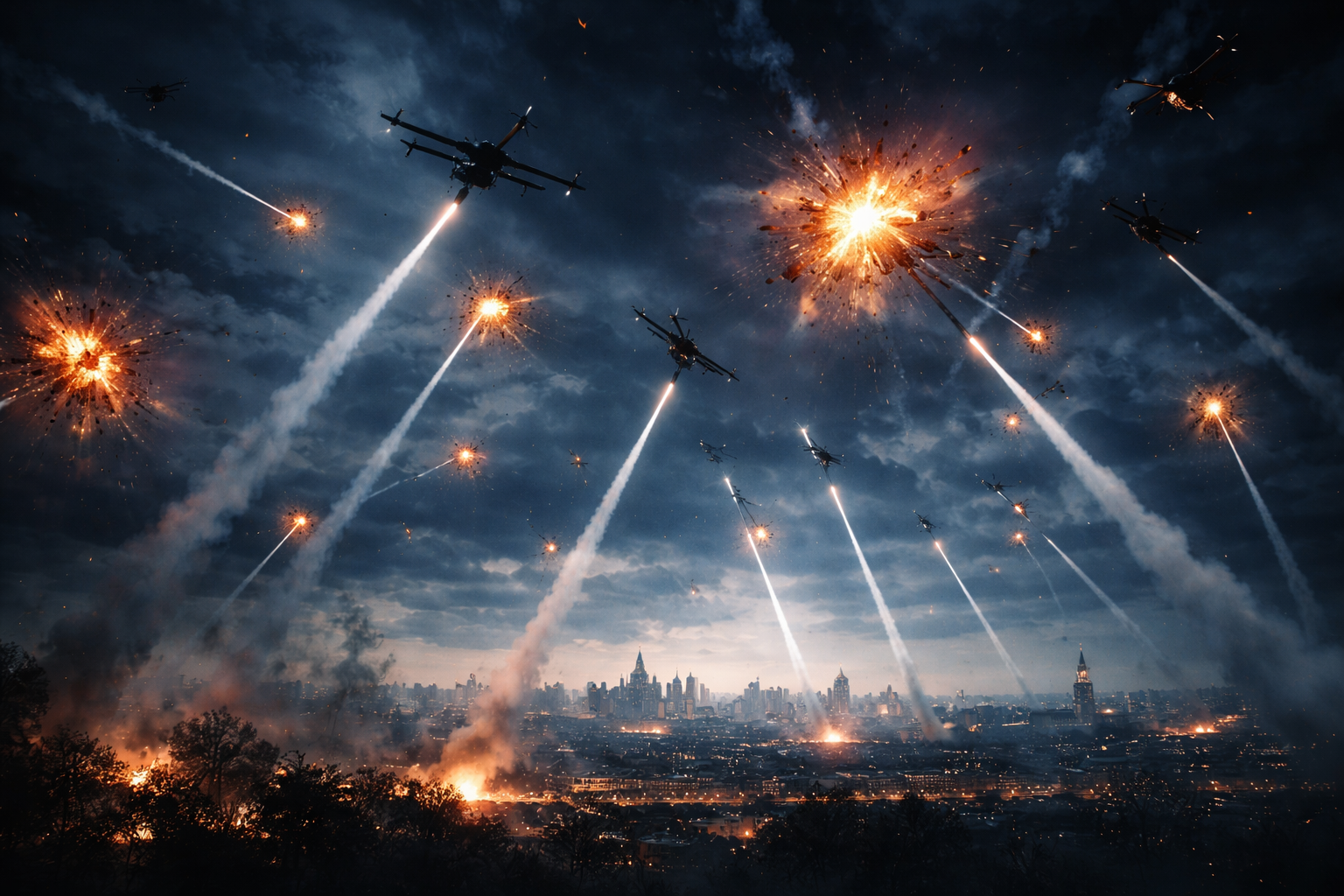
Ukraine Launches Huge Drone Wave Toward Russia, Moscow Targeted
Ukraine Launches Huge Drone Wave Toward Russia, Moscow Targeted
Russia says its air defense systems intercepted 170 Ukrainian drones in just four hours, including aircraft heading toward Moscow, in what Moscow describes as one of the largest concentrated drone assaults on its territory recently.
The barrage reportedly occurred between 2 p.m. and 6 p.m. Moscow time on March 8, 2026, with drones targeting multiple regions across central and southern Russia.
Russian authorities say two drones were shot down while approaching the capital, while the highest number—73 drones—were intercepted over Bryansk, a border region adjacent to Ukraine.
No casualties or major damage have been reported so far.
But the scale and tempo of the attack underline a deeper shift in the war: the front lines are no longer the only battlefield.
The story turns on whether Ukraine can sustain increasingly large drone swarms deep inside Russian territory—and whether Russia’s defenses can keep pace.
Key Points
The Russian defense ministry reports that they intercepted 170 Ukrainian drones in four hours across several regions.
Reports indicate that two drones were on their way to Moscow before authorities shot them down.
The Bryansk region saw the largest concentration, with 73 drones intercepted near the Ukrainian border.
So far, Moscow authorities have not confirmed any damage or casualties.
The attack follows heavy Russian strikes on Ukrainian cities, including missile and drone attacks that killed civilians in Kharkiv the previous day.
Drone warfare has become one of the defining features of the Russia-Ukraine conflict, expanding the battlefield hundreds of kilometers beyond the front line.
A War Increasingly Fought by Drones
Since Russia’s full-scale invasion in 2022, both sides have steadily expanded their use of unmanned aerial vehicles (UAVs), which are aircraft that operate without a human pilot on board.
In the early stages of the war, both sides primarily utilized drones for reconnaissance and battlefield strikes. But over the past two years, they have evolved into tools for deep-strike campaigns targeting infrastructure, logistics hubs, and cities far from the front line.
Ukraine has developed a growing domestic drone industry, producing long-range systems capable of traveling hundreds of kilometers into Russian territory. The strategy serves several goals:
disrupt military supply chains
pressure Russian air defenses
force Moscow to defend vast areas of territory
Russia has pursued a similar strategy in reverse, launching waves of drones and missiles against Ukrainian cities and infrastructure. The latest Russian strikes on Kharkiv, for example, killed civilians and damaged residential buildings and energy systems.
The result is a conflict where airspace saturation—not territorial advances—increasingly defines the tempo of the war.
Why Moscow Matters Symbolically
Drone attacks toward Moscow carry strategic and psychological weight.
The Russian capital lies hundreds of kilometers from the Ukrainian border, and strikes near the city demonstrate that Ukraine can reach the political heart of Russia.
This is not the first time drones have targeted the capital. In November 2024, Ukraine launched what was then its largest drone attack on Moscow, forcing airport closures and air defense responses across the region.
Each new attack tests Russia’s defensive perimeter and challenges the Kremlin’s claim that the war is geographically distant from everyday Russian life.
Even when intercepted, these drones serve a political purpose: they remind Russian citizens that the conflict has extended beyond Ukraine.
How the Drone Swarm Strategy Works
Large drone attacks rarely rely on a single breakthrough weapon.
Instead, they use sheer volume and dispersion.
A typical swarm strategy involves launching dozens or even hundreds of relatively inexpensive drones, which are unmanned aerial vehicles, toward multiple targets simultaneously. The objectives are simple:
Overwhelm radar coverage
Force air defenses to expend missiles
Create openings for a small number of drones to penetrate defenses
Even if most drones are intercepted, the attack can still achieve strategic goals by forcing the defender to spend costly interceptors or redeploy systems away from other areas.
In the Russia-Ukraine war, this cost imbalance is becoming increasingly important. A drone can cost tens of thousands of dollars, while the missile used to shoot it down may cost hundreds of thousands or more.
Over time, that math can become strategically decisive.
What Most Coverage Misses
The key story is not the number 170.
It is the rate.
Launching 170 drones within a four-hour window suggests a level of production scale, logistics coordination, and launch capacity that did not exist earlier in the war.
The real escalation is industrial.
Ukraine has quietly built an expanding domestic drone ecosystem involving private manufacturers, defense startups, and military units designing their own systems. That production base allows Kyiv to experiment rapidly and scale attacks when needed.
This means the future of the conflict may hinge less on artillery or tanks and more on which side can manufacture and deploy autonomous systems faster.
The war is gradually becoming a test of industrial robotics at a national scale.
Who Gains—and Who Feels the Pressure
Large drone attacks create ripple effects far beyond the battlefield, impacting logistics, civilian infrastructure, and international relations.
For Russia:
Air defense systems must be spread across a huge geographic area
Major cities and infrastructure require constant monitoring
Military resources are diverted from front-line operations
For Ukraine:
Drone attacks allow strategic pressure without risking pilots
They demonstrate continued reach despite Russian territorial gains
They show Western partners that Ukraine retains offensive capability
But the tactic also carries risks.
If a major drone strike were to hit a dense urban area or critical infrastructure inside Russia, it could trigger retaliatory escalation, including heavier missile campaigns against Ukrainian cities.
The escalation ladder remains unpredictable.
The Next Phase of the Drone War
Technological adaptation increasingly defines the Russia-Ukraine conflict.
Every few months, both sides introduce new tactics:
interceptor drones
electronic-warfare jamming
autonomous targeting systems
longer-range strike drones
The next major turning point may involve fully autonomous swarms, where hundreds of drones coordinate attacks without human control.
This would fundamentally alter the dynamics of warfare.
For now, the key signals to watch include
whether Ukraine continues to launch large-scale drone swarms into Russia
whether Russian air defenses begin missing more targets
whether attacks increasingly reach Moscow or deeper strategic sites
If those trends accelerate, the war may enter a new phase—one where the decisive battles are fought not by armies advancing on maps, but by machines crossing borders in the sky.
