Nine Reported Wounded as Russia Claims Its Highest Overnight Drone Tally
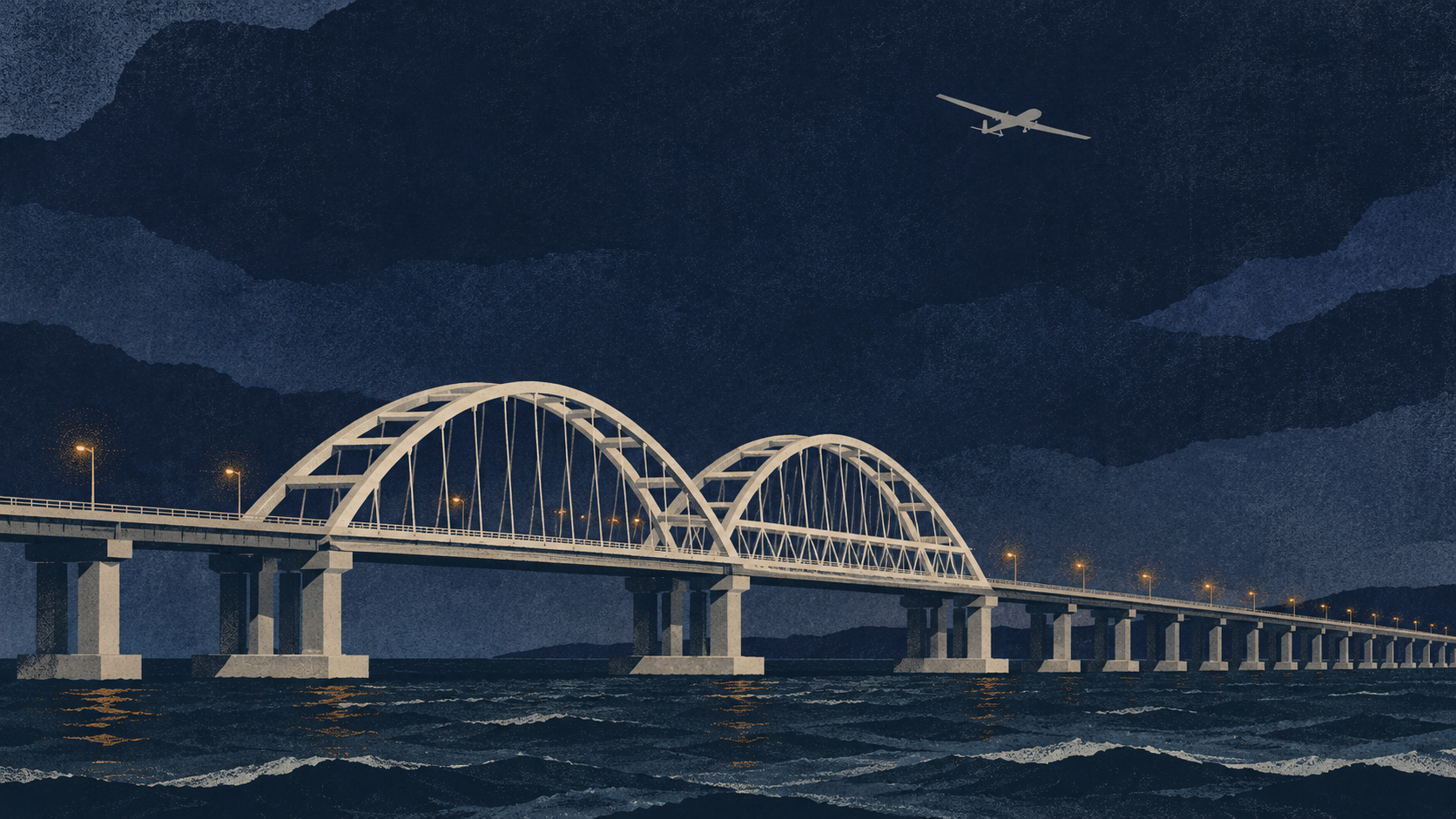
Cars Had To Wait At The Crimean Bridge While Trains Kept Running.
By Monday evening, 16 November, drivers could again cross the Kerch Strait between Russia and occupied Crimea. Road traffic had stopped for repairs after an overnight strike. Russia’s transport ministry said trains continued to run normally. For people trying to reach the peninsula, those two details said more about the damage than the figure dominating the day’s news.
Russia’s defence ministry said its forces had downed 1,336 Ukrainian drones overnight, the highest tally it has reported since the full-scale invasion began in 2022. On the ground, officials reported industrial fires in southern Russia and at least nine people wounded across two regions, including children. Ukraine’s military named an oil refinery and two fuel depots it said it had struck. How much fuel was lost, and whether the refinery had to cut production, remained open questions.
What Happened to the Crimean Bridge?
Sergei Aksyonov, the Russian-installed head of occupied Crimea, acknowledged that Ukraine had struck the bridge. His administration set up an emergency headquarters in Kerch and directed travellers to information about ferries. Aksyonov initially expected road restrictions to last until around midday. The announcement that vehicles were moving again came on Monday evening.
The crossing carries both road and rail traffic between Russia’s Krasnodar region and the Ukrainian peninsula that Russia seized in 2014. Civilians use it to travel, and Russia uses it to move supplies. A prolonged interruption to both services would therefore have had consequences well beyond a queue of stranded motorists. On Monday, the distinction between the two crossings mattered. Anyone describing Crimea as having been cut off would have to account for the trains that continued crossing the strait.
Kremlin spokesman Dmitry Peskov described the physical damage as minor. Photographs circulated online purporting to show damage to an arch, but the extent of any deformation could not be independently verified. Reopening the road establishes something specific: the authorities judged that vehicles could cross again. It tells readers less about the repair bill or whether further engineering work will be necessary.
Where Were People Hurt?
In the southern Krasnodar region, local officials said falling drone debris injured six people, including children. They also reported a fire at an industrial facility in Ilsky. In the city of Azov, in the neighbouring Rostov region, Governor Yuri Slyusar said three people were wounded and fires broke out at four industrial sites. Emergency crews attended the fires.
Those accounts help explain how a night of claimed interceptions could still leave people injured. Bringing down a drone does not make the falling wreckage harmless. In Krasnodar, officials specifically attributed the injuries to debris. The public account from Azov gave fewer details about how its three casualties were hurt.
The two regional reports together account for at least nine wounded. They give a clearer picture of the human cost in those places than can be inferred from the national tally, which covers a much larger area.
What Is Known About the Refinery and Oil Depots?
Ukraine’s military said it hit the Ilsky oil refinery in Krasnodar and two oil depots in Azov. There is some overlap with the Russian accounts. Officials on both sides described incidents in the same places, and Russian authorities acknowledged industrial fires in each. Their descriptions differed in one important respect. Local officials identified the burning site in Ilsky only as an industrial facility. Ukraine identified it as the refinery.
There is a similar gap in Azov. Four industrial sites on fire and two oil depots reportedly hit are counts of different things. Without a site-by-site account, it would be misleading to add them together and report six damaged facilities. Equally, the fire reports alone cannot establish that both depots sustained the damage Ukraine claimed.
For anyone trying to judge the effect on fuel supplies, a refinery and a depot also pose different questions. A depot stores fuel that has already been produced. The consequential details there are how much stock was lost and when deliveries can resume. A refinery turns crude oil into products such as petrol and diesel. Its economic losses can continue after a fire is out if equipment has to be repaired before processing restarts.
No verified figure for lost output at Ilsky emerged in the accounts of Monday’s attack. An earlier round of strikes illustrates the kind of evidence that would change that assessment. In September, figures for diesel production at individual Russian plants showed which refineries had stopped and which were still operating at reduced rates. That is a more informative measure of disruption than the number of buildings where flames were seen.
What Does Russia’s Figure of 1,336 Actually Count?
The figure comes from the Russian defence ministry’s account of drones its forces brought down during the night of 15–16 November. It covers 16 regions, with interceptions also reported over occupied Crimea and the waters of the Black Sea and Sea of Azov. The ministry’s previous reported high was 1,254 on 29 October. On Russia’s figures, the new count exceeded it by 82.
An interception rate requires a second number: the total launched. The ministry’s tally by itself cannot supply that denominator. It therefore cannot tell readers what proportion got through, how many reached their intended destinations or how many failed for other reasons.
Moscow Mayor Sergei Sobyanin gave a separate account of the capital region. He said roughly 600 drones had headed in its direction, most were brought down farther away, and 191 were shot down on the approaches to Moscow. Subtracting 191 from 600 would produce a number, but it would be the wrong way to estimate how many hit the city. Sobyanin’s wider figure included aircraft he said had already been intercepted at a distance. Nor should either Moscow figure be added to the national total as though it described an additional attack.
Why the Timing of Ukraine’s Oil Claim Matters
On Sunday night, President Volodymyr Zelenskyy said Ukrainian strikes had disabled more than 55 per cent of Russia’s refining capacity. That was his assessment of a campaign extending over time. It was already public before Monday’s damage reports emerged, and the percentage had not been independently verified. Attributing that much lost capacity to the overnight attack would give readers the wrong time period as well as an unwarranted degree of certainty.
There is a practical way to judge what happened next. At the bridge, a public milestone has already arrived: vehicles started crossing again. At Ilsky, the equivalent would be evidence of how much crude the plant processed after the fire, whether deliveries continued and how long any interruption lasted. Until those details emerge, the night’s clearest consequences are the ones people experienced directly: a road journey interrupted, emergency crews called to industrial fires, and at least nine people wounded.
Sources
Reuters — Ukraine launches biggest drone attack on Russia since war began, defence ministry data shows — Russia’s national tally, the October comparison, rail services and regional reports of fires and injuries.
Associated Press — Russia says its defenses intercepted over 1,300 Ukrainian drones in a major attack — The reopening to road traffic, casualties in Azov and Krasnodar, Ukraine’s account of the oil facilities struck and Zelenskyy’s earlier estimate.
Hromadske — Russian-installed Crimean official reports strike on Kerch Bridge, traffic restricted — Aksyonov’s initial timetable, the emergency arrangements in Kerch and the limits of the photographic evidence.
Next Reads
Half Of Russia’s Biggest Diesel Refineries Cut Output After Drone Strikes — How production figures revealed the impact of earlier strikes on three individual refineries.
Ukraine Launches 650-Drone Assault Towards Moscow In One Of War’s Biggest Attacks On Russian Capital Region — An earlier Moscow-region attack shows how the mayor distinguishes drones heading towards the capital from those intercepted nearby.
Drone Strike Hits the Industrial Heart of Russia’s Petrochemical Empire — What became possible to establish when a Siberian plant actually stopped operating.
