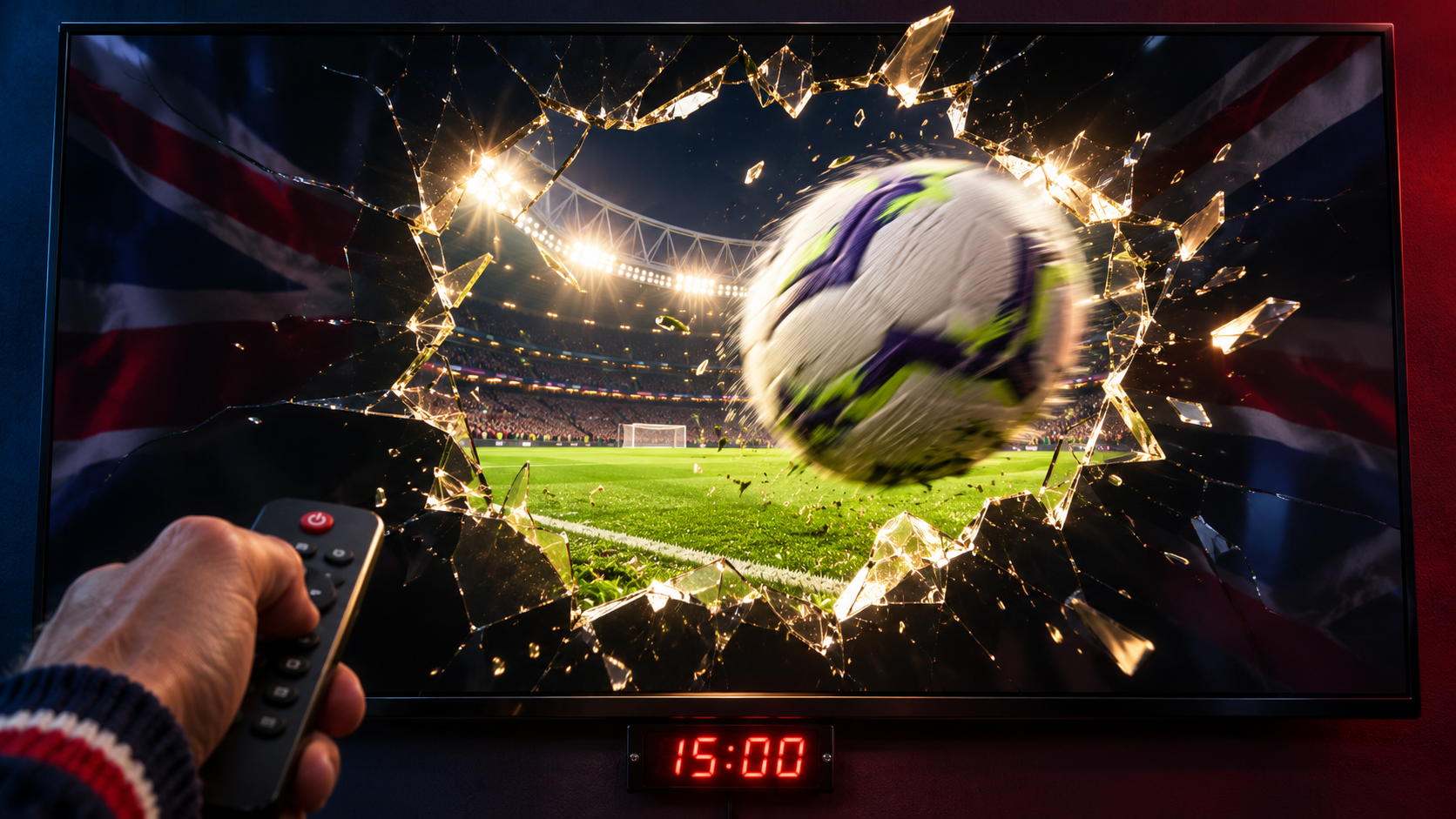
Why a Sold-Out Premier League Game Still Can’t Be Shown Live at 3pm
An Everton Fan In Singapore Could Watch A Match A Fan In Liverpool Could Only Hear.
On Saturday 22 August 2026, Everton played Crystal Palace at three o’clock. A supporter in Liverpool could have paid for both Sky Sports and TNT Sports and still had no way to watch the match live at home. In Singapore, it was ten in the evening, and subscribers could choose Everton, Ipswich against Sunderland, or Nottingham Forest against Leeds. All three were live on the Premier League’s own streaming service.
The reason is the Saturday 3pm blackout. On designated Saturdays, UK broadcasters cannot show live Premier League football between 2.45pm and 5.15pm. The Football Association adopts the protected period to encourage people to attend matches, including games further down the football pyramid. The league sells overseas viewing rights separately, so a broadcaster abroad can show the same match to its own audience.
The ground that explains the rule might be several miles from the one on television. Even if every seat at Everton is taken, there could still be room at a local club playing at the same time.
Who Decided That Football Should Go Dark At Three?
The blackout grew out of a concern dating back to the 1960s. Saturday afternoon was when much of British football played. Put a leading club on television at that hour and a supporter who might otherwise pay at a local turnstile had another way to spend the afternoon.
Today, Article 48 of UEFA’s statutes provides the framework. Its regulations allow a national football association to designate a two-and-a-half-hour period on a Saturday or Sunday that corresponds to its main domestic fixture programme. The English FA chooses to use that power. In September 2026, the UK government told Parliament it supported the arrangement and regarded the decision as one for the FA.
That distinction matters when a game disappears from the listings. Sky and TNT cannot make an exception because a title race is close, a ground is sold out or particularly bad weather makes travel difficult. Their domestic broadcast packages were sold around the closed period. Switching from a television to the broadcaster’s app makes no difference.
The rule can even interrupt coverage of football played abroad. A Spanish or Italian match taking place during the protected hours can also face restrictions on UK television. The reasoning follows the viewer. From the perspective of a club hoping to sell a ticket on Saturday afternoon, a live game from Madrid can compete for someone’s attention just as readily as one from Manchester.
Why Can The Premier League Show All 380 Games In Singapore?
The Premier League sells the right to show football to audiences in particular territories. Its UK agreement gives Sky Sports at least 215 live games a season and TNT Sports 52. For the 2026/27 season in Singapore, Premier League+ offers all 380 live and on demand.
The difference becomes especially clear on a Saturday with several simultaneous kick-offs. On that opening weekend in August, British viewers could watch Hull City against Manchester United at 12.30pm on TNT Sports and Brentford against Tottenham at 5.30pm on Sky Sports. Singapore subscribers could watch those games too. What they gained was a choice of three more matches in between.
Time zones explain why Everton kicked off at ten in the evening for someone in Singapore. Territorial rights explain why they could watch. Other overseas markets have their own deals, so the precise choice depends on where the supporter is watching.
Why Does Moving A Game To Sunday Put It On Television?
When the fixture list first comes out, many weekend games appear in the Saturday 3pm slot. Some subsequently move because a broadcaster selects them. Others move because a club has played in Europe and needs time before its next league fixture.
Under the UK agreement running from 2025/26 to 2028/29, every Premier League match played outside the Saturday closed period is available live domestically. That includes games moved to Sunday afternoon following European commitments, even when several kick off together.
The November schedule shows what that means in practice. On Saturday 7 November, Arsenal against Hull City and Fulham against Newcastle occupied the 3pm slot. The following afternoon, four games kicked off at 2pm, including Crystal Palace against Liverpool and Sunderland against Chelsea. Sky Sports listed all four. Broadcasters could handle four simultaneous matches on Sunday. Two on Saturday fell inside the protected hours.
For a supporter planning a weekend, the most useful listing is the confirmed kick-off time after broadcast selections and European changes. The Saturday afternoon printed beside a fixture when the calendar first appears can be provisional.
Can You Listen Live Or Watch Highlights?
Yes. The blackout applies to match pictures. Live scores, text commentary and radio coverage can continue throughout the afternoon. Under the current national radio deal, the BBC holds the Saturday 3pm package, with two matches selected for audio commentary in each window. On a busy afternoon, it is worth checking which games the BBC has picked.
The BBC also holds UK free-to-air highlights rights for all 380 Premier League matches each season. A supporter can hear a goal described as it goes in and see how it was scored later on Match of the Day. What the domestic packages leave unavailable is the chance to see the move unfold live.
Does The Blackout Actually Help Smaller Clubs?
The strongest argument for keeping it concerns the occasional spectator. A non-league season-ticket holder may go whatever is on television. A supporter who watches their local team five or six times a season has a more open choice. If their Premier League side is away and the match is live at home, one of those visits might disappear. For the local club, that could mean a lost admission and whatever that person would have spent inside the ground.
The strongest objection comes from a supporter for whom attending any match that afternoon is impractical. Someone caring for a relative may have ninety minutes to watch football at home and no chance of making a three-hour trip to a ground. Keeping the game off television costs that person something without selling a local ticket. The rule applies equally to both supporters because a broadcaster cannot tell which one would otherwise have gone.
How often each situation occurs is the question that matters. In September 2026, MP Alex Mayer asked whether the government had assessed the blackout’s effect on lower-league attendances and on piracy. The minister explained the policy and endorsed its purpose. The answer gave no estimate of extra tickets sold or of viewers turning to unauthorised streams.
The pandemic offers a comparison, with an important catch. After the interrupted 2019/20 season resumed, all Premier League matches were shown live in the UK through the end of 2020/21. That period demonstrated that domestic broadcasters could deliver every fixture. Crowd restrictions made it a poor test of what supporters would choose on an ordinary Saturday when both the television and the turnstile were available.
Could The Saturday 3pm Blackout Be Scrapped?
It could. The FA adopts the restriction voluntarily, and the current Premier League domestic rights agreement runs through the 2028/29 season. The next deal gives English football an opportunity to revisit the question. It does not give supporters a confirmed end date. On 16 November 2026, Prime Minister Andy Burnham urged caution about removing a protection on which lower-league clubs may depend.
There is a practical cost to the current compromise, too. Moving a match makes it available to viewers at home, but a Saturday lunchtime or Sunday evening kick-off can be harder for away supporters to reach. Keeping a fixture at three and showing it live would preserve the traditional start for those travelling. It would also put that match on television while local teams were playing. Each choice benefits a different group of supporters.
The most useful evidence for the next decision would come from clubs with space on their terraces. How many occasional visitors come through the gate when a nearby Premier League side plays away? How does that change when its match is on television? A subscriber in Singapore can already show English football what complete coverage looks like. A club selling tickets on a Saturday afternoon is better placed to show what it might cost.
Sources
UEFA’s regulations governing Article 48 and protected broadcasting hours
Premier League broadcast FAQ, including the pandemic exception
Premier League UK live television and highlights agreement through 2028/29
Premier League November 2026 fixtures and UK broadcast selections
UK Parliament’s September 2026 written answer on attendance and piracy
Andy Burnham’s November 2026 comments on the blackout and travelling supporters
Next Reads
The Premier League Has Changed Forever — And The New Era Starts Now looks at the money and rule changes reshaping England’s top division.
Manchester City’s Premier League Fight Could Drag On For Years — And Football May Be Stuck In Legal Limbo examines another test of how the league governs its clubs.
Manchester United’s Crisis in Numbers: What Must Change? examines what nine league games revealed about United’s problems at both ends of the pitch.
