Spanish PM Calls Shock Snap Election As Housing Crisis Breaks His Parliamentary Grip
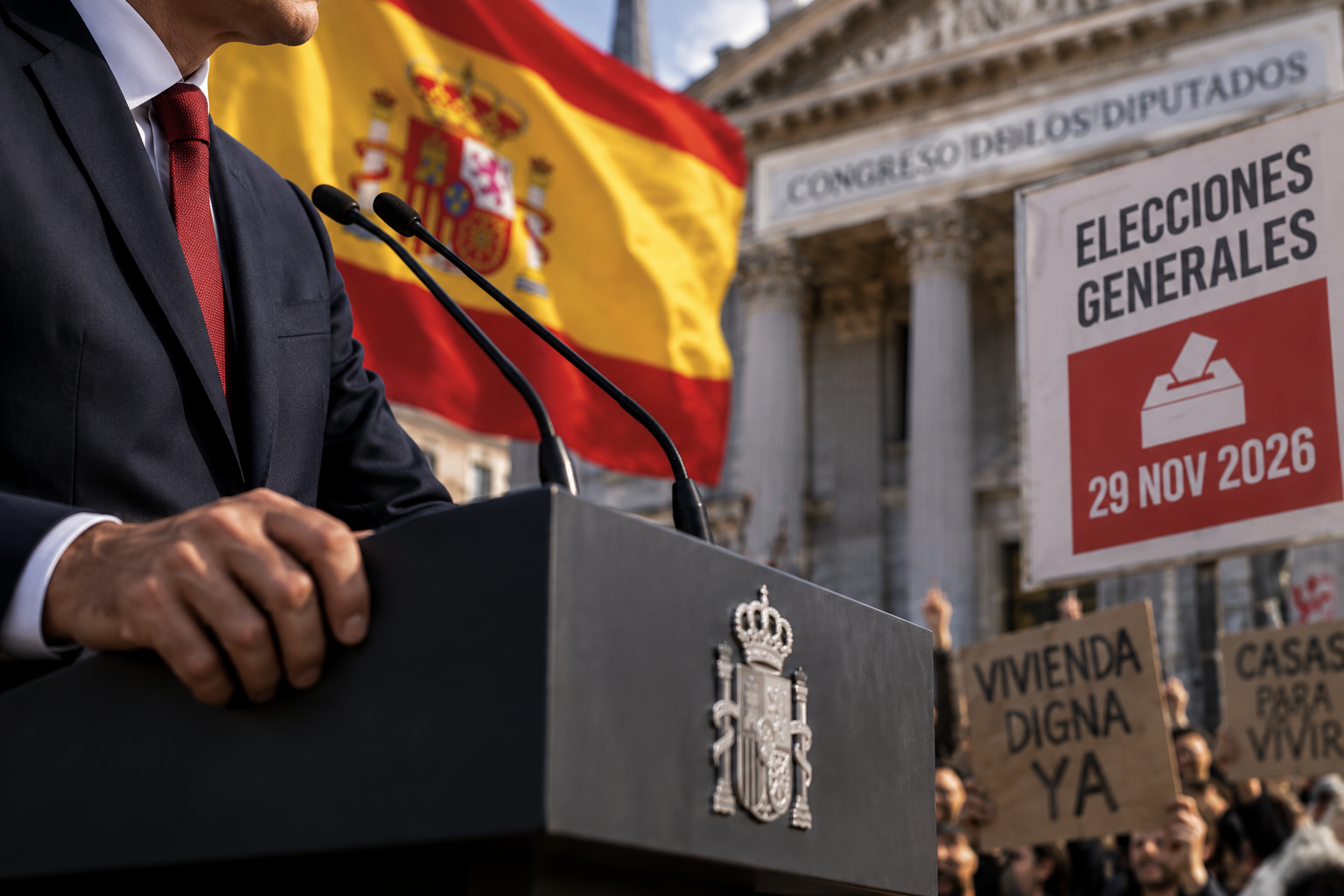
Spain Heads Back To The Ballot Box
Pedro Sánchez Gambles On Early Election As Spain’s Housing Crisis Erupts
Pedro Sánchez has called a general election for 29 November after his government lost crucial housing votes and nationwide protests exposed the weakness of Spain’s fragmented parliament.
Spain is heading into an early general election after Prime Minister Pedro Sánchez announced that voters will return to the polls on Sunday, 29 November 2026.
The decision brings the election forward from 2027 and ends months of argument over whether Sánchez could keep governing through a deeply divided parliament. The immediate trigger was political failure over housing. Two government measures designed to strengthen tenant protections were rejected in Congress as public anger over rents, evictions and housing shortages intensified across the country.
Sánchez said his government now needs to renew and broaden public support if it is to continue pursuing major social reforms. That turns a parliamentary defeat into a national test of whether Spain wants to continue with the current progressive coalition or change political direction.
Why Sánchez Called The Election Now
Sánchez has spent much of the current parliamentary term governing without a dependable majority. His coalition has relied on shifting agreements with smaller parties, including regional and separatist groups, to pass legislation.
That arrangement became increasingly difficult as the term progressed. Housing exposed the problem in its clearest form.
The government wanted to extend protections for vulnerable tenants, maintain some rent controls and tighten rules around short-term accommodation. Those measures failed after opposition parties and the Catalan party Junts rejected the package.
The defeat mattered because housing is no longer a secondary political issue in Spain. It has become one of the most visible pressures on younger voters and urban households. Rents have risen sharply in many cities, affordable supply is constrained, and evictions have become politically explosive.
Tens of thousands of people demonstrated across dozens of Spanish cities in the days before Sánchez’s announcement. In Madrid, the eviction of an 87-year-old woman became a symbol of a broader argument about whether the state has lost control of housing affordability.
For Sánchez, the parliamentary arithmetic left a simple problem. If his government could not pass one of its defining domestic priorities, continuing for several more months risked making the administration look unable to govern.
The snap election is therefore both a response to deadlock and a political gamble.
Housing Has Become The Centre Of The Campaign
Spain’s housing pressures have several causes, and the political parties disagree sharply over the solution.
The left has generally favoured stronger tenant protections, intervention in rental markets and restrictions on some forms of short-term letting. The right has argued that excessive regulation can discourage landlords, reduce available supply and make the shortage worse.
That disagreement is now moving from parliament directly to the electorate.
Sánchez will try to frame the election around whether Spain should expand social protections and maintain a progressive governing programme. The opposition will focus on the government’s record, political scandals, migration pressures, coalition instability and the repeated difficulty of passing legislation.
The housing issue may complicate that contest because it does not fit neatly into the usual left-right divide. Voters can be angry about rent, frustrated with government intervention and worried about immigration or supply constraints at the same time.
That mixture of material pressure and political distrust has become a recurring feature of European politics. Taylor Tailored has examined the same wider pattern in why Western politics increasingly feels incoherent under the pressure of housing, immigration and institutional distrust.
The Ceuta Crisis Still Hangs Over Sánchez
Housing is the immediate trigger, but it is not the only issue shaping the campaign.
Sánchez entered the autumn under pressure after a major migration crisis in Ceuta, where a sudden mass crossing from Morocco pushed border policy back to the centre of Spanish politics. The episode sharpened arguments over migration, state capacity and Spain’s relationship with the rest of the European Union.
The political consequences are important because migration and housing increasingly overlap in public debate. Population growth can support economic expansion, but when housing supply does not rise quickly enough, additional demand can intensify pressure on rents and availability.
That does not make migration the sole cause of Spain’s housing shortage. Construction levels, planning rules, tourism, investor demand, labour markets and regional policy all matter. But the combination gives opposition parties a powerful way to connect border policy with everyday living costs.
The wider European dimension is already visible in the dispute over Ceuta and the EU’s external borders, where Spain has argued that border pressure cannot be treated as a Spanish problem alone.
What The Election Means For Spain’s Political Balance
The election will test whether Sánchez can rebuild a workable parliamentary majority or whether the opposition can convert public frustration into a change of government.
The conservative People’s Party remains the main opposition force, led by Alberto Núñez Feijóo. Vox is also entering the election with substantial support, which means the balance between the two parties on the right may matter almost as much as the contest between left and right.
Sánchez’s Socialist Party faces a different challenge. It needs not only to compete with the opposition but also to rebuild enough support on the left to create a stable governing bloc.
That is difficult in Spain’s electoral system because forming a government depends on parliamentary seats and coalition arithmetic, not simply which party wins the largest share of the vote.
A strong result for any major party may still leave it dependent on smaller parties or coalition partners.
That is why the election is less a straightforward presidential-style duel than a test of which bloc can construct a majority after the votes are counted.
The Result Will Matter Beyond Spain
Spain has become an important political test case inside Europe.
Its economy has grown faster than several other large European economies, while Sánchez has positioned the country firmly inside the European Union and taken distinctive positions on migration, social policy, defence spending and international affairs.
His government has also clashed with Washington over defence expectations. That tension was visible in Donald Trump’s pressure on Spain over NATO spending and trade.
An election therefore has consequences beyond Madrid. A different governing coalition could alter Spain’s approach to EU policy, migration, defence, taxation and relations with the United States.
It would also feed into a wider European argument about whether voters facing high housing costs, strained public services and migration pressures are moving away from established centre-left governments.
That question should not be answered before the ballots are cast. Polls are snapshots, not results, and the campaign has only just begun.
What is already clear is that Sánchez has decided continuing with the existing parliament is no longer the better option.
Why 29 November Matters
The timing gives Spain a short, intense campaign.
Housing will be impossible to avoid because it helped force the election. Migration will remain prominent after Ceuta. The opposition will raise corruption allegations and government instability. Sánchez will argue that a broader progressive majority is necessary to break parliamentary obstruction and continue social reforms.
Those arguments will now be tested directly at the ballot box.
The prime minister could have continued trying to survive vote by vote. Instead, he has chosen to end the parliamentary stalemate and ask voters for a new mandate.
On 29 November, Spain will decide whether that gamble restores Sánchez’s authority, produces a different governing majority or delivers another fragmented parliament that leaves the country facing many of the same problems under a new set of numbers.
Sources
La Moncloa — Institutional Statement by the President of the Government of Spain — Pedro Sánchez’s official 5 October 2026 announcement calling the general election for 29 November and setting out his stated reasons.
Reuters — Spain’s Sánchez Gambles On Snap Election After Housing Protests Give Rare Boost — Background on the housing protests, parliamentary weakness, party competition and wider political pressures surrounding the election call.
El País — Spain Calls Snap Election As Housing Protests Spread Nationwide — Detail on the rejected housing decrees, protests and the political sequence leading to dissolution.
Next Reads
Ceuta Has Triggered A New EU Border Push — And Brussels Is Listening — Explains the migration and border crisis that forms part of the wider political pressure on Sánchez.
Why Trump Is Threatening To Cut Off Spain — Examines Spain’s separate confrontation with Washington over NATO burden-sharing and trade.
Why Western Politics Feels So Confused — Provides wider context on how housing, migration, economic pressure and institutional distrust are reshaping Western politics.
