Why Trump Is Threatening To Cut Off Spain
Trump's warning to Spain changes NATO forever
Trump’s Spain Trade Threat Exposes NATO’s Free-Rider Problem
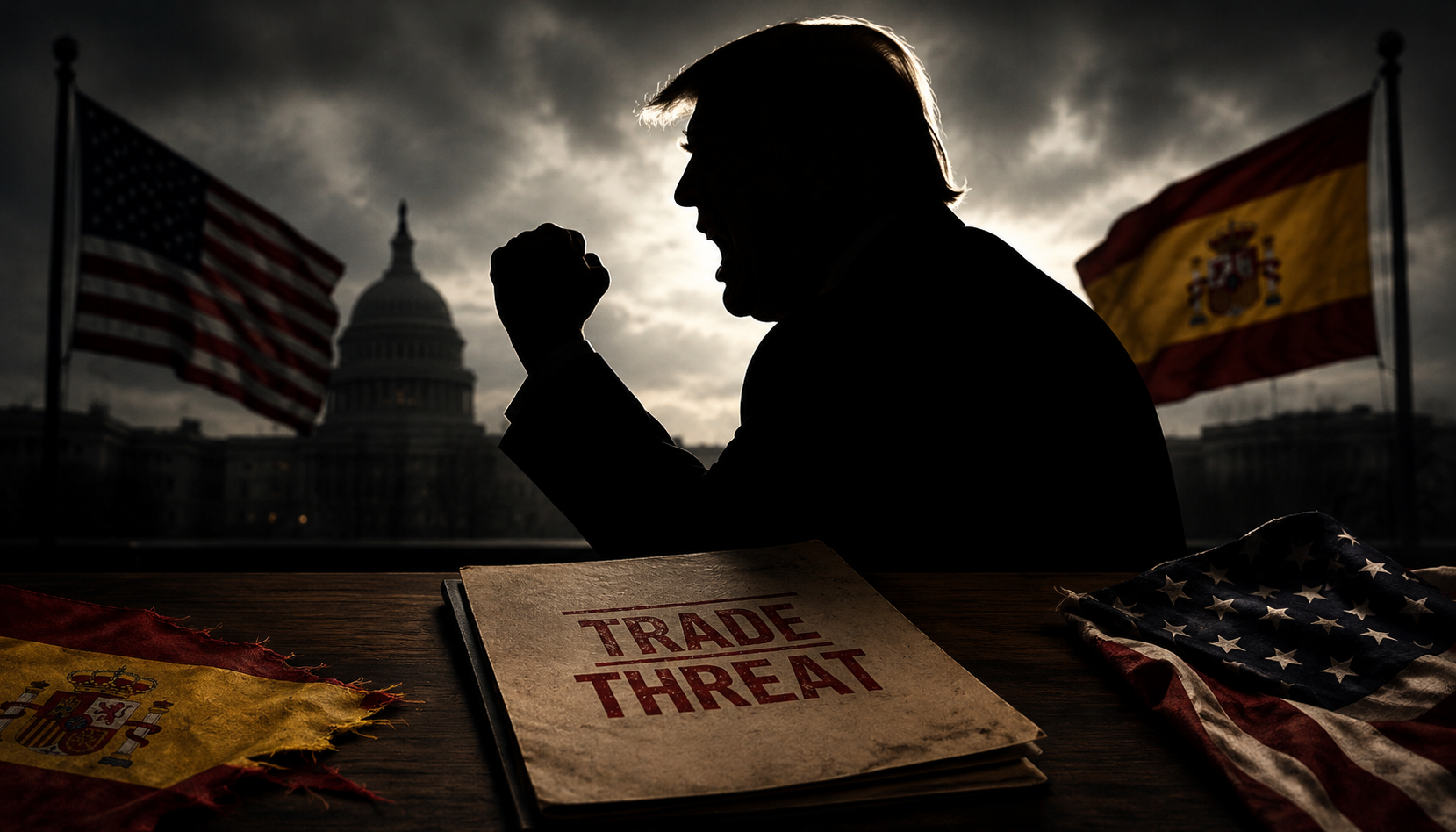
Donald Trump has turned Spain into the latest test case for his hard-edged NATO doctrine: pay more, support the alliance, or face consequences. The US president said he wanted trade with Spain cut off, including visits, after accusing Madrid of being a poor partner at a moment when NATO is demanding far higher defence spending from its members.
The immediate question is whether Trump can actually shut down all trade with Spain. The real answer is more complicated than the threat. He has powerful tools, but a total embargo against a NATO ally inside the European Union would face legal, economic and diplomatic obstacles that make it far harder than the words suggest.
Can Trump Actually Cut Off All Trade With Spain?
In narrow legal terms, a US president has broad emergency powers under the International Emergency Economic Powers Act, which can restrict or block economic dealings with foreign countries. But that power normally requires a national emergency and a finding that the country involved poses an unusual or extraordinary threat to US national security, foreign policy or the economy.
That is why a full Spain embargo would be difficult. Spain is not Iran, Cuba, North Korea or a wartime enemy. It is a NATO ally, an EU member and a major Western economy, so turning a defence-spending dispute into a legal justification for cutting all trade would invite immediate challenge.
The European Union is the second obstacle. Trade policy for Spain is not handled by Madrid alone, because EU trade negotiations are conducted at bloc level. That means a direct American trade war against Spain would not simply be a bilateral fight between Washington and Madrid; it would almost certainly become a US-EU confrontation.
That does not mean Trump is powerless. He could pursue tariffs, quotas, targeted penalties, import restrictions or sector-specific action. US law gives the president options under mechanisms such as Section 232 for national-security-related imports and Section 301 for unfair or burdensome trade practices.
So the clean answer is this: Trump probably cannot easily or cleanly cut off every form of trade with Spain overnight, but he can make Spain’s access to the American market more painful. That is the point of the threat. It is not only a legal order; it is leverage.
Why Spain Has Become Trump’s Target
Spain has put itself on the wrong side of Trump’s central NATO demand. At the 2025 Hague Summit, NATO allies committed to investing 5% of GDP annually on defence by 2035, made up of at least 3.5% for core defence and up to 1.5% for wider defence-and-security-related spending.
Trump sees that as the new price of alliance membership. From his perspective, the United States has carried Europe for decades, while many European governments protected domestic welfare budgets and left Washington to underwrite their security. Spain’s resistance therefore becomes more than a budget argument; it becomes a symbol of the old NATO model Trump wants to destroy.
Madrid’s position is that it can meet NATO capability needs without accepting the full 5% GDP benchmark. Spain has argued for a lower path and has resisted pressure from Trump and NATO leadership to embrace the higher spending target.
Trump’s anger is also linked to Spain’s wider posture. Recent reports say his criticism was sharpened by Spain’s lack of support for the Iran war and its refusal to allow US use of Spanish airspace or bases for operations connected to that conflict.
That matters because Trump is not treating defence spending, Iran, trade and alliance loyalty as separate files. He is treating them as one question: is Spain acting like a serious ally, or is it enjoying American protection while withholding support when Washington asks for help?
Spain’s Defiance Has Raised The Stakes
Spain’s response has been openly defiant. A Spanish minister said Spain accepts neither blackmail nor threats, presenting Madrid as a sovereign democracy defending peace, multilateralism and its own decision-making.
That plays well domestically for Spain’s government, but it also gives Trump the confrontation he wants. The harder Madrid frames the dispute as American bullying, the easier it becomes for Trump to present Spain as an ungrateful ally that wants US protection without accepting US pressure.
There is a serious economic reason this threat matters. US Census data shows American goods exports to Spain totalled $26.57 billion in 2025, while imports from Spain totalled $21.35 billion, giving the United States a goods trade surplus of about $5.22 billion with Spain. In the first five months of 2026, US exports to Spain were $10.25 billion and imports were $8.24 billion.
That trade relationship is large enough to hurt both sides, but it is also small enough for Trump to use politically. Spain is not China. It is not the core of the US economy. That makes it a useful pressure target: big enough to send a message across Europe, but not so large that Washington would be paralysed by the consequences.
Trump’s Case For The Threat
The strongest pro-Trump argument is simple: alliances cannot survive if one side pays and the other side lectures. NATO’s own declaration says allies face profound security threats, including Russia and terrorism, and must invest enough to deter and defend.
Trump’s critics call his language reckless, but his supporters would argue that polite diplomacy failed for years. European governments repeatedly promised higher defence spending, then moved slowly, delayed, argued over definitions or prioritised domestic politics. Trump’s pressure has forced the alliance to talk in numbers, deadlines and consequences rather than vague solidarity.
Spain is particularly exposed because it is not merely asking for time. It is challenging the spending logic itself. If every NATO member claimed its own special calculation, the 5% pledge would become theatre rather than policy.
That is why Trump’s threat has strategic value even if it is never fully executed. It tells Europe that the US security guarantee is no longer free from commercial consequence. It warns other capitals that resisting defence commitments may carry costs outside the defence file.
There is also a defence-industrial angle. The US-EU trade framework has already stressed increased European procurement of American military and defence equipment, stronger transatlantic defence cooperation and deeper NATO interoperability.
From Trump’s view, Spain cannot reject higher spending, limit support for US operations, resist American pressure and still expect normal economic treatment. That is the heart of his America First approach: friendship is measured by burden-sharing, not speeches.
Why A Full Cut-Off Would Be Harder Than A Tariff War
The practical problem is that a total trade cut-off is a blunt instrument. It would hit American exporters, Spanish firms, investors, airlines, tourists, supply chains and the wider EU relationship. It would also raise the question of why a NATO ally is being treated like an adversary.
A targeted tariff or sector-by-sector pressure campaign is more plausible. Trump could look for products, sectors or regulatory disputes where the White House can justify action under existing trade tools. That would be legally easier, politically cleaner and still damaging enough to get Madrid’s attention.
This is where Trump’s threat should be read less as a final policy and more as the opening bid in a negotiation. He is setting the ceiling of pressure high so that any later tariff, quota or trade penalty looks restrained by comparison.
Spain may believe the EU shield protects it. That is partly true. But the EU cannot make the political pain disappear if Washington starts singling out Spanish-linked sectors, Spanish firms or Spanish priorities in future trade talks.
What Happens Next
The most likely outcome is not a total US-Spain trade blackout. The more realistic path is a period of pressure, retaliation threats, EU involvement and possible targeted trade measures if Spain refuses to move on defence spending or alliance support.
For Trump, that may be enough. His goal is not only to punish Spain; it is to make Spain an example. If one NATO member can openly resist the new burden-sharing order without consequence, others may follow.
For Spain, the danger is that defiance becomes expensive. Madrid can say it rejects blackmail, but Trump is testing whether words of sovereignty are worth more than access to the American market, US goodwill inside NATO and protection from being branded Europe’s weakest link.
The deeper story is not whether every Spanish product disappears from American shelves tomorrow. It is whether Trump has changed the meaning of NATO membership from a diplomatic promise into a transaction with a bill attached. Spain is now the country being asked to pay it.
