Street Shooting to Supermarket Siege: How a Kyiv Rampage Unfolded in Minutes
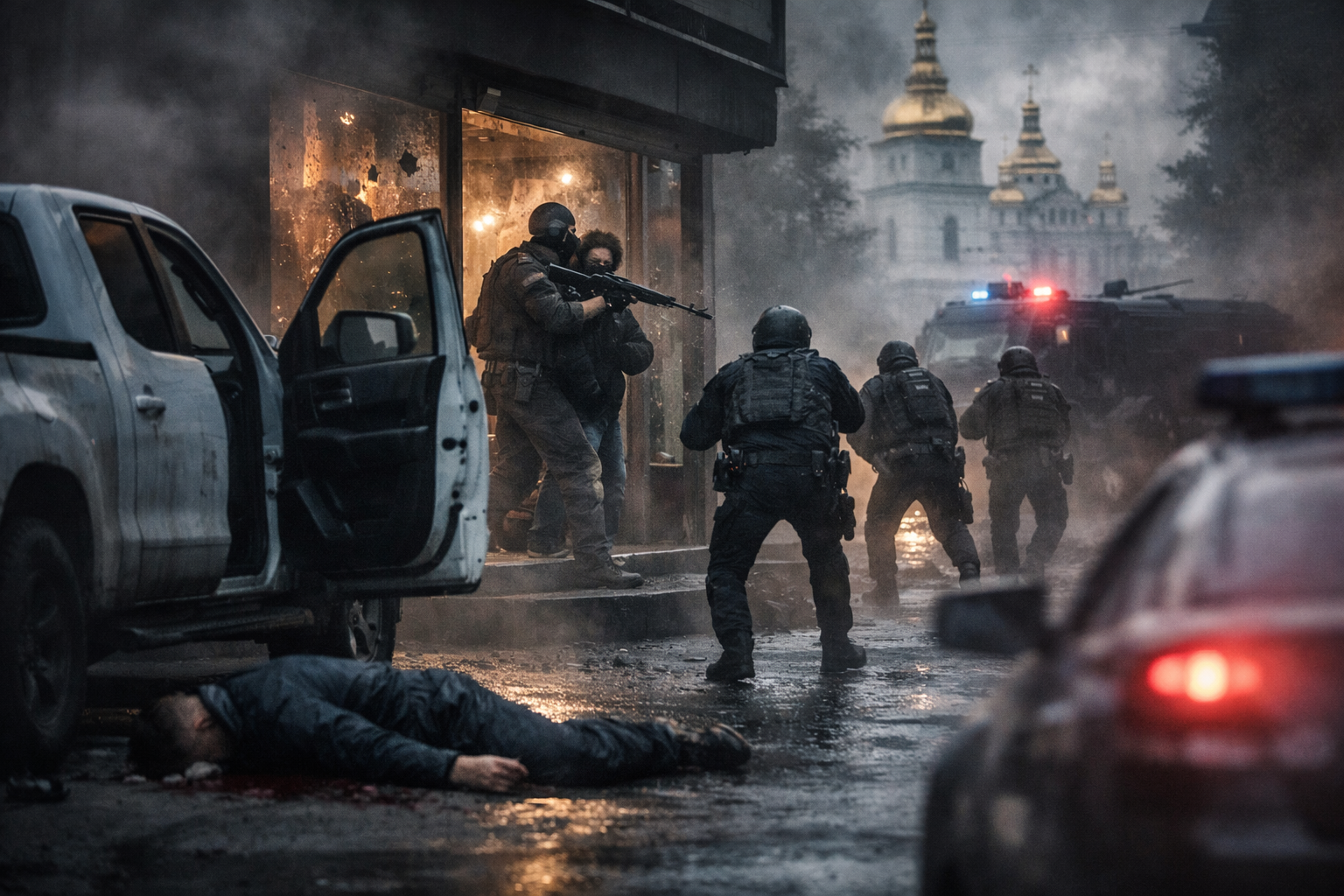
From Random Gunfire to Hostage Horror: The Kyiv Attack That Shocked a War-Hardened City
Kyiv Gunman Turns City Street Into Killing Ground Before Hostage Siege Ends in Deadly Police Assault
A burst of random gunfire, a supermarket siege, and a police storming operation—this was not just another act of violence, but a rupture in a city already living under pressure
The violence did not build gradually. It detonated.
One moment, a residential district in Kyiv was moving through an ordinary day. The next moment, gunfire cut through the street—indiscriminate, close-range, and lethal. Civilians fell where they stood. No warning. No pattern. No clear target.
Within minutes, the attack mutated.
The gunman moved from open street chaos into a supermarket, turning panic into containment. Hostages were taken. A second phase began. And with it, the stakes changed completely.
The police killed the attacker after a failed standoff, leaving multiple people dead and more wounded by the time the situation ended.
The Attack Unfolded in Three Phases
The sequence matters. It explains both the scale of the tragedy and the urgency of the response.
Phase one: street killings.
Witness accounts and official statements indicate the attacker opened fire on civilians in a public area, killing several people almost immediately. Victims were hit at close range, with no sign of a specific target or pattern.
Phase two: escalation into hostage-taking.
After the initial shooting, the gunman entered a supermarket and barricaded himself inside, taking hostages. This shift transformed the incident from a mass shooting into a live crisis with unpredictable outcomes.
Phase three: armed standoff and forced resolution.
Police attempted to negotiate. The attacker did not engage meaningfully. After roughly 40 minutes, special units moved in. The operation ended with the gunman shot dead and the remaining hostages freed.
Across all three phases, the toll climbed: multiple fatalities, including victims on the street and at least one hostage, alongside more than a dozen injured.
The Human Cost Behind the Headlines
Numbers flatten what actually happened.
Among the injured was a child. Among the dead were parents. In at least one case, a family was torn apart in seconds—two lives lost, one left behind to carry it.
This was not targeted violence against institutions or infrastructure. It was direct, humane, immediate.
People were hit while walking, shopping, and living.
That distinction matters. In a country shaped by large-scale conflict, this kind of close-range civilian violence cuts differently. It is intimate. It feels random. It removes any illusion of distance.
Who the Attacker Was—and What We Know
Authorities have identified the gunman as a man in his late 50s, with a criminal past and a background linked to both Ukraine and Russia.
He reportedly used a legally obtained firearm.
Before the shooting began, he set fire to his residence—an act that suggests premeditation rather than sudden impulse.
What remains unclear is motive.
Investigators are examining multiple lines of inquiry, including ideological factors, personal grievances, and potential external influence.
At this stage, the facts establish preparation and escalation—but not intent.
Why This Feels Different
Ukraine is not unfamiliar with violence. Cities regularly face aerial attacks. Explosions, sirens, and military threats have become part of daily life.
But the situation was different.
This was not a distant strike or incoming drone. It was a man with a weapon, walking into civilian space and firing directly at people.
That shift—from war-scale threat to personal proximity—changes how fear operates.
It collapses distance.
And it creates a different kind of psychological shock.
What Media Misses
The immediate framing focuses on the act itself: a shooting, a hostage crisis, a police response.
But the deeper shift is about the type of threat.
Ukraine’s security posture is built around large-scale external danger—missiles, drones, and military operations. This attack cuts across that framework.
It exposes a different vulnerability:
individual actors operating inside civilian space, outside predictable patterns.
That does not require a large network.
It does not require military infrastructure.
It requires one person, one weapon, and one moment.
That is why this incident resonates beyond its scale.
The Strategic Questions Now
Several questions now sit at the center of the investigation:
Was the attack purely an individual act, or part of something wider?
How did the attacker obtain and retain access to a weapon?
Were there warning signs—behavioral, digital, or social—that were missed?
Could this type of incident become more frequent under current conditions?
Authorities have already indicated the attack is being treated as a potential act of terrorism, even as motive remains unresolved.
That classification is not just legal—it shapes the response that follows.
What Happens Next
Three trajectories are likely to define the aftermath.
The investigative phase.
Authorities will focus on the attacker’s communications, contacts, and history to determine whether the incident was isolated or influenced.
The security response.
Expect tighter scrutiny around firearms access, behavioral warning systems, and rapid-response protocols in civilian areas.
The psychological ripple.
For residents, the impact goes beyond the event itself. It introduces a new layer of uncertainty—one that cannot be tracked on radar or predicted through military intelligence.
The Real Meaning of the Kyiv Attack
The incident was not just a tragedy. It was a signal.
A city already managing the pressure of war was forced, suddenly, to confront a different kind of violence—one that feels closer, less predictable, and harder to contain.
The attack began in seconds.
It escalated in minutes.
It ended in force.
But its impact will last far longer than the timeline suggests.
Because the most unsettling shift is not what happened.
It is what this kind of event makes possible next.
