Supreme Court Sets Up Fresh Battles On Guns, LGBT Rights And Voting Rules
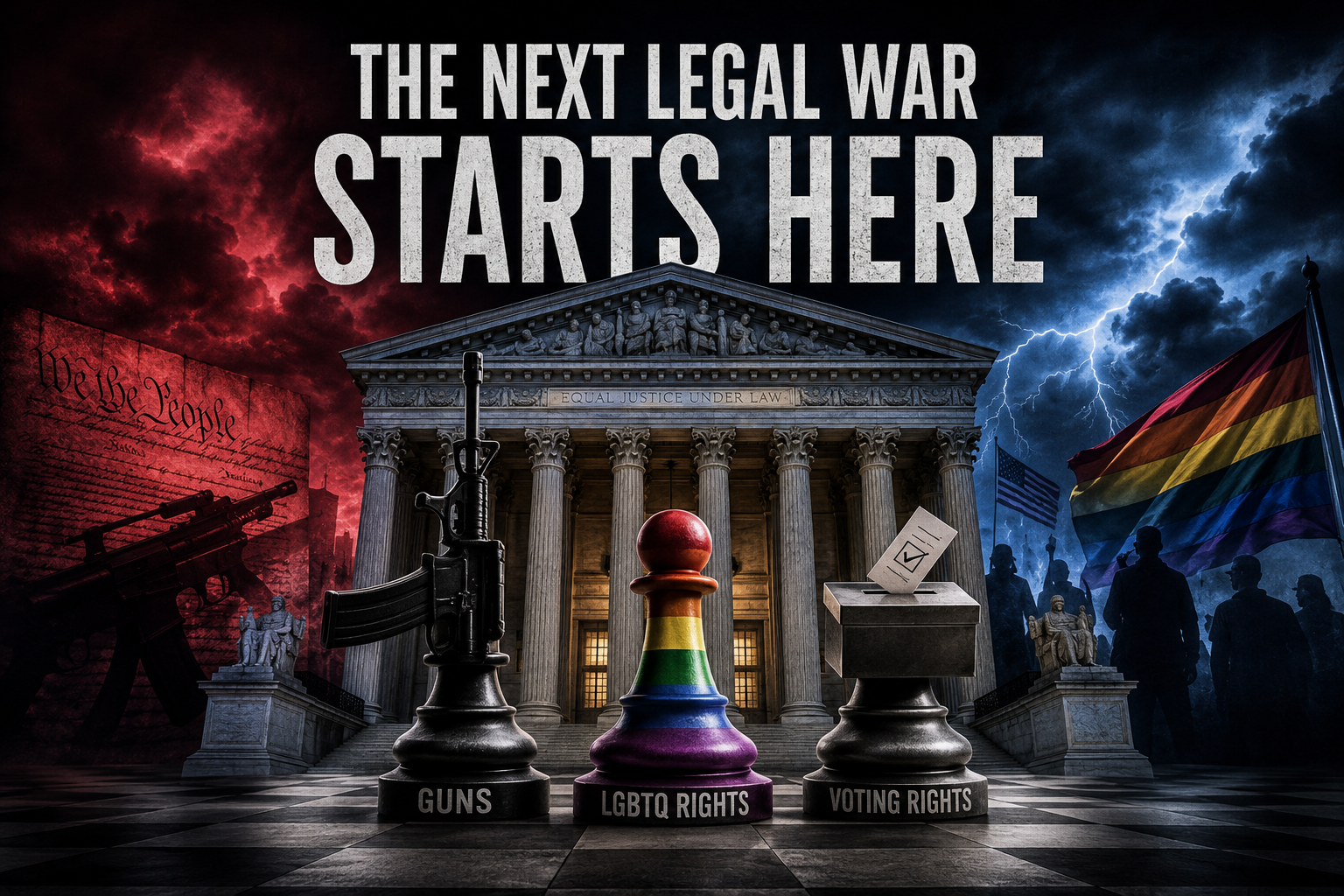
Guns, Trans Rights And Voting Rules Are Heading Back To The Court
The Supreme Court’s Next Term Could Reshape American Rights Again
The U.S. Supreme Court has ended one explosive term and immediately set up another. The next fights are already clear: gun restrictions, LGBT rights, and voting rules are heading back into the centre of American constitutional politics.
The Court is not writing a manifesto or announcing a political programme. It is doing something more powerful in legal terms: choosing which disputes to hear, which lower-court rulings to leave standing, and which constitutional tests will govern the next wave of cases.
What The Court Is Setting Up
The biggest new gun case concerns state and local bans on AR-15-style semiautomatic rifles. The justices have agreed to hear challenges involving Cook County, Illinois, and Connecticut, after lower courts upheld restrictions on weapons covered by those laws.
That matters because the Court has already moved American gun law sharply since its 2022 Bruen decision. Recent rulings struck down Hawaii’s handgun carry restrictions on private property open to the public and narrowed the application of a federal gun ban affecting some drug users.
The new rifle-ban cases could become the Court’s most important Second Amendment decision since Bruen. If the justices rule broadly, states and cities with similar restrictions may face immediate legal pressure.
Why LGBT Rights Face A Harder Court
The Court has also moved into a more difficult phase for LGBT-rights claims, especially transgender-rights claims. In West Virginia v. B.P.J., the Court upheld state restrictions barring transgender girls from girls’ sports, with the majority stressing the difficulty of judicially measuring the effects of puberty blockers, hormones, and athletic differences across individual athletes.
That ruling followed a wider pattern. The Court has recently rejected a Colorado ban on LGBT “conversion therapy” for minors on First Amendment grounds, while also allowing several restrictions affecting transgender people to survive legal challenge.
The direction is now clearer than it was after the Court’s earlier gay-rights decisions. The Court may still protect LGBT people in some statutory settings, but newer claims involving gender identity, schools, sports, medical treatment, speech, and parental rights face a more sceptical bench.
Why Voting Rules Remain Unsettled
Voting law is moving in two directions at once. In Watson v. Republican National Committee, the Court upheld Mississippi’s rule allowing mail ballots postmarked by Election Day to be counted if received within five business days. The majority said federal Election Day laws require ballots to be cast by Election Day, not necessarily received by then.
That ruling protects similar ballot-receipt systems in many states. It also gives states room to decide how they handle timely mailed ballots, especially where postal delays affect voters who followed the rules.
But the Court’s voting-rights picture is not broadly pro-access. In Louisiana v. Callais, the Court struck down Louisiana’s congressional map and tightened the legal space around race-conscious redistricting under Section 2 of the Voting Rights Act.
What Led To This Moment
The current Court is shaped by a durable conservative majority, a long campaign by legal activists to revisit rights doctrines, and a flood of state laws designed to test constitutional boundaries. States are passing restrictions, advocacy groups are challenging them, and lower courts are splitting over how to apply recent Supreme Court precedent.
On guns, the key driver is the Court’s historical-tradition test. On LGBT rights, the driver is the collision between equality claims and arguments about speech, sex classification, parental authority, and state control of schools. On voting, the driver is the unresolved tension between state election power, federal election statutes, racial representation, and constitutional limits on race-based mapmaking.
This is why the next term matters. The Court is not merely settling isolated disputes. It is deciding which side gets the stronger legal tools before the next wave of political and cultural litigation.
What Happens Next
The AR-15-style rifle cases are the most direct next flashpoint. A narrow ruling could leave room for some state restrictions. A broad ruling could undermine bans across much of the country and force lower courts to reassess firearm laws under a tougher Second Amendment standard.
On LGBT rights, new cases are likely to focus on schools, bathrooms, pronouns, parental notice, medical care, and participation rules. On voting, litigation will continue around mail ballots, voter ID, proof-of-citizenship rules, district maps, and the remaining force of the Voting Rights Act.
The likely outcome is not calm. It is a harder-edged constitutional landscape where states keep testing the limits, activists keep bringing challenges, and the Supreme Court keeps deciding which rights expand, which protections shrink, and which political battles become national law.
