Taiwan’s Shrinking War Window Is A Warning The World Cannot Ignore
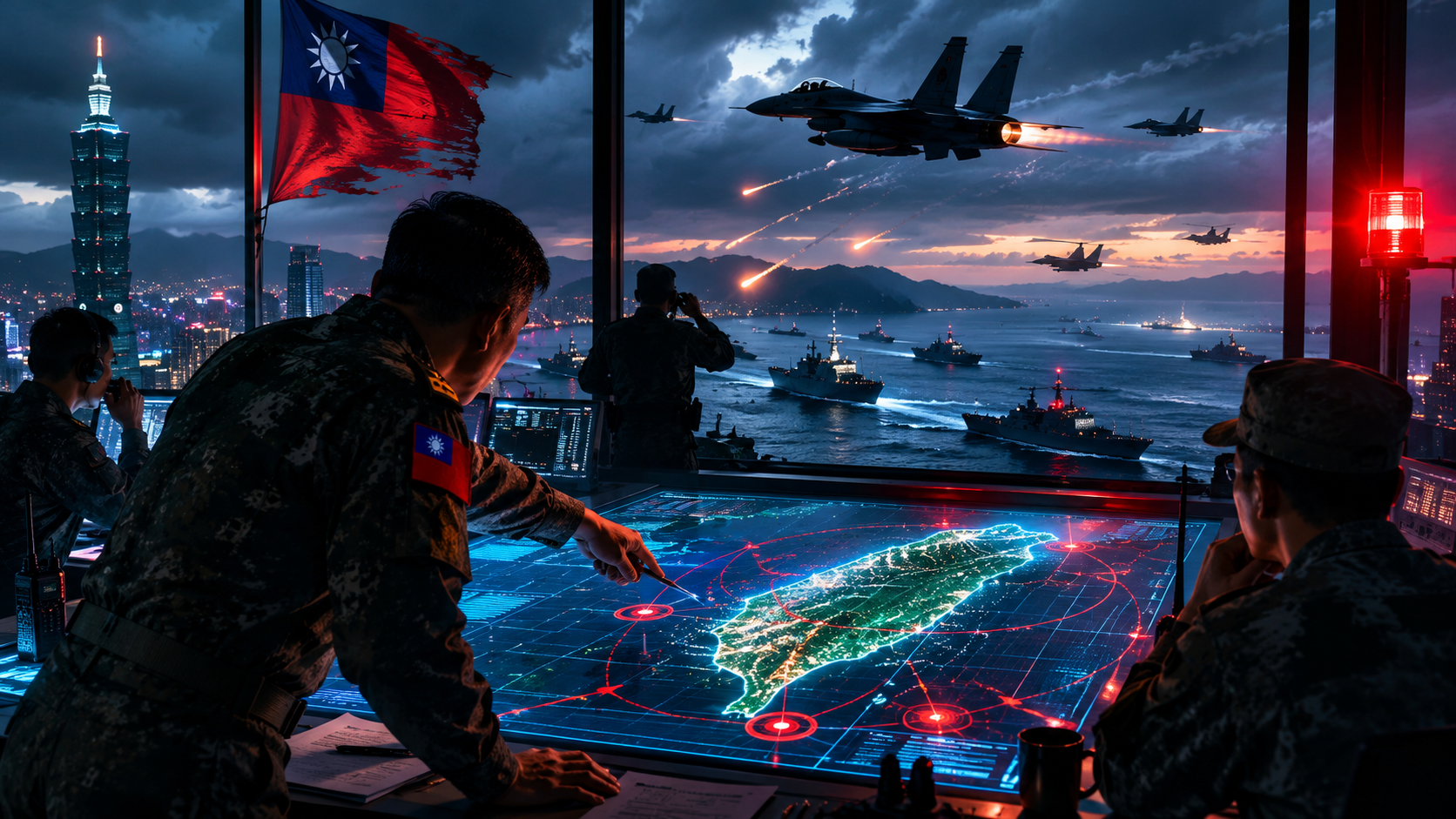
China May Not Need Surprise If Taiwan Runs Out Of Time To React
Taiwan Is Now Fighting The Clock Before It Fights China
The Warning Is About Minutes, Not Just MissilesTaiwan’s defence minister Wellington Koo has warned that the warning time for any Chinese attack is getting shorter, forcing Taiwan to test how quickly its forces can move from normal readiness into real conflict. That is the real significance of the island’s latest five-day Immediate Combat Readiness Exercise: it is not theatre, and it is not routine signalling. It is a rehearsal for the nightmare scenario in which China’s next “exercise” stops being an exercise.
The frightening part is not simply that China has more aircraft, ships, missiles and coercive tools around Taiwan. It is that Beijing’s near-daily activity around the island may compress the decision-making window. When military pressure becomes constant, the first moments of a real attack become harder to distinguish from another provocation, another patrol, another drill, another test of Taiwan’s nerves.
That is why this story matters. A war over Taiwan would not necessarily begin with a clean announcement, a formal declaration or a cinematic first strike. It could begin inside ambiguity, with forces already in motion, commanders forced to decide under pressure, and politicians trying to understand whether the line between coercion and war has already been crossed.
China’s Pressure Works Because It Trains Everyone To Hesitate
China claims Taiwan as its territory, while Taiwan’s elected government rejects Beijing’s right to rule the island. That dispute has sat at the centre of the Indo-Pacific security order for decades, but the pressure around it has changed. Chinese military activity near Taiwan is no longer rare enough to automatically produce global shock. It has become part of the region’s background noise.
That background noise is strategically useful. The more often Chinese aircraft and ships operate near Taiwan, the more Beijing can blur intent. A major exercise can be framed as training. A blockade rehearsal can be framed as pressure. A sudden escalation can be hidden inside a familiar pattern until the moment it is too late to treat it as familiar.
Taiwan’s response problem is therefore psychological as much as military. React too slowly, and the island risks losing the first phase of a conflict before it has fully mobilised. React too aggressively, and Beijing can accuse Taipei of provocation. That is the trap: China does not have to make every move decisive if it can force Taiwan to constantly judge which move is real.
This is also why Taylor Tailored has repeatedly treated Taiwan as the pressure point where modern power, technology and deterrence collide, from What If China Invaded Taiwan In 2027? to What If China Blockaded Taiwan For 30 Days. The key issue is not whether Beijing has one possible path. It is that Beijing may have many routes to squeeze time, space and confidence at once.
Taiwan Is Testing The Moment Normal Life Becomes War
The latest readiness drills are designed around rapid transition. Taiwan is testing whether troops, command structures and equipment can shift from peacetime activity to wartime posture quickly enough if China’s actions suddenly change character. Armour has been seen moving through urban areas, and the exercise is built to make readiness more realistic rather than ceremonial.
That matters because Taiwan’s problem is brutally practical. It is an island democracy under constant observation, with limited strategic depth and enormous dependence on fast coordination. If airports, ports, communications nodes, energy systems or command channels are hit early, the first hours would become decisive. A slow response would not simply be inefficient. It could be strategically fatal.
Taiwan has also been strengthening its defence posture, including testing U.S.-supplied HIMARS rocket systems and pursuing a broader military modernisation drive. President Lai Ching-te has set out an ambition to raise defence spending to 5% of GDP by 2030, while Taipei has continued seeking stronger U.S. arms support. Those moves signal that Taiwan understands the central problem: deterrence depends not only on what weapons exist, but on whether they can be used quickly enough to matter.
The deeper anxiety is that Taiwan may not get a clean mobilisation period. A classic invasion warning assumes the defender sees the storm gathering. Taiwan is preparing for something more dangerous: the storm may already look like weather.
Beijing’s Message Is Designed To Narrow Everyone Else’s Choices
China has condemned Taiwan’s drills, portraying them as linked to separatism while continuing to insist that the Taiwan question is an internal Chinese matter. Beijing has also never ruled out the use of force. That creates a deliberate pressure structure: Taiwan is told that preparing for attack is provocative, while China’s own military activity is presented as legitimate sovereign signalling.
This is the core imbalance. China can escalate around Taiwan and call it pressure. Taiwan can prepare to survive that pressure and be accused of escalation. The result is a battlefield of interpretation before any battlefield of firepower. Every exercise, every transit, every aircraft sortie and every statement becomes part of a contest over who appears defensive and who appears reckless.
The passage of China’s newest aircraft carrier through the Taiwan Strait adds another layer to that pressure. Carrier movements are not automatically war signals, but they are highly visible demonstrations of reach, confidence and presence. For Taiwan, the message is obvious: China is not only increasing the scale of its military options, it is normalising their proximity.
That is why the latest warning should not be read as panic. It should be read as adaptation. Taiwan is not saying an attack is inevitable tomorrow. It is saying the margin for recognising one may be shrinking.
The Real Danger Is A Crisis That Moves Faster Than Politics
The Taiwan Strait is not only a local flashpoint. It is connected to U.S. credibility, Japanese security, global shipping, advanced semiconductors, the first island chain and the wider balance of power between Washington and Beijing. Any Chinese attack or coercive blockade would force rapid decisions far beyond Taipei. The problem is that democratic decision-making, alliance coordination and military mobilisation all take time.
Time is exactly what Taiwan fears losing.
If China can create a situation where Taiwan, the United States and regional allies spend the first hours debating intent, classification and response thresholds, Beijing gains the most valuable commodity in modern conflict: initiative. It may not need to defeat every opponent immediately. It may only need to move faster than they can agree on what is happening.
That is the brutal lesson behind the shrinking response window. Deterrence is often discussed in terms of firepower, budgets and alliances. But deterrence also depends on recognition. A weapon that cannot be authorised in time is weaker than it looks. An ally that cannot decide in time is less reliable than it sounds. A government that cannot communicate clearly in the first phase of crisis may lose control of the narrative before it loses territory.
The World Is Being Warned Before The Ambiguity Arrives
Taiwan’s latest warning should be understood as a message to three audiences at once. To Beijing, it says Taiwan is preparing for sudden escalation. To Washington and regional partners, it says any future crisis may demand faster judgement than previous planning assumed. To the public, it says the Taiwan story is not just about whether China attacks, but how little warning may separate coercion from conflict.
This is why the Taiwan question keeps returning to the centre of geopolitics. It combines military force, national identity, technological dependence, superpower rivalry and political pride in one small geographic space. It is also why The Taiwan Danger Xi Just Put Directly In Front Of Trump remains part of the same strategic picture: Taiwan is not a side issue in U.S.-China rivalry. It is the test case for whether deterrence still works when both sides believe the stakes are existential.
The uncomfortable possibility is that a future Taiwan crisis may not begin with the world asking whether China is about to attack. It may begin with the world asking whether China already has. That is the meaning of a shrinking response window. It is the difference between preparing for danger and waking up inside it.
