

The Car Bomb That Failed — But Still Changed The Threat Picture In Northern Ireland
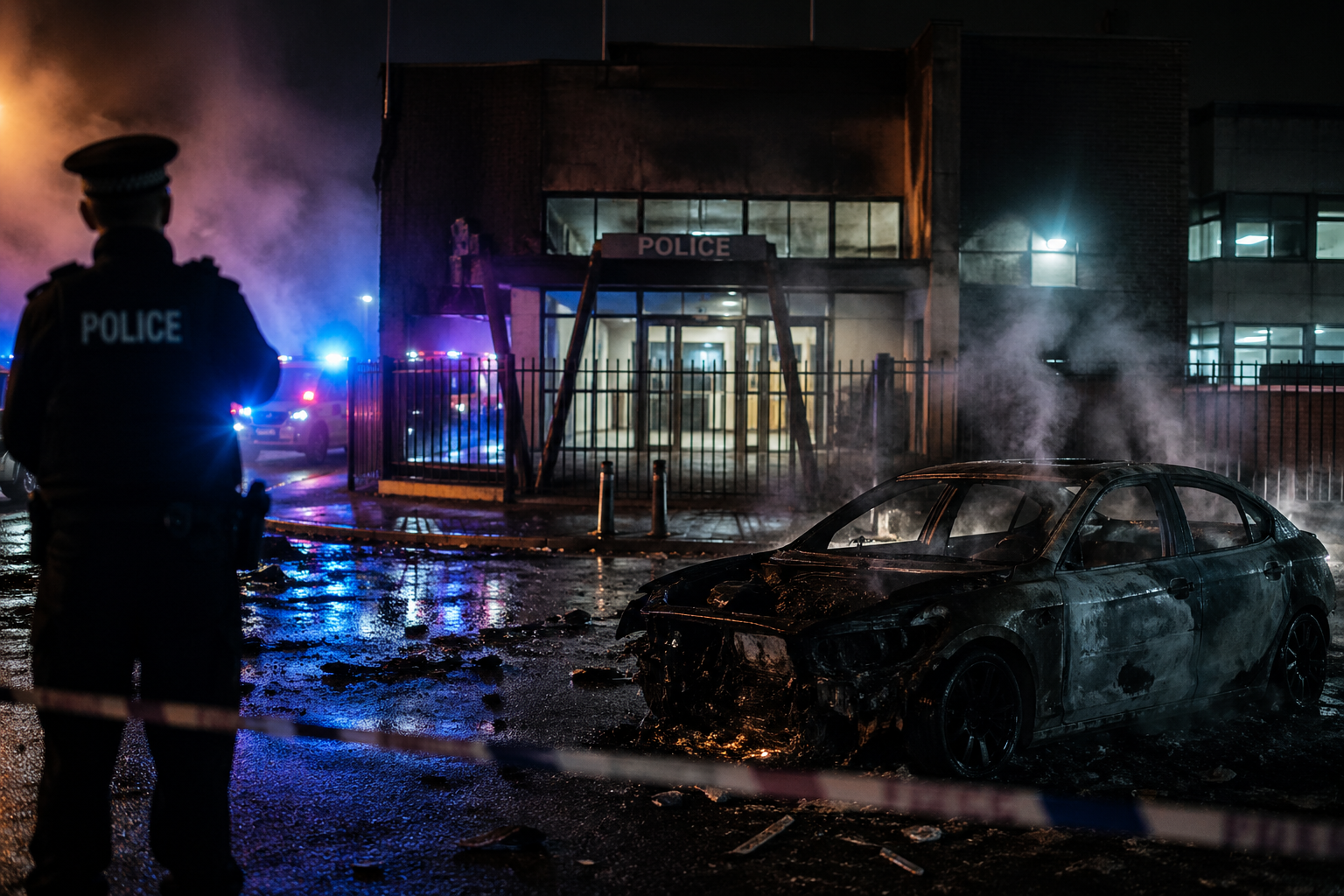
The Northern Ireland Car Bomb That Almost Reopened Old Wounds
The Dunmurry Attack: Why A Failed Bombing Still Sends A Dangerous Signal
The explosion outside a police station in Northern Ireland could easily have been a completely unique story. It was not the lack of intent that prevented deaths — it was timing, response, and a narrow margin of safety.
A 66-year-old man has now been charged with multiple serious offenses, including attempted murder, explosives offenses, possession of terrorist-related articles, and hijacking, following the car bomb attack on a Police Service of Northern Ireland (PSNI) station in Dunmurry.
The charges formalize what investigators had already made clear: the attack was not symbolic, and it was not accidental. It was an attempt to kill.
What Actually Happened
The attack began with a hijacking—a tactic deeply familiar in Northern Ireland’s past. A delivery driver in west Belfast was reportedly forced to transport a vehicle containing an explosive device to the Dunmurry police station.
The device was then detonated outside the station as officers were evacuating the area. Crucially, no one was injured.
That outcome, however, reflects rapid police response rather than reduced danger. The device itself was capable of causing serious harm, and the charges — including attempted murder — underline the intent behind it.
The suspect was arrested under the Terrorism Act and is due to appear before Lisburn Magistrates’ Court, with the case subject to review by the Public Prosecution Service.
The Method Matters
There is a reason this attack has drawn such immediate attention beyond the absence of casualties.
The method — a hijacked civilian vehicle turned into a delivery mechanism for an explosive — is not new. It is historically associated with paramilitary tactics during decades of conflict in Northern Ireland. The use of coercion, particularly forcing civilians into participation, is a defining feature of that strategy.
In this case, the driver was reportedly compelled under threat to deliver the bomb.
That detail shifts the narrative from a simple “failed bombing” to something more complex: a deliberate attempt to replicate older forms of violence in a modern context.
Why No One Was Hurt
The absence of injuries is the most striking outcome—and also the most misleading if taken at face value.
Police had begun evacuating the area before the explosion, including nearby residents.
That response likely prevented fatalities. The timing of the detonation, combined with the evacuation, created a scenario where the attack failed operationally but not strategically.
Because the strategy was clear: detonate a device at a police facility at a moment when officers and civilians could be present.
The Suspected Context
Authorities have linked the attack to dissident republican activity, with the New IRA claiming responsibility in the aftermath.
That matters because it places the incident within a broader pattern rather than treating it as isolated.
Recent incidents — including similar attempted attacks — suggest continuity rather than escalation. The capability appears limited compared to historical campaigns, but the intent remains consistent: target police, destabilize public confidence, and generate attention.
What Most People Miss
The instinctive reading of this story is simple: no injuries, suspect charged, and situation contained.
But the more important layer sits underneath that surface.
This was not a spontaneous act. It involved planning, coercion, and execution across multiple stages—hijacking, transport, placement, and detonation. That implies coordination, even if limited in scale.
More importantly, it demonstrates persistence. The infrastructure of organized violence may be weaker than in past decades, but it has not disappeared.
And the psychological objective remains unchanged. Even a failed attack can serve a purpose: reminding communities and institutions that the threat still exists.
The Modern Reality Of An Old Threat
Northern Ireland today is not the Northern Ireland of the past. The scale, frequency, and capability of violence are dramatically reduced.
But the Dunmurry attack highlights something more subtle — the endurance of small, committed groups willing to attempt high-impact actions.
The devices used are often less sophisticated. The operational success rate is lower. But the symbolic weight remains high.
A single explosion outside a police station still resonates, particularly when it echoes methods associated with earlier decades.
The Legal And Operational Next Steps
The charging of a suspect marks a transition from immediate response to judicial process.
The offenses—including attempted murder and possession of explosives with intent—reflect the seriousness with which authorities are treating the case.
The Public Prosecution Service will now review the charges, and the court process will determine the outcome.
Parallel to that, the security response continues. Investigations remain ongoing, and police have already conducted searches linked to the incident.
Why This Still Matters Now
It would be easy to dismiss the event as a failed attack with no casualties.
That would not address the main issue.
The Dunmurry bombing sits at the intersection of three realities:
The continued existence of dissident groups
The persistence of legacy tactics adapted for modern conditions
The thin margin that often separates a failed attack from a fatal one
The outcome — no injuries — is reassuring. The intent behind it is not clear.
The Bottom Line
The suspect has been charged. The immediate threat from this specific incident has been contained.
But the story does not end there.
The Dunmurry attack was not defined by what happened. It was defined by what was supposed to happen — and how close it came.
