

New Footage Shows Alleged Assassin Charging Security At White House Dinner
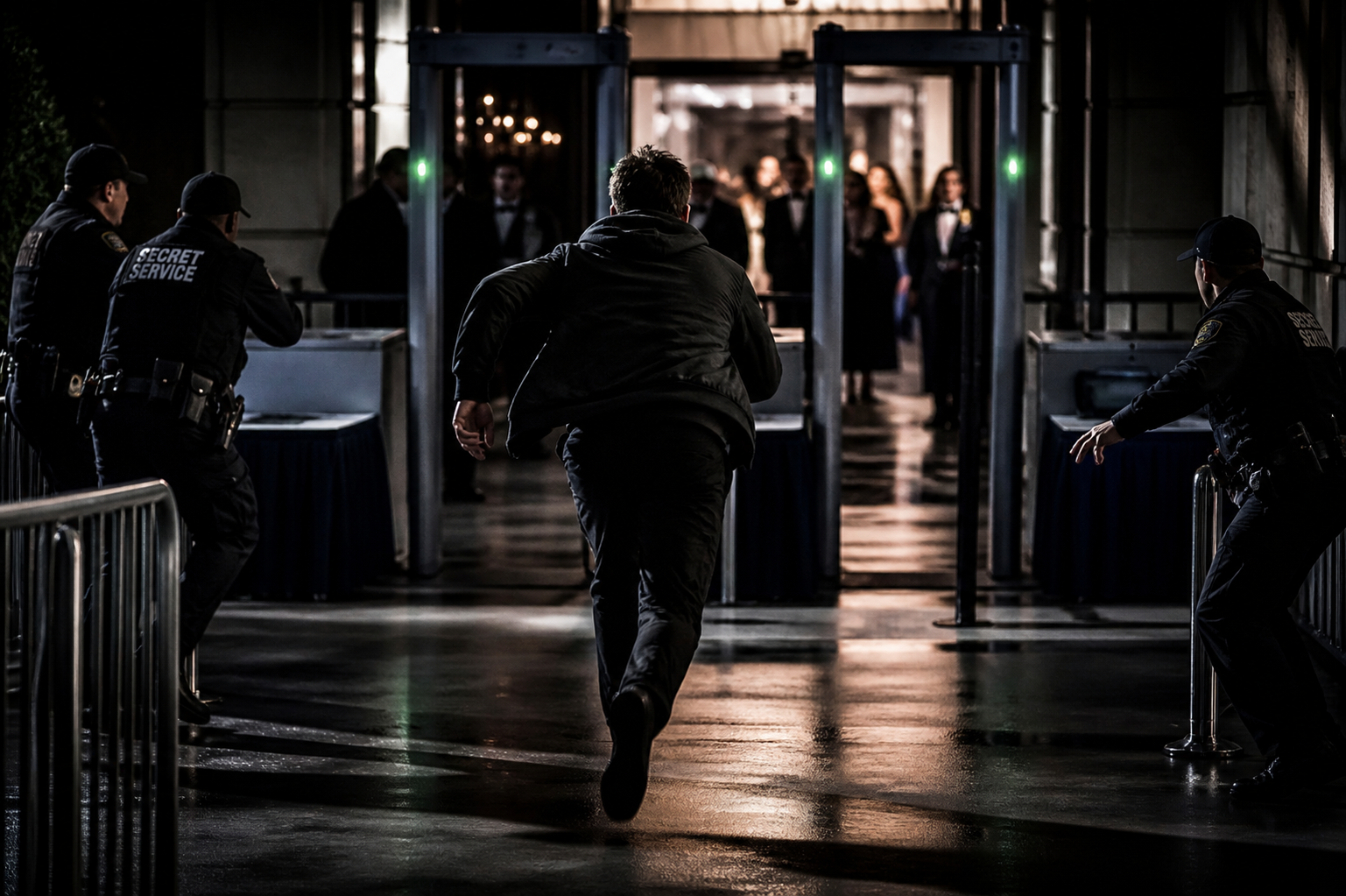
The Moment Security Broke: What The New Trump Attack Footage Reveals
The Six Seconds That Shook Washington: Inside The Alleged Trump Assassination Attempt
For a few seconds, the system failed.
That is the unsettling takeaway from newly released surveillance footage showing a man identified by prosecutors as 31-year-old Cole Tomas Allen charging through a security checkpoint at one of the most tightly protected events in the United States.
The video is short. The implications are not.
What The Footage Actually Shows
The footage, released by federal prosecutors, captures a moment that unfolds faster than most people would expect.
A man emerges from a doorway near a security screening area. He moves quickly and decisively, committing rather than hesitating or testing boundaries. Within moments, he is running directly toward officers stationed at magnetometers.
There is no long standoff. No dramatic escalation. Just movement — fast, direct, and purposeful.
Authorities say Allen was armed with firearms and knives and attempted to push through the outer security layer protecting the White House Correspondents’ Dinner, a high-profile annual event attended by senior political figures, journalists, and, on this occasion, the president of the United States.
The response is immediate. An officer engages. Shots are reported. Within seconds, the suspect is stopped before reaching the inner event space.
And that is the line that held.
What Happened That Night
The incident took place on April 25, 2026, at the Washington Hilton in Washington, D.C., during the White House Correspondents’ Dinner—an event with layered but complex security due to its location in an operating hotel.
According to investigators:
The suspect had checked into the hotel as a guest
He moved through public areas in the hours before the attack
He approached the main screening area where guests were entering the event
He ran past the checkpoint and was confronted by security
Authorities allege the intent was far more serious than a breach.
Allen has been charged with attempting to assassinate the president and other federal offenses. If convicted, he could face life in prison.
But even within that framework, key details remain contested.
The Disputed Seconds That Matter Most
The most important part of the incident—whether the suspect fired his weapon—is not fully settled.
Prosecutors maintain that shots were fired during the confrontation and that a Secret Service officer was struck in a bullet-resistant vest.
However, defense attorneys argue the footage does not clearly show a muzzle flash or definitive evidence that Allen discharged a weapon.
This matters more than it might seem.
Because in cases like this, the difference between what is alleged and what can be proven visually becomes central to the legal outcome.
And here, the video—despite its dramatic nature—leaves space for interpretation.
The Part Most People Will Miss
The story is not just about an attempted attack.
It is about proximity.
The footage suggests the suspect was able to move from a side area to within immediate range of security personnel in seconds — before a coordinated response fully formed.
That does not necessarily mean the system failed overall. The suspect was stopped. The protectee was safe.
But it does mean something more uncomfortable:
The margin between containment and catastrophe was measured in seconds, not minutes.
And in security terms, that margin is everything.
The Structural Problem Behind The Incident
Unlike a sealed government facility, the White House Correspondents’ Dinner takes place inside a functioning hotel — a space with multiple entry points, mixed access levels, and constant movement.
That creates a layered but imperfect security environment.
Even with screening checkpoints, surveillance, and armed personnel, the outer perimeter is not absolute. It cannot be—not without shutting down the building entirely.
Investigators say the suspect exploited exactly that.
He was able to move through non-secured or lightly monitored areas before approaching the checkpoint where the breach occurred.
Such behavior is not unusual in complex venues.
But it is where risk lives.
The Human Factor
The footage also highlights something harder to quantify: reaction time.
Reports suggest that when the suspect emerged, some officers did not immediately focus on an imminent threat.
That is not necessarily negligence. It is reality.
Security at large events involves long periods of normality punctuated by rare, sudden threats.
The challenge is not just having security in place.
It is switching from routine to crisis instantly.
In this case, that switch appears to have happened just in time.
The Motive — And The Unknowns
Authorities say the suspect had expressed grievances against the Trump administration and sent writings to family members before the incident.
But even here, the picture is incomplete.
The writings did not explicitly name the president.
The full motive is still under investigation
Some elements of the prosecution case rely on inference rather than direct statements
This leaves a gap between narrative and proof—one that will likely define the trial.
Why This Story Is Bigger Than It Looks
On the surface, this is a single incident involving a single suspect.
But it sits inside a broader pattern.
Political events in the United States increasingly require complex, layered security — often in spaces that were never designed for it.
Hotels. Conference centers. Public venues.
Places where total control is impossible.
What the footage shows is not just a breach attempt.
It shows how quickly a determined individual can test the limits of that system.
And there is so little time to respond.
The Outcome — And The Reality
The most important fact remains unchanged:
The suspect was stopped before reaching the ballroom.
No high-level targets were harmed.
The system, ultimately, held.
But the footage changes how that outcome is understood.
It was not distant.
It was not controlled.
It was close.
The Final Line
Security failures are often imagined as large, obvious breakdowns.
This was not that.
This was a narrow gap—seconds wide—that nearly became something far worse.
And now, for the first time, everyone can see exactly how close it came.
