The Celebrity Deepfakes Pushing Russia’s Message Are Becoming Almost Impossible To Spot
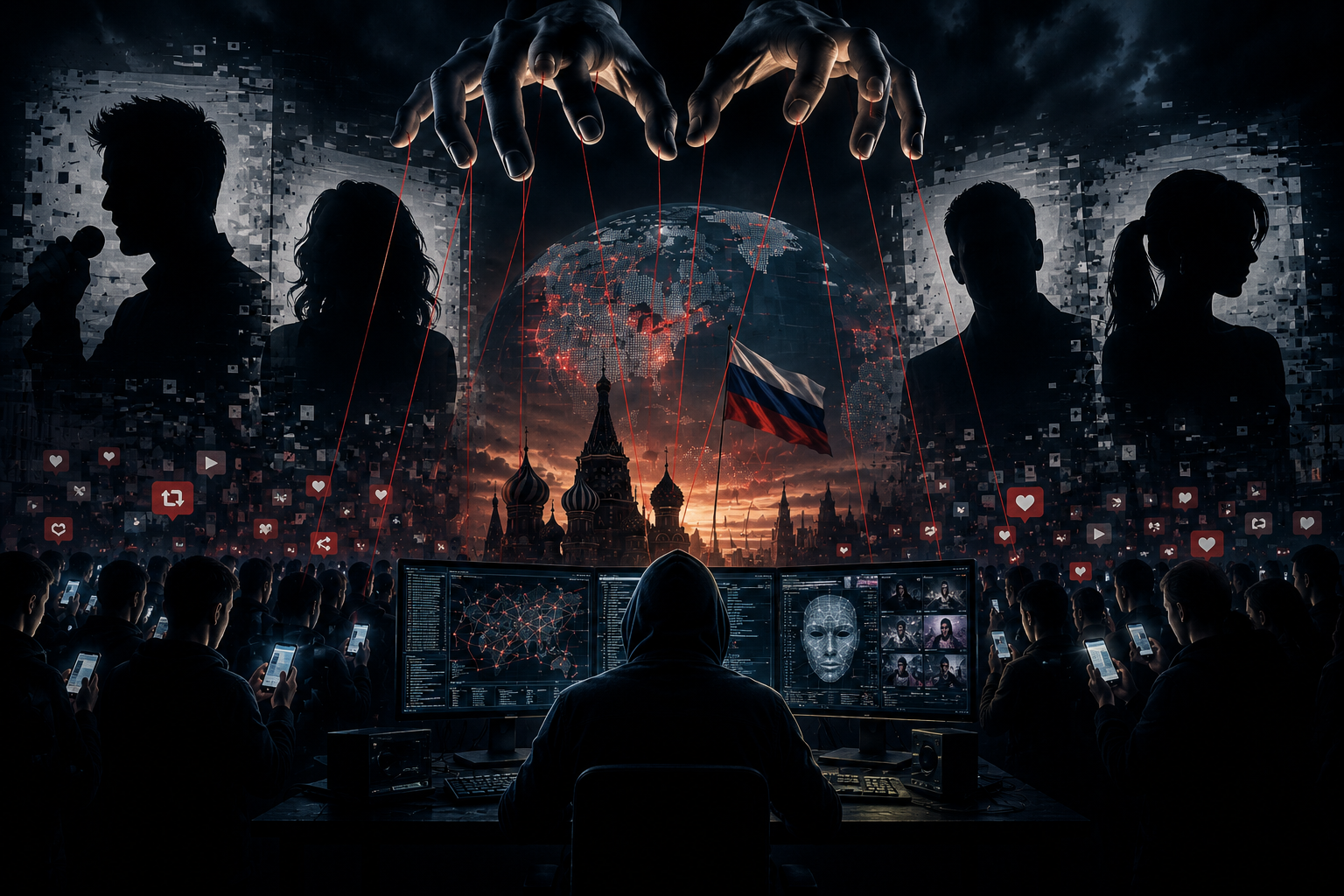
The AI Celebrity Videos Flooding Social Media May Be Part Of A Much Bigger Information War
The fake celebrity videos looked real enough to spread.
A growing wave of AI-generated celebrity deepfakes is being linked to coordinated pro-Russia influence campaigns, exposing how quickly synthetic media is moving from internet novelty into geopolitical weaponry. The videos are designed to imitate actors, influencers, musicians, or public figures closely enough to trigger emotion before viewers stop to question whether what they are seeing is even real.
Researchers and monitoring groups have identified videos circulating across X, TikTok, Telegram, and other platforms that appear to show celebrities criticizing Ukraine, pressuring European leaders, or promoting narratives favorable to Moscow. Some clips allegedly encouraged Western audiences to support peace deals on Russian terms, while others attempted to undermine confidence in NATO governments and Western institutions.
The more profound problem is not simply that fake videos exist. The more profound problem is that they increasingly feel emotionally believable inside fast-moving social feeds where outrage, fear, tribal politics, and algorithmic amplification reward emotional reaction over verification.
The Technology Has Quietly Crossed A Dangerous Threshold
Early deepfakes were often easy to spot. Faces glitched. Eyes looked unnatural. Voices sounded robotic. That protection layer is collapsing fast.
New generative AI systems can now create realistic speech patterns, facial movements, emotional expressions, lighting consistency, and lip synchronization with alarming accuracy. Researchers increasingly warn that the quality gap between authentic footage and manipulated footage is shrinking faster than most institutions can respond to.
That changes the psychology of misinformation completely.
The old internet usually relied on crude fake posts, edited images, or misleading headlines. Modern AI propaganda can manufacture emotionally convincing “evidence” at an industrial scale. The combination of synthetic video, cloned voices, fake subtitles, manipulated context, and platform algorithms creates a system where emotional impact often arrives before truth has time to catch up.
That is part of why AI is already reshaping trust, politics, and human behavior faster than many governments seem prepared for.
Celebrity culture has become a perfect psychological delivery system.
Celebrity faces carry emotional familiarity. People instinctively recognize them. Trust them. Share them. React to them. That makes celebrities uniquely useful inside modern influence operations.
A political speech from an unknown account may struggle to spread. A convincing fake video appearing to show a famous actor, athlete, or musician suddenly talking about war, corruption, Western hypocrisy, or government failure has far more viral potential.
Researchers studying synthetic media increasingly warn that celebrity manipulation works because it bypasses traditional political skepticism. Many viewers process the emotional reaction before they process the authenticity question.
That creates a dangerous hybrid between entertainment culture and psychological operations.
The internet already struggles to separate authentic emotion from performative content. AI deepfakes push that instability much further by turning recognizable human identities into infinitely reusable digital assets that can be manipulated, repackaged, and weaponized at scale.
The Goal Is Bigger Than Convincing Everyone
One of the most misunderstood parts of modern disinformation campaigns is that they do not necessarily need universal belief to succeed.
Confusion itself can become the objective.
Experts increasingly describe a strategy where the sheer volume of manipulated content gradually weakens public confidence in reality itself. If people stop trusting videos, photos, institutions, journalists, governments, elections, or even direct visual evidence, the information environment becomes easier to destabilize.
That is part of why deepfake propaganda feels bigger than isolated fake clips.
The long-term effect is erosion.
People begin asking whether any footageis trustworthyd. It is unclear whether every scandal is fake. We need to determine whether every denial is fake. Whether every viral moment is manipulated. Eventually, uncertainty itself becomes politically useful.
That broader collapse of trust is becoming one of the defining risks of the AI era.
The Russia-Ukraine War Has Become A Testing Ground
The Russia-Ukraine conflict has accelerated experimentation around AI-generated propaganda, deepfake media, synthetic news, and coordinated online influence operations. Multiple reports and studies now describe the war as a live testing environment for modern information warfare techniques.
Some campaigns appear highly coordinated. Others operate through looser networks of influencers, repost accounts, anonymous channels, automated amplification systems, or opportunistic actors piggybacking on geopolitical chaos.
The key factor is speed.
AI drastically lowers the cost of producing persuasive media. A campaign that previously required editing teams, graphic designers, translators, actors, and distribution infrastructure can now be executed with far fewer resources. Synthetic media also scales globally far faster because AI translation systems allow narratives to spread across multiple languages almost instantly.
That matters because information warfare increasingly behaves like software.
It updates rapidly. Evolves rapidly. Replicates rapidly. And once manipulated content spreads widely enough, removing it rarely fully reverses the damage.
Social Media Platforms Are Struggling To Keep Up
Platforms remain trapped between scale, moderation, politics, free speech arguments, and the technical difficulty of identifying increasingly sophisticated synthetic media.
Even when we detect manipulated videos, the correction cycle often arrives too late. Millions may already have seen, shared, downloaded, reposted, clipped, or emotionally absorbed the content before warnings appear.
The economics of viral content also complicate everything. Emotional outrage drives engagement. Engagement drives platform activity. Platform activity drives advertising revenue. AI-generated propaganda exploits exactly the same attention systems that already reward sensationalism online.
The result is a digital ecosystem where synthetic political manipulation can spread with extraordinary efficiency.
That is part of why the future of AI increasingly looks tied to questions of power, control, infrastructure, and public trust.
The Real Crisis Is What Happens Next
The most unsettling part of the deepfake era may not be the current wave of fake celebrity propaganda videos. It may be how normal all of these videos could soon become.
As generative AI becomes cheaper and easier to use, the barrier to creating persuasive misinformation keeps collapsing. Governments, criminal groups, extremists, propagandists, scammers, trolls, and ideological movements all gain access to tools that previously belonged only to sophisticated intelligence operations or professional studios.
The internet was already struggling under misinformation pressure before synthetic video reached this level.
Now the emotional power of celebrity culture, algorithmic amplification, AI image generation, cloned voices, geopolitical conflict, and mass distrust are colliding at the same time.
That combination may become one of the defining information risks of the decade.
