The Deadliest U.S. Shooting in Years Was Not Random
Seven of His Own: The Unfathomable Violence Inside One Family
A Father, Eight Children, and a Morning That Shattered a City
What is confirmed, what remains unknown, and the deeper pattern behind one of the most disturbing mass killings in recent U.S. history
This incident was not random violence. It happened inside a family.
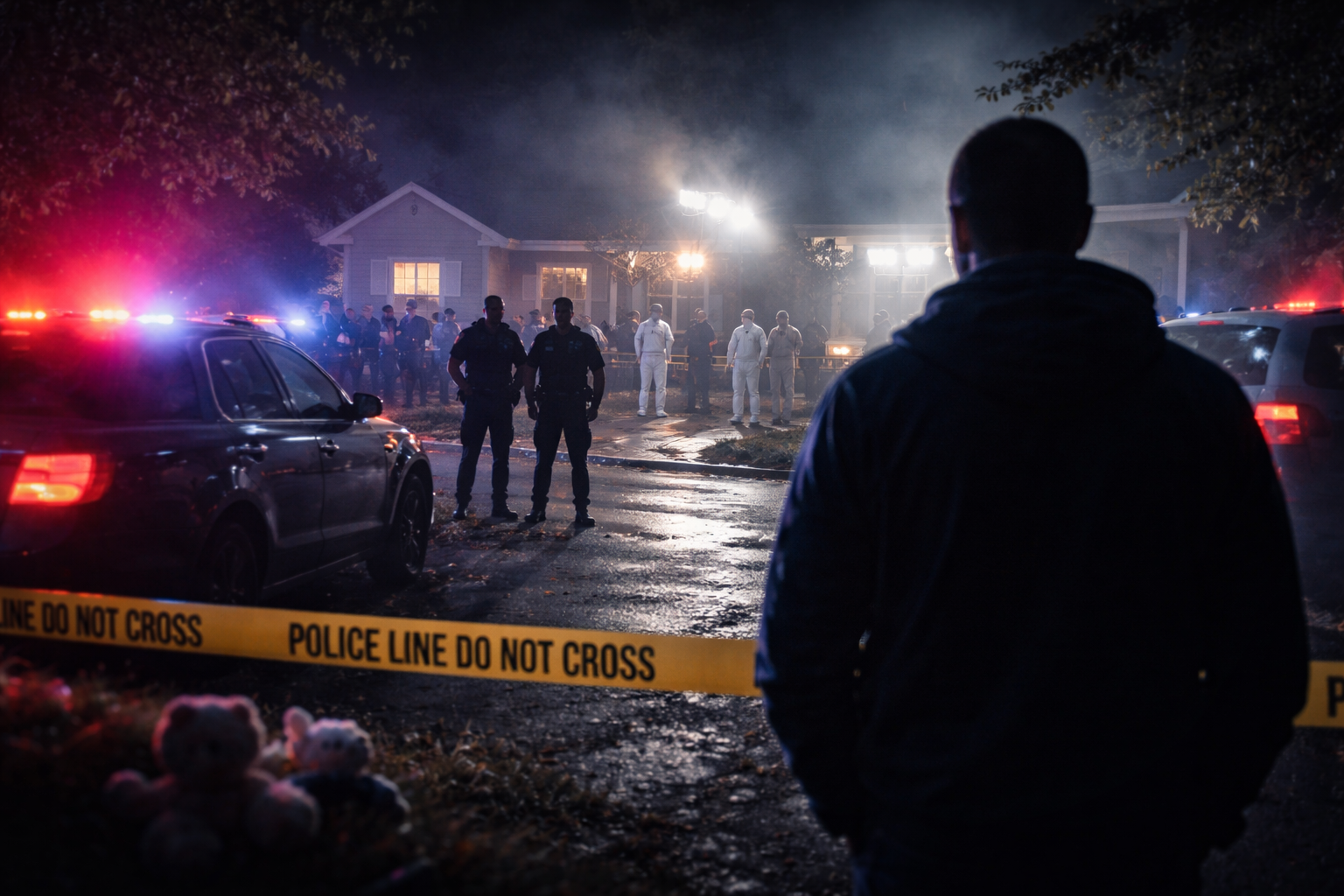
In Shreveport, Louisiana, a man killed eight children—seven of them his own—in a sequence of shootings that began as a domestic incident and ended in a police pursuit. The scale is shocking. The setting is worse. Most mass shootings are framed as public threats. This one forces attention somewhere more uncomfortable: the home.
Here is what is known—and what still isn’t.
What Happened
The violence unfolded across multiple nearby homes in a residential neighborhood. Authorities have identified the suspect as Shamar Elkins, who first shot a woman before relocating to another location where he killed the children. killed.
Eight children were killed
Seven were his own children
One was another child connected to the household
Two women were critically injured
A teenage boy survived after jumping from a roof to escape
The children were young—ranging from toddlers to early teens.
Following the shootings, the suspect fled, carjacked a vehicle, and police shot him dead after a pursuit.
The entire sequence—from first shot to police confrontation—unfolded rapidly across several connected scenes.
The Victims
Eight children.
That number is simple to read and impossible to process.
Most were siblings
All were under the age of mid-teens
Some reports indicate several were shot while asleep
One child died attempting to escape
Another survived by jumping from a roof
This attack was not collateral damage. It was targeted, close-range, intimate violence.
The Perpetrator
Shamar Elkins, aged in his early 30s.
What is confirmed about him:
Father of seven of the victims
Previously arrested on firearms charges in 2019
Former member of the Louisiana National Guard
What is emerging but not fully established:
He was reportedly in the middle of a relationship breakdown or separation
Family members suggested he had been emotionally distressed
There are indications of deteriorating mental state prior to the attack
Authorities have not confirmed a definitive motive.
Motive: What We Know—and What We Don’t
Officially, the attack is being treated as domestic in nature.
That matters, because it places this event in a specific category of violence: familicide, sometimes referred to as “family annihilation.”
What is confirmed:
The victims were directly connected to the perpetrator
The violence began within a domestic setting
There is no evidence of a wider external target
What remains unknown:
The precise trigger
Whether there was prior documented domestic violence
The exact sequence of emotional or psychological escalation
In cases like these, a single clean motive rarely exists. It is usually a convergence: personal crisis, relationship collapse, control loss, and psychological breakdown.
The Pattern Most People Miss
The event was not a public attack that moved inward.
It was a private collapse that exploded outward.
A large proportion of mass killings in the U.S. involve victims known to the perpetrator—often family members.
That changes the frame completely.
The threat is not always ideological, random, or external.
It is often:
Domestic instability
Relationship breakdown
Emotional crisis without intervention
Access to a weapon at the moment of collapse
This case is extreme—but the underlying pattern is not rare.
Why This Case Feels Different
Even among domestic mass killings, this instance stands out.
The number of child victims
The direct parent-child relationship
The apparent speed of escalation
The multiple locations involved
It pushes beyond tragedy into something harder to categorize: a complete psychological rupture.
What Happens Next
The investigation will focus on:
Communication history leading up to the incident
Relationship dynamics and legal context
Mental health signals or prior warnings
Weapon access and ownership
There are three likely outcomes from here:
Most likely:
A clearer picture of personal crisis emerges, but no single “why” fully explains the act.
Most dangerous:
The event becomes absorbed into broader debates without addressing domestic risk factors.
Most underestimated:
Attention shifts away quickly—despite the pattern being one of the most persistent drivers of mass violence.
The Hard Reality
This case will be discussed as a mass shooting.
But that label hides something more important.
This was a family event before it was a national one.
Eight children were not caught in crossfire.
They were at the center of it.
And that forces a more difficult conclusion than most headlines allow:
The most dangerous place, in moments like these, is not always public.
Occasionally, it is where people assume they are safest.
