Veterans Arrested Inside Capitol in Dramatic Stand Against Iran War
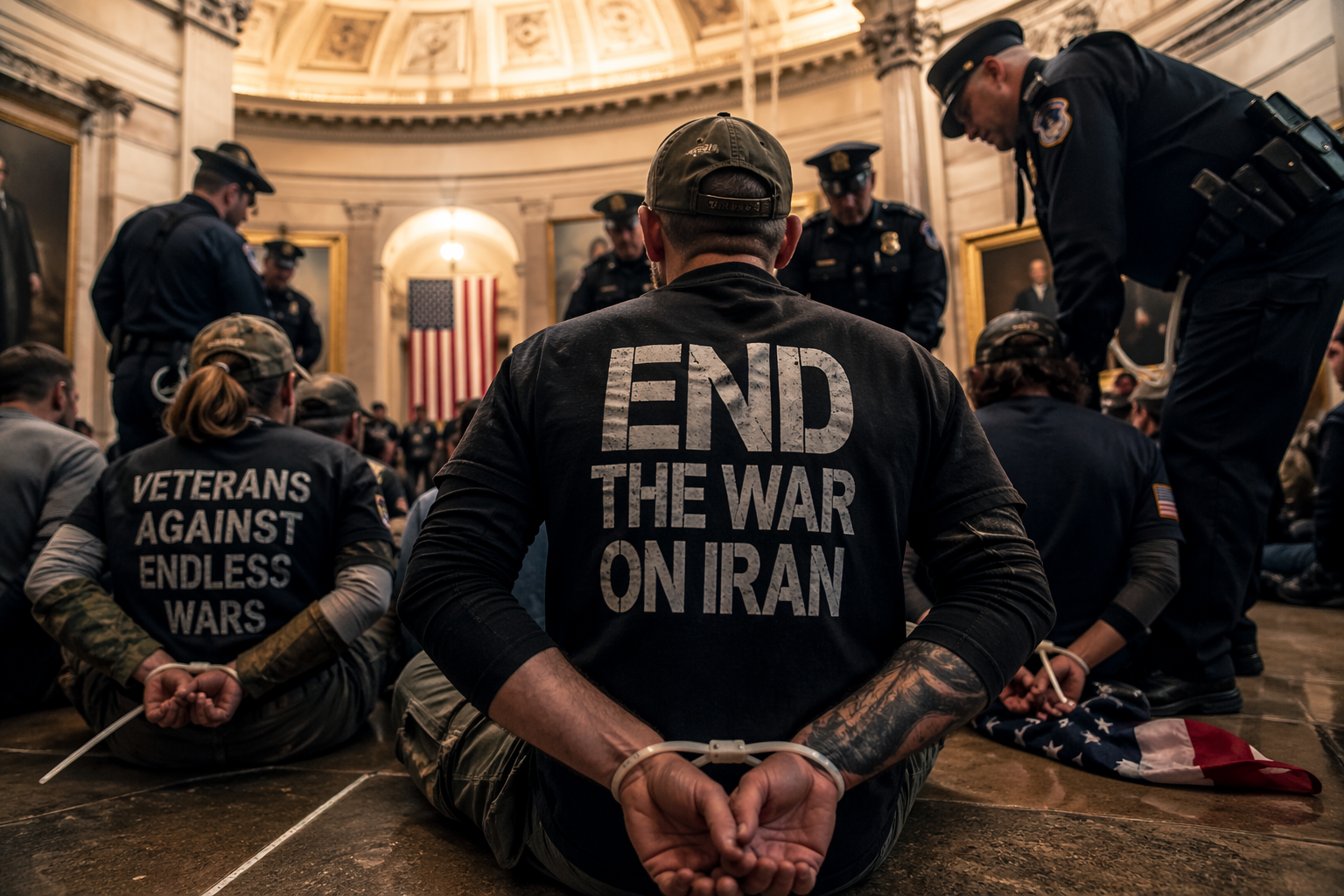
Inside the Capitol Protest That Ended in Arrests—and a Warning to Washington
War Comes Home: Veterans Arrested in High-Stakes Capitol Sit-In
Dozens of former service members staged a rare act of civil disobedience inside Congress—turning foreign war into a domestic flashpoint
They once carried out orders. This time, they refused.
Inside one of the most symbolic spaces in American power, dozens of military veterans—some visibly disabled, some in uniform, some carrying folded flags—stood in silent protest against the war with Iran. Minutes later, they were being led away in handcuffs.
The images are already spreading. They convey a message that goes beyond a typical protest: when those who fought in the last wars begin openly resisting the next one, a fundamental shift has occurred.
What Happened Inside the Capitol
The protest unfolded inside a congressional office building on Capitol Hill, where a group of veterans and military family members staged a coordinated sit-in.
Around 60 individuals were arrested after refusing orders to disperse
Many participants were veterans of previous conflicts, including some with visible injuries or disabilities
Protesters displayed banners reading “End the War on Iran” and conducted symbolic acts such as flag-folding ceremonies
This gathering was not a chaotic protest. It was deliberate, controlled, and highly symbolic—designed to force confrontation in the most visible political space possible.
Why This Protest Is Different
Anti-war demonstrations are not new. However, this protest holds a unique significance.
These are not students, activists, or career protesters. These are people who have already lived the consequences of war.
That changes the optics—and the politics.
Veterans have a unique moral authority in public debate. When they protest:
It becomes harder to dismiss the movement as uninformed
It reframes opposition as experience-based rather than ideological
It raises uncomfortable questions about whether lessons from past wars are being ignored
In simple terms, this is not just dissent. It is testimony.
The War Is No Longer Distant
What makes this moment more volatile is timing.
The Iran conflict has already begun reshaping global markets, political alliances, and domestic debate. Economic shocks—especially energy disruption—are feeding into public frustration, while uncertainty around escalation continues to grow.
At the same time, protests are spreading.
Demonstrations in major cities have already led to mass arrests
Anti-war sentiment is building across multiple political groups
Activist networks are increasingly coordinating high-visibility actions
In that context, the Capitol protest is not an isolated event. It is a signal.
What Media Misses
The surface story is simple: veterans protested, and police arrested them.
The deeper story is more dangerous for policymakers.
This protest collapses the usual distance between war and society.
For decades, policymakers have fought modern conflicts far from home—geographically, psychologically, and politically. A small segment of the population bears the burden.
That model depends on one key condition: most people must feel detached.
This protest breaks that condition.
When veterans occupy Congress itself, the message is clear:
The consequences of war are not abstract—and they are not contained.
A Movement That Could Grow
There are early signs the movement may not stop here.
Veteran-led movements historically follow a pattern:
Small symbolic protests
Rapid amplification through media and social platforms
Broader civilian alignment
Political pressure that becomes harder to ignore
We are somewhere between stages one and two.
What makes this movement especially potent is credibility. Veteran protests have historically played a pivotal role in shifting public opinion—particularly when wars begin to lose support.
Already, organizers are framing the conflict as
Economically damaging
Strategically questionable
Morally costly
That combination is politically combustible.
What Happens Next
Three potential paths are currently being explored:
Most Likely:
Protests expand gradually, with more coordinated demonstrations in major cities and government spaces.
Most Dangerous:
A trigger event—casualties, escalation, or economic shock—rapidly accelerates public backlash and polarization.
Most Underestimated:
Veteran-led dissent begins influencing political insiders, quietly shifting debate inside Congress itself.
Because once opposition reaches people with both lived experience and institutional credibility, it becomes harder to contain.
The Real Shift
This is the moment where war stops being something “over there.”
It transforms into a topic of debate within the halls of power, driven by those who have already borne the cost, and becomes so prominent that it can no longer be overlooked.
The arrests will fade from headlines.
The image will not.
Veterans—standing in silence, inside the Capitol, refusing to move—have already changed the shape of the conversation.
And once that line is crossed, it rarely goes back.
