

The “Donroe Doctrine” After Venezuela: What Doctrine-Talk Means in Sanctions, Oil Control, and Hemispheric Power
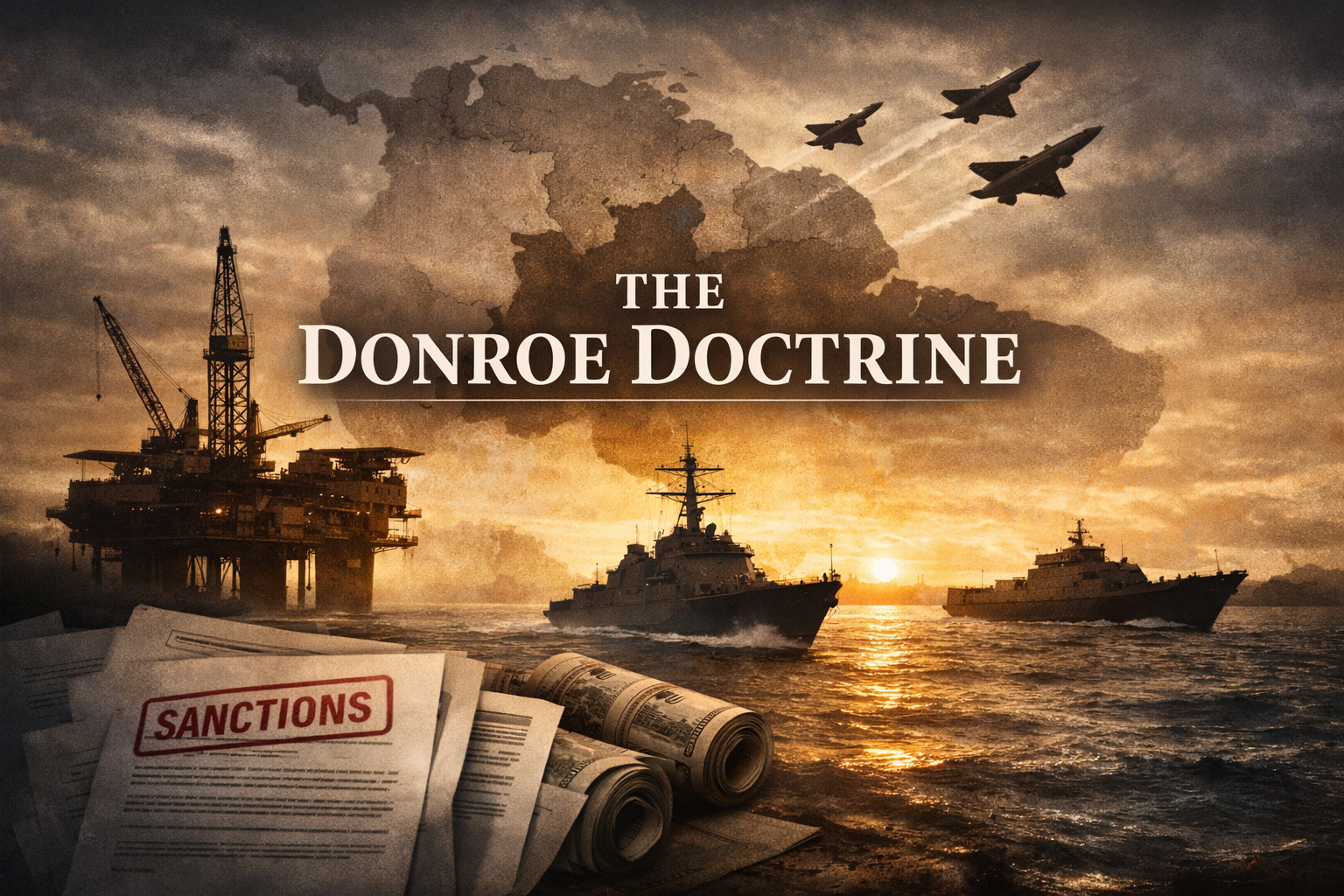
Donroe Doctrine signals a new U.S. hemisphere posture—here’s what it means for Venezuela sanctions, oil control, maritime enforcement, and escalation risk.
As of January 8, 2026, the White House is presenting the Venezuela operation as more than a one-off strike. The president has framed it as a new era of a “Donroe Doctrine,” a play on the Monroe Doctrine that signals a claim of primacy across the Western Hemisphere.
That shift matters because doctrine language is not mainly about rhetoric. It is a promise of repeatable policy. If the administration intends to make this real, the mechanics will show up in a small number of levers: who gets legal permission to buy and move Venezuelan oil, which government Washington treats as legitimate, how aggressively U.S. forces police shipping lanes, and how hard the U.S. dares to push an escalation ladder in the face of Congress, courts, and regional blowback.
This piece translates the doctrine label into the actionable tools that would make it operative, and the steps that would signal the next stage.
The story turns on whether Washington can turn a shock operation into durable leverage without triggering a wider regional backlash or a domestic constraint that forces a climbdown.
Key Points
“Donroe Doctrine” framing is a doctrine-level signal: it suggests repeatable policy across the hemisphere, not a single Venezuela-specific action.
The practical toolkit is narrow and powerful: sanctions licensing, recognition and conditionality, maritime enforcement, and control of oil revenue channels.
Oil “control” is not a slogan; it is paperwork, ports, insurance, banking, shipping permissions, and the credible threat of interdiction.
The doctrine’s biggest near-term test is domestic: war-powers pushback and legal scrutiny can limit follow-on strikes, even if sanctions and seizures continue.
The biggest international test is China: redirecting Venezuelan flows away from Chinese buyers is leverage, but it also creates retaliation risk for U.S. firms abroad.
Watch for three tells of escalation: broader interdictions at sea, tighter conditions attached to licenses/waivers, and any move from “pressure” to “stabilisation” on the ground.
Background
The original Monroe Doctrine, articulated in 1823, warned European powers against expanding their influence in the Americas. It was a boundary-setting statement, not a day-to-day enforcement regime. Over time, U.S. policy in the region has oscillated between restraint and intervention, and between diplomatic influence and coercive tools.
In the current episode, the administration has paired force with a claim of hemispheric authority. The Venezuela operation has been presented as a turning point, and the president’s doctrine language implies a wider posture: the hemisphere as a strategic zone where outside powers, especially major rivals, are to be pushed back.
At the same time, the administration’s agenda is colliding with domestic checks. Congress is already signalling unease about open-ended military commitments, even while many lawmakers support pressure on Venezuela. This matters because doctrine only holds if it can survive the U.S. system’s internal friction.
Analysis
Political and Geopolitical Dimensions
Doctrine branding is aimed at three audiences at once.
First is Latin America. The message is deterrence through example: the U.S. is willing to act unilaterally and then impose terms. That can intimidate smaller states, but it also encourages regional hedging. Countries that dislike a precedent of “decapitation” style operations will not need to love Caracas to dislike Washington’s method.
Second is U.S. rivals. A doctrine frame is a warning to China, Russia, and Iran that their footholds in the hemisphere can be treated as targets, not facts of life. The most direct way this plays out is not speeches. It is pressure on governments to sever energy ties, deny port services, and limit financial channels that connect sanctioned systems to global markets.
Third is domestic U.S. politics. Framing the operation as a doctrine is a bid to normalise a wider campaign. But that invites a counter-mobilisation: war-powers resolutions, court challenges, and intra-party splits between hawks and constitutionalists. If the administration wants to keep freedom of action, it must keep follow-on steps below the political pain threshold.
Recognition is the political lever with the most consequences. If Washington recognises an interim authority, it can claim legal and diplomatic cover for licensing decisions, revenue controls, and contract approvals. If recognition stays ambiguous, the U.S. can still squeeze oil flows, but every contract becomes more fragile, and every “reconstruction” promise looks more like extraction.
Economic and Market Impact
Oil is the centerpiece because it is Venezuela’s most liquid source of power and the U.S. system already knows how to weaponise it.
Sanctions do not just restrict a government. They shape who can buy cargoes, which ships can insure voyages, which banks can clear payments, and which companies can touch infrastructure without criminal exposure. That is why “oil control” is credible even without troops on wells: the U.S. can make most legal buyers disappear.
If the U.S. selectively relaxes sanctions while keeping enforcement tight, it creates a funnel. Oil can move, but only through approved channels, under terms the U.S. can adjust. That turns revenue into a dial: loosen it to reward compliance, tighten it to punish defiance.
There is also a second-order market effect. If Washington can steer Venezuelan barrels, it gains a form of discretionary supply influence. That matters for prices, for refiners that depend on certain crude grades, and for geopolitics beyond the hemisphere, because displaced buyers do not vanish. They bid for other barrels.
The risk sits with U.S. firms. If American companies are invited to step into assets previously tied to rival-state interests, they face long legal shadows and potential retaliation abroad. Even if the deals are profitable, they can turn U.S. multinationals into hostages of geopolitics.
Social and Cultural Fallout
The human layer is easy to lose in doctrine talk. Venezuelans experience these moves as immediate scarcity or relief: fuel availability, inflation, remittances, and whether basic services function. Diaspora communities, especially in U.S. cities, will amplify moral narratives that pull policy toward harder lines or faster results.
Across the region, public opinion will split along familiar lines: anti-authoritarian sentiment versus anti-intervention reflex. The more the policy looks like “control” rather than “transition,” the more it fuels nationalist backlash even among governments that privately want Maduro-era networks weakened.
In the U.S., the social politics are about mission creep. Voters may support decisive action; they tend to punish open-ended stabilisation. That gap is where war-powers fights, leaks, and partisan fractures grow.
Technological and Security Implications
If the doctrine becomes real, maritime enforcement becomes routine.
Sanctions enforcement at sea is an intelligence-and-technology problem: tracking ship identity games, routing anomalies, flag changes, spoofed location signals, and the financial plumbing behind “shadow” shipping. Enforcement also relies on partners: port states, insurers, classification societies, and banks.
This is where doctrine hardens into daily posture. A U.S. “blockade” style approach, even if framed as sanctions enforcement, forces every shipper and trader to calculate seizure risk. That changes behaviour faster than speeches do.
The security risk is escalation by accident. Interdictions can turn into standoffs. Misidentification or overreach can pull in third-country crews, trigger retaliation, or create a cascade of tit-for-tat moves that outpace political control.
What Most Coverage Misses
Most coverage treats “Donroe Doctrine” as a vibe: swagger, imperial throwback, or domestic messaging. The missing piece is that the doctrine’s real grammar is administrative.
The policy will live or die in waivers, licenses, escrow-like revenue controls, shipping approvals, and enforcement tempo. If the U.S. keeps sanctions broad but issues narrow permissions with heavy conditions, it effectively governs the oil economy without formally governing the country.
The second missed element is the escalation ladder’s asymmetry. Washington can escalate economically and maritime-first, staying below the public threshold of “war,” while still exerting coercive control. That makes it easier to sustain politically, but also easier to slide into a new normal of constant confrontation.
Why This Matters
For Venezuela, the stakes are sovereignty and survival: who controls revenue, who can import essentials, and whether any transition has legitimacy. For Latin America, the precedent is just as important as the target: whether the U.S. is returning to sphere-of-influence enforcement as a default tool.
For global markets, the issue is not just short-term price volatility. It is whether the U.S. is building a template for “security-managed supply” in the hemisphere, where barrels move when Washington allows it, to buyers Washington prefers.
For the U.S., the near-term hinge points are congressional constraint and international coordination. A war-powers push in the Senate is a sign that even some supporters want guardrails. Abroad, watch whether key regional powers cooperate quietly, resist loudly, or try to sit on both sides of the fence.
Real-World Impact
A Gulf Coast refiner planning its quarter worries less about doctrine labels and more about whether certain heavy crude flows will be steady, interrupted, or suddenly re-routed.
A shipping operator watches enforcement signals: which flags are being stopped, which insurers are getting nervous, and whether a routine voyage now carries seizure risk.
A Colombian exporter selling into U.S.-linked supply chains worries about diplomatic spillover: tighter border security postures, pressure campaigns, and the knock-on effect on trade confidence.
A Venezuelan family measuring daily life in supermarket prices cares whether revenue controls translate into restored services and stabilised currency, or into new bottlenecks and fresh corruption.
The Escalation Ladder Ahead
The first rung is rhetorical doctrine plus selective enforcement. That looks like speeches, symbolic seizures, and narrow licensing decisions designed to prove control without broad disruption.
The second rung is economic tightening with a clear compliance menu. Expect explicit conditions tied to oil permissions: who can sign contracts, which foreign partners must be cut out, which reforms must be enacted, and where revenues must be held.
The third rung is routine maritime interdiction. If the U.S. treats sanctions enforcement as a standing naval mission around Venezuela, it raises the cost of evasion dramatically and turns “control” into a lived reality for traders.
The fourth rung is de facto trusteeship over oil cashflows. This is the moment revenue stops being merely restricted and becomes directed: proceeds routed into controlled accounts and disbursed under U.S.-set criteria.
The fifth rung is political reconstruction by contract. This would mean U.S. firms returning at scale under protective licensing, with infrastructure deals tied to political outcomes, and with rivals formally excluded.
The sixth rung is stabilisation by force. That is where mission creep begins: advisors, security arrangements, protection of infrastructure, and the argument that control requires presence.
The clearest signposts will be boring on paper and huge in consequence: the scope of licensing, the breadth of interdiction, the structure of oil revenue custody, and whether Congress succeeds in forcing a vote that raises the political price of the next strike.
