

The Funniest New Cambridge Dictionary Words Prove The Internet Has Won English
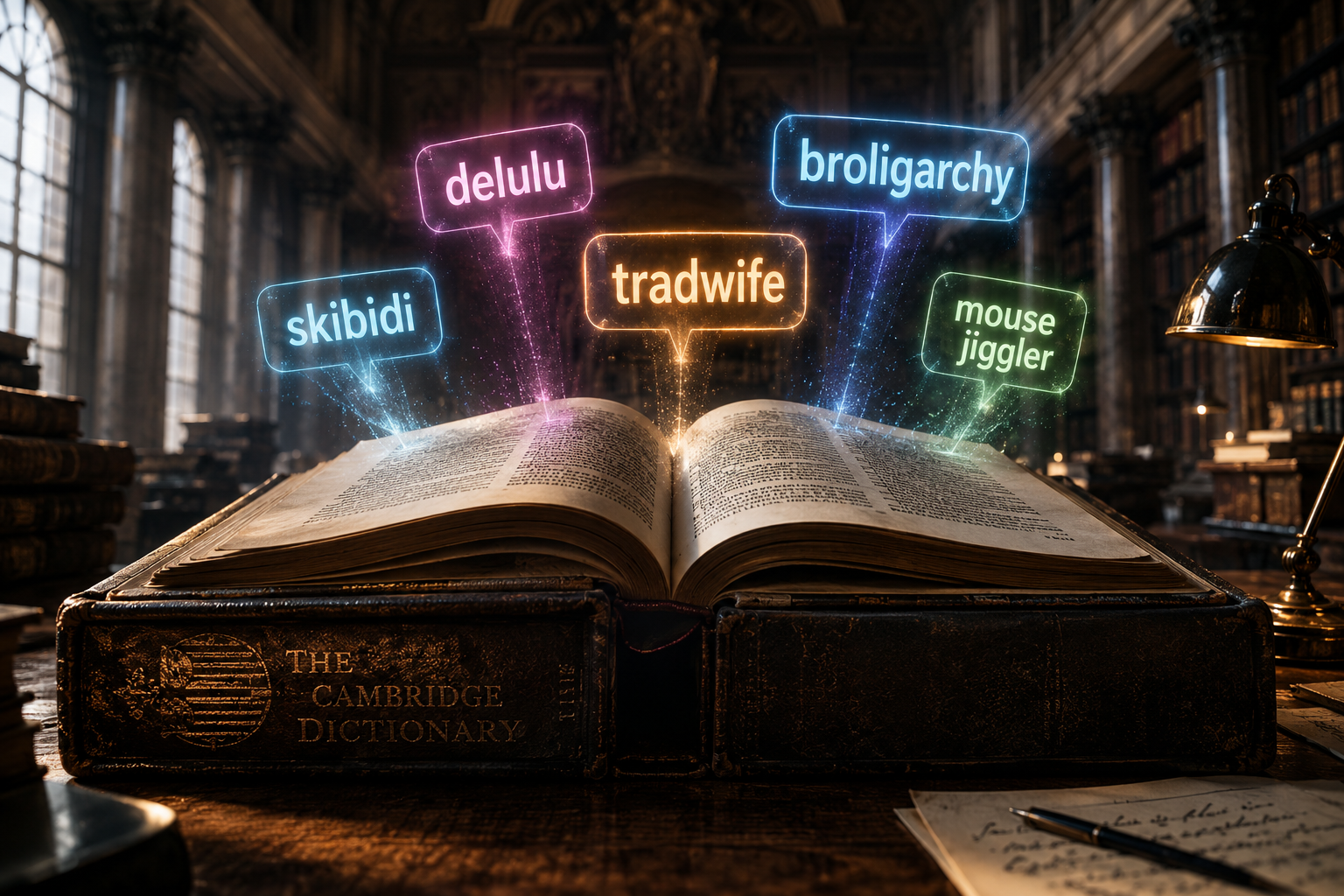
Skibidi, Delulu And Tradwife Are Now Officially Dictionary Words
The Group Chat Has Officially Reached The Dictionary
Cambridge Dictionary has added more than 6,000 new words, phrases and meanings, including several that feel less like traditional English and more like a teenager dropped their phone into a university library. The most eye-catching additions include “skibidi,” “delulu,” “tradwife” and “broligarchy,” all confirmed among recent Cambridge Dictionary updates.The funny part is not just that these words exist. It is that they have crossed the invisible line between online noise and recorded language. A dictionary does not usually invent words. It admits defeat after everyone else has already started using them.
That is why this latest update feels so entertaining. It is not simply a list of slang. It is a cultural receipt. Cambridge has effectively looked at the internet, the workplace, TikTok, remote work, influencer culture, and modern politics, then said: fine, apparently this is English now."
Number Ten: 15-Minute City
The least funny word on the list is “15-minute city,” but it earns its place because of how strangely dramatic it became. On paper, it means an urban planning idea where people can access most daily needs within a short walk, cycle, or public transport journey. In practice, it somehow became a phrase capable of making parts of the internet behave as if a pedestrianized high street were the opening scene of a dystopian thriller.
That is the comedy. The phrase itself is sensible, almost painfully municipal. It sounds like something said by a council planner wearing a fleece gilet and pointing at a laminated map. Yet around it grew suspicion, argument, and culture-war energy wildly disproportionate to the actual words.
Number Nine: Snackable
“Snackable” is one of those words that makes you feel slightly worse about civilization, but only slightly. It means content that is easy to consume quickly, especially online. It is usually used for short videos, short articles, quick clips and anything designed to be swallowed by the brain before the brain notices it has been fed.
It is funny because it makes information sound like crisps. A serious political explainer can now be “snackable.” A science discovery can be “snackable.” A human being’s entire attention span can apparently be reduced to something between a Mini Cheddar and a TikTok carousel.
Number Eight: Work Spouse
“Work spouse” is funny because it sounds like a harmless office joke until HR starts sweating. It describes a close colleague with whom someone has a particularly trusted, supportive or emotionally familiar relationship at work. The phrase has been around in real use for years, but its dictionary-level recognition captures something very modern about blurred boundaries.
The workplace has always had alliances, confidants, and people who know exactly which meeting could have been an email. “Work spouse” gives that relationship a sitcom label. It is affectionate, awkward and faintly dangerous, especially if someone’s actual spouse hears it at the Christmas party.
Number Seven: Inspo
“Inspo” is short for inspiration, which is already a fairly clear word. But modern English does not always shorten words because it needs to. Sometimes it shortens words because everyone is typing with one thumb while pretending not to be on their phone.
It is funny because it sounds like inspiration after it has been put through a smoothie maker. Interiors inspo. Outfit inspo. Gym inspo. Dinner inspo. Life inspo. It is the language of mood boards, algorithms and people who own too many beige storage baskets.
Number Six: Lewk
“Lewk” is “look” with extra theatricality. It usually means a distinctive, striking, or carefully styled fashion appearance. A look is what you wear to leave the house. A lewk is what you wear when you want someone to say, “Go on then,” even if you are only going to a bottomless brunch in Solihull.
The humor is in the spelling. “Lewk” already sounds like it has cheekbones. It is a word, wearing sunglasses indoors. It does not want to be practical. It wants to be photographed near a suspiciously clean staircase.
Number Five: Tradwife
“Tradwife” is funny in a darker, sharper way. Cambridge’s recent update includes it as a term for a woman, especially one visible online, who embraces traditional wife or homemaker roles.
The comedy comes from the contradiction. It presents itself as a return to the old world but often arrives through very modern tools: social media platforms, ring lights, brand partnerships, comment sections and carefully staged domestic perfection. The tradwife may be rejecting modern chaos, but she is often doing it in high resolution with affiliate links.
Funny score: 8 out of 10. A 1950s kitchen aesthetic filtered through TikTok, monetization, and a sourdough starter with its own personal brand.
Number Four: Mouse Jiggler
“Mouse jiggler” is one of the bleakest and funniest new terms because it explains an entire era of remote work in two words. It refers to a device or software tool that makes a computer appear active, even when the person is not actually working. Cambridge-linked coverage of the update identified “mouse jiggler” among the new practical workplace terms recognised in the wider batch.
This is workplace comedy at its purest. The employer pretends a green status dot proves productivity. The employee pretends to be available. The mouse jiggler pretends to move. Everyone involved knows the system is ridiculous, but the calendar invitation still says “quick sync.”
Number Three: Broligarchy
“Broligarchy” is not the silliest word, but it may be the sharpest. It blends “bro” and “oligarchy” to describe a small group of wealthy, powerful men, especially in the technology world, who hold or seek political and cultural influence. Cambridge included it among the high-profile new additions alongside “skibidi,” "delulu," and “tradwife.”
The genius of the word is that it sounds ridiculous while being brutally specific. “Oligarchy” alone feels heavy and historical. “Broligarchy” adds hoodies, podcasts, seed funding, rockets, supplement stacks and a man explaining the future of civilization while sitting on a very expensive stool.
Number Two: Delulu
“Delulu” is probably the most useful funny word on the list. It is short for delusional and describes believing something unrealistic, usually because you want it to be true. Cambridge highlighted it as one of the major new additions, and its rise shows how internet language can move from fandom slang into mainstream public speech.
The reason it works is simple: everyone knows someone delulu. Dating apps are delulu. Political promises can be delulu. A man saying he is “just popping out for one pint” on a Friday in Merseyside is operating at a level of delulu that should probably be peer-reviewed.
The best real-world example is “delulu with no solulu,” used by Australian Prime Minister Anthony Albanese in parliament on 26 March 2025. Hansard records him saying: “They are delulu with no solulu,” meaning delusional with no solution.
Number One: Skibidi
“Skibidi” is the funniest new Cambridge Dictionary word because it barely has the manners to mean anything. It can mean “cool,” it can mean “bad,” or it can be used with no real meaning at all, usually for comic effect. Cambridge’s own update confirmed it as one of the headline additions, with wider reporting noting its connection to online meme culture and the viral “Skibidi Toilet” phenomenon.
That is why it wins. Most words point at something. “Skibidi” wanders into the room wearing a traffic cone, knocks over the furniture, refuses to elaborate and somehow becomes official English.
It is not the most useful word. It is not the most elegant word. It is not even necessarily a word that should be trusted with cutlery. But it captures the absurdity of modern language better than anything else on the list.
The Best Real-Life Combinations
The best real-life combination is “delulu with no solulu,” because it has already escaped the internet and entered the formal parliamentary record. That alone makes it magnificent. A phrase that sounds like it was invented in a group chat ended up in Hansard, which is either proof of democratic renewal or a sign the adults have left the building.
The second strongest real-world grouping is Cambridge’s own headline cluster: “skibidi," "delulu," and "tradwife." That combination is funny because it sounds less like a dictionary update and more like three people you would desperately avoid sitting beside on a rail replacement bus.
“Mouse jiggler” and “work spouse” also belong together beautifully. One describes pretending to work. The other describes the colleague who probably knows you are pretending to work, but says nothing because they also need you to cover them during a Teams call. That is not just vocabulary. That is a full workplace ecosystem.
Then there is “tradwife lewk inspo,” which sounds like a real caption from someone filming themselves making bread in a spotless kitchen while their husband is mysteriously never asked to unblock the sink. “Broligarchy snackable content” also works almost too well: powerful tech men reducing politics, culture, and the future of humanity into clips short enough to consume before your coffee goes cold.
Why This Is Bigger Than Slang
The easy reaction is to say English is collapsing. That reaction is also ancient. Every generation believes the next generation has ruined language, usually just before stealing half its words.
Dictionaries are not museums of perfect speech. They are records of language people actually use. Cambridge has said internet culture is changing English, and its additions reflect words with enough staying power to be captured rather than dismissed as passing noise.
That is the deeper point. “Skibidi” shows meme culture. “Delulu” shows self-aware fantasy. “Mouse jiggler” shows remote-work distrust. “Tradwife” shows identity performance. “Broligarchy” shows how new power gets mocked as soon as it becomes visible.
The words are funny because they sound unserious. They matter because they describe a world that is extremely serious underneath.
Final Ranking Verdict
The funniest new Cambridge Dictionary word is “skibidi,” because it is almost aggressively meaningless and still somehow useful. The best actual word is “delulu,” because it describes a recognisable human condition with embarrassing precision. The sharpest word is “broligarchy,” because it turns concentrated modern power into a joke that lands instantly.
The full top 10 ranking is skibidi first, delulu second, broligarchy third, mouse jiggler fourth, tradwife fifth, lewk sixth, inspo seventh, work spouse eighth, snackable ninth and 15-minute city tenth.
The larger story is not that young people have ruined English. People have been saying that for centuries, usually while using yesterday’s slang as if it came down from Shakespeare personally. The real story is that online culture now moves faster than old institutions can politely ignore, and even Cambridge Dictionary has had to admit the group chat is part of the language now.
