

The New Pandemic Panic? Deadly Hantavirus Cruise Crisis Spirals Off West Africa
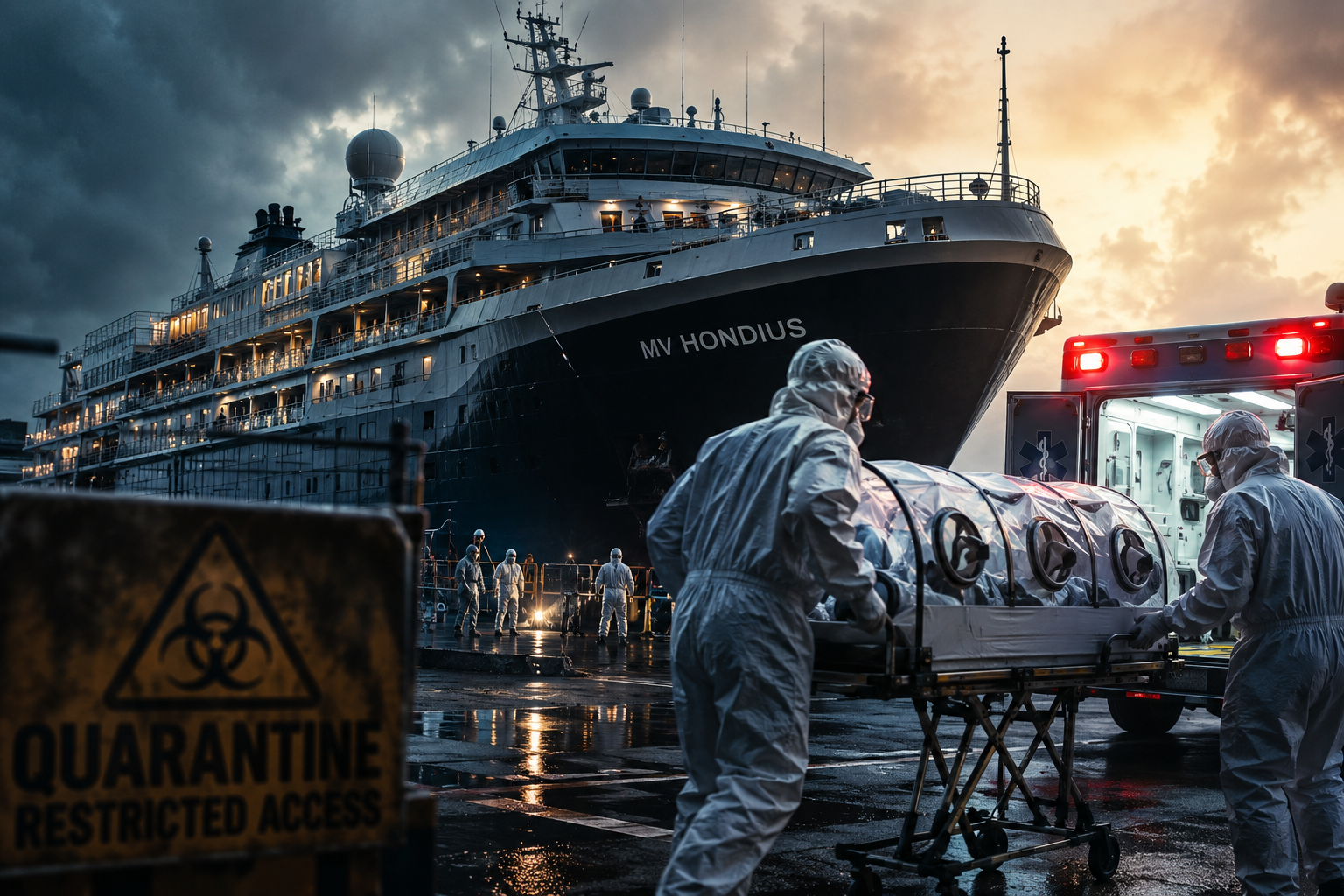
The Deadly Virus Cluster Alarming Global Health Officials Off The Coast Of West Africa
The Cruise Ship Horror Raising Fears Of Another COVID-Style Global Health Emergency
A deadly virus outbreak aboard an isolated cruise ship off West Africa is triggering memories of the earliest days of COVID, but scientists say the real danger may be more complicated than panic headlines suggest.
A luxury expedition cruise ship drifting off the coast of West Africa has suddenly become the center of a rapidly escalating international health investigation after multiple deaths, emergency evacuations, and fears surrounding a rare strain of hantavirus capable of limited human-to-human transmission.
The ship at the center of the crisis, the MV Hondius, has spent days under intense scrutiny after passengers and crew developed severe respiratory symptoms during a voyage linked to South Atlantic and Antarctic expedition routes. Several people have now died. Others have been medically evacuated. Remaining passengers have reportedly been confined to cabins while international health agencies investigate what exactly happened onboard.
The atmosphere surrounding the outbreak has inevitably triggered comparisons to the early pandemic era. A cruise ship. Confined spaces. A poorly understood virus. International passengers. Conflicting information. Growing online panic.
But the reality behind the headlines is both more alarming and more limited than social media speculation suggests.
Health authorities and the World Health Organization are investigating whether the outbreak involves the Andes strain of hantavirus—a rare variant associated with limited human-to-human transmission under close-contact conditions. That single detail has transformed what might otherwise have been a tragic but isolated outbreak into a global story attracting intense attention.
Why This Outbreak Has Triggered Global Attention
Most hantaviruses do not spread efficiently between humans. They are normally transmitted through exposure to infected rodent urine, saliva, or droppings. In many parts of the world, hantavirus infections are extremely rare and usually linked to wilderness exposure or rural environments.
That is why this outbreak feels different.
The suspected involvement of the Andes strain changes the psychological equation completely. Unlike most hantaviruses, Andes virus has historically shown evidence of limited person-to-person spread among close contacts, particularly family members or intimate partners.
Scientists stress that this risk is not remotely comparable to COVID-19 in transmissibility. The virus is not believed to spread efficiently through casual airborne contact in the same way as influenza or SARS-CoV-2. WHO officials have repeatedly emphasized that the risk to the broader public remains low.
But confined environments change risk calculations.
Cruise ships became symbolic during the COVID era because they combine almost every condition infectious diseases exploit: shared air, close social contact, international travel, delayed medical intervention, and dense populations inside semi-sealed environments. Even a virus with relatively weak human transmission potential becomes more dangerous in that setting.
That is one reason this outbreak has exploded across global headlines.
Inside The MV Hondius Crisis
The MV Hondius is not a typical leisure mega-cruise ship packed with casinos and entertainment decks. It is an expedition vessel designed for wildlife and polar exploration voyages. The ship had reportedly departed from Argentina before traveling northward through the Atlantic.
According to health authorities, illness onset among affected passengers occurred over several weeks and included fever, gastrointestinal symptoms, respiratory deterioration and, in severe cases, acute respiratory distress syndrome.
Three deaths have already been linked to the outbreak. Multiple additional suspected cases remain under investigation. Several passengers and crew members have required evacuation for advanced medical treatment.
At one stage, Cape Verde reportedly refused to allow passengers to disembark while authorities assessed the risk. Spain later agreed to allow the vessel to move toward the Canary Islands as international coordination intensified.
What makes the story even more unsettling is the uncertainty surrounding where the virus originated.
Investigators believe at least some infections may have been acquired before passengers boarded the ship, potentially during travel in South America, where Andes virus is endemic in certain rodent populations. However, health agencies have not ruled out onboard human transmission among close contacts.
That distinction matters enormously.
If transmission occurred primarily before boarding, the event may ultimately be remembered as a contained cluster that involved unfortunate timing and close-contact exposure. If significant onboard spread occurred, even at low efficiency, the implications for expedition travel and infectious disease monitoring become much larger.
Why COVID Comparisons Are Both Understandable And Misleading
The emotional response online has been immediate.
Images of quarantined passengers, medical evacuations, and masked responders boarding a ship in the Atlantic have revived memories many people never fully processed from 2020. Search interest around hantavirus has surged as people try to understand whether the disease could become “the next pandemic.”
The answer, based on current evidence, is probably no.
Hantaviruses behave very differently from respiratory pandemic viruses like COVID-19. Transmission patterns are far less efficient. Outbreaks tend to remain localized. The conditions required for spread are narrower. Experts continue to stress that the overall public risk remains very low.
But dismissing the psychological impact would also miss the deeper story.
COVID permanently changed how people interpret disease outbreaks. Before 2020, a rare viral cluster aboard a ship would likely have remained a niche international health story. Today, the same images immediately activate collective memories of lockdowns, border closures, and institutional confusion.
The world now reacts differently to uncertainty.
That shift may ultimately become one of the defining legacies of the pandemic era. Every outbreak now exists inside a public environment shaped by trauma, distrust, hyper-connectivity, and viral information cycles.
The Detail Most People Are Missing
The most important aspect of this story may not be the virus itself.
It may be the demonstration of how quickly isolated health events can become global psychological flashpoints in the post-COVID world.
Within hours, speculation online transformed a serious but relatively contained outbreak into warnings about a coming civilization-scale pandemic. Some headlines focused heavily on fatality rates. Others emphasized human transmission without context. Social media amplified worst-case scenarios before investigators had even confirmed the precise transmission pathway.
That reaction reveals a world permanently conditioned for outbreak anxiety.
At the same time, the incident also exposes something genuinely important about modern travel systems. Expedition tourism increasingly places travelers in remote ecological environments where unusual pathogens exist naturally. Wildlife tourism, climate shifts, global mobility, and adventure travel create new interfaces between humans and disease ecosystems that were once geographically isolated.
Most of these interactions never become crises.
But occasionally, they do.
And when they happen inside a cruise ship environment—isolated, international, and visually dramatic—the symbolism becomes impossible to ignore.
What Happens Next
International health agencies are now focused on containment, treatment, and contact tracing.
Investigators continue to monitor passengers onboard the MV Hondius while they attempt to reconstruct the outbreak timeline. Scientists are working to determine whether the infections were entirely exposure-based or whether limited human transmission occurred onboard.
For now, officials continue to insist the risk to the wider public remains low.
Still, the story has already achieved something larger than epidemiology.
It has reminded the world how fragile the sense of normality still is after COVID. A single outbreak on a remote ship off the coast of Africa was enough to trigger worldwide anxiety within days. The images felt familiar. The uncertainty felt familiar. The fear felt familiar.
That may be the most revealing part of the entire crisis.
The virus aboard the MV Hondius may ultimately remain a tragic but isolated outbreak. But the reaction to it showed that the psychological aftershocks of the pandemic era are still very much alive
