The Premier League's New World Order Has Arrived
The Rich Are Getting Richer: Inside Football's Brutal New Reality
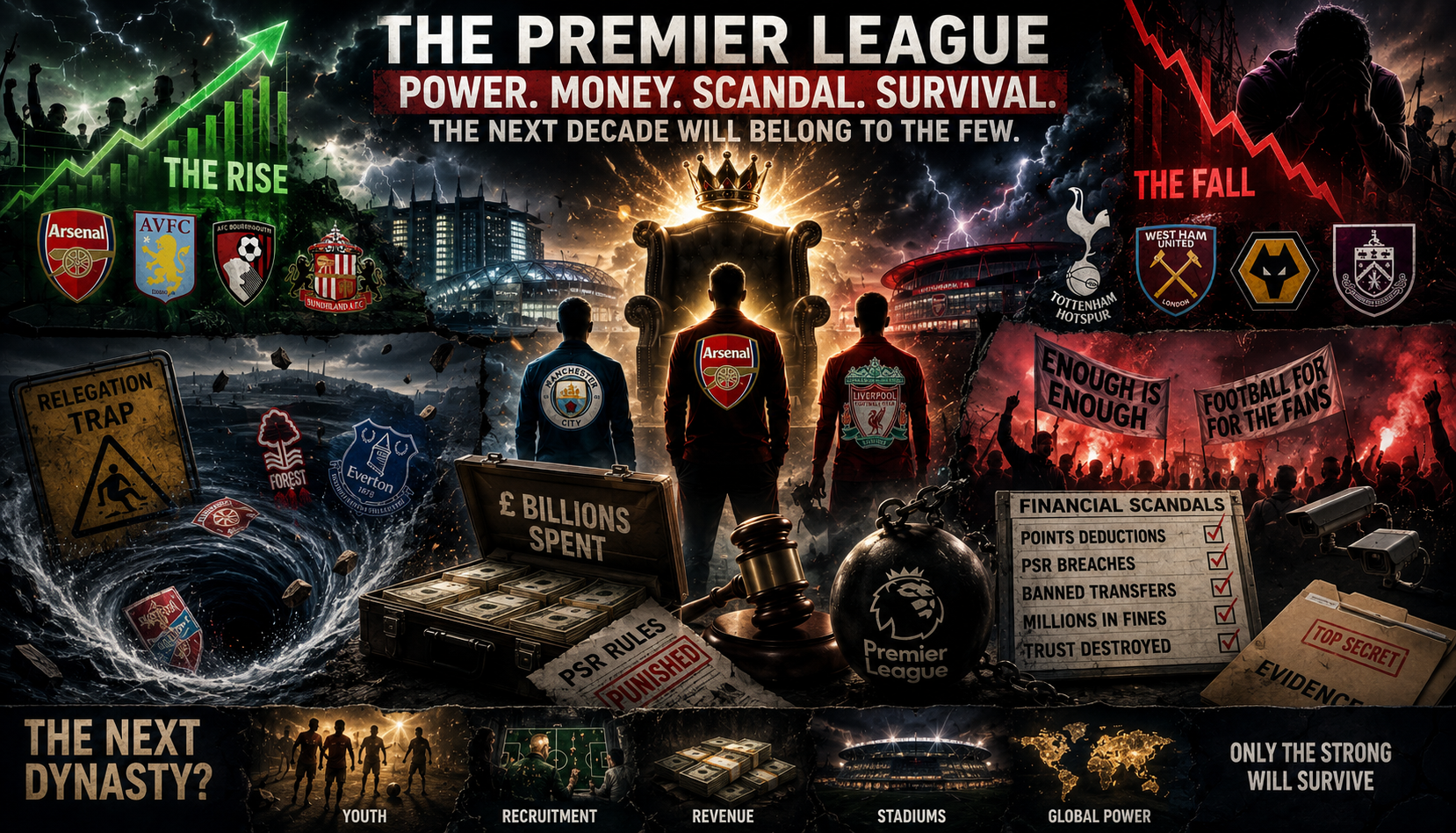
The Premier League Power Map Has Changed
The Premier League has entered a brutal new phase. Arsenal finished the 2025/26 season as champions on 85 points, Manchester City remained close behind on 78, Manchester United returned to the Champions League places, Aston Villa forced themselves into the top four, and Tottenham survived in 17th after a season that should terrify a club of their size.
That is the story beneath the table: the league is no longer just a race between rich clubs and poor clubs. It is becoming a fight between clubs with a clear football machine, clubs with money but no stability, and clubs trapped in a middle class where one bad recruitment cycle can become a relegation scare.
Arsenal Have Become the New Benchmark
Arsenal are no longer simply the nearly team. They are now the club everyone else has to explain themselves against: title winners, young enough to sustain the run, rich enough to keep strengthening, and structured enough to avoid the chaos that has swallowed several rivals. Their 26 wins, 85 points and +44 goal difference made them the cleanest sporting case in the league.
Manchester City remain the obvious dynasty threat because their squad value, infrastructure and decade of winning cannot be dismissed. Transfermarkt lists City as the Premier League’s most valuable squad at around €1.32bn, with Arsenal close behind at about €1.25bn, Chelsea third, and Liverpool also in the billion-euro conversation. That is the real dynasty table: not just who won last season, but who owns the talent base to keep coming back.
Liverpool are still dangerous because they combine scale with repeatable revenue. Deloitte’s 2026 Football Money League ranked Liverpool as the highest-revenue English club, fifth globally, with €836m in revenue, while City, Arsenal, Manchester United, Tottenham and Chelsea all sat inside the global top ten. The next decade will not be decided by vibes; it will be decided by who turns that money into elite recruitment without breaking financial rules.
The Rising Teams Are No Longer Cute Stories
Aston Villa are the most serious disruptor because their rise has moved from “good season” to institutional shift. A top-four finish in 2025/26 put Villa in the Champions League places, and Deloitte ranked them 14th in the global revenue table, a sign that European football and commercial growth have pushed them out of the old mid-table category.
Bournemouth are the shock data point. Finishing sixth with 57 points and European qualification changes the way they have to be discussed. They are no longer just a well-run smaller club punching up for a few months; they are proof that recruitment discipline, coaching clarity and player trading can create a real ladder into Europe.
Sunderland’s 54-point finish after promotion may be even more dramatic. Promoted clubs have usually been treated as cannon fodder, but Sunderland turned survival into Europe. That is not normal Premier League behaviour, and it is why the bottom half should be nervous: a club with momentum, a huge fan base and European revenue can stop being a survival story very quickly.
Brighton and Brentford remain the model clubs of the analytics age. They do not have the same commercial ceiling as the biggest six, but they keep forcing richer clubs to buy their players, copy their structures or poach their staff. Their biggest risk is not decline through incompetence; it is decline through success being constantly harvested by richer predators.
The Falling Clubs Are a Warning to Everyone
Tottenham are the loudest warning sign in the league. A club with a huge stadium, global reach and top-ten world revenue should not be finishing 17th, yet that is exactly where Spurs ended up in 2025/26. Their response has been explosive: Sandro Tonali has joined from Newcastle in a club-record deal worth up to £100m, after Tottenham had already moved heavily in the market.
That spending can be read two ways. It could be the beginning of a fast correction, because Tottenham have the money, facilities and revenue base to recover. Or it could be the sign of a club trying to buy its way out of structural confusion, which is one of the most dangerous traps in elite football.
West Ham’s fall into relegation is the harsher version of the same lesson. Deloitte still ranked West Ham 20th in its global Money League, but Premier League status was lost anyway when the 2025/26 season ended and the league confirmed West Ham, Wolves and Burnley had transferred back their Premier League shares. Revenue protects clubs from some risks; it does not protect them from bad football decisions forever.
Wolves and Burnley complete the warning. Wolves had been a stable Premier League club for years, while Burnley had become familiar with the promotion-relegation cycle. Both now show how quickly the floor disappears when recruitment, wage control and squad quality stop lining up.
The Relegation Battle Is Becoming a Permanent Trap
The clubs most likely to live in constant relegation danger are not always the weakest squads on paper. They are the clubs that cannot build three things at once: a Premier League attack, a wage bill that survives relegation, and a squad with resale value.
Everton have spent years as the symbol of this trap. Their survival record remains impressive, but financial-rule penalties, ownership turmoil and repeated bottom-half finishes have turned a historic giant into a case study in how not to run a Premier League rebuild. The Premier League’s Everton appeal statement confirmed the club admitted a PSR breach in the earlier case, with the original 10-point penalty reduced on appeal.
Nottingham Forest have been another high-risk case. Their return to the Premier League brought massive recruitment, but it also brought financial-rule punishment, with the Premier League confirming a four-point deduction in 2024 for a PSR breach. Forest’s 2025/26 finish just above Tottenham and above the relegated sides kept them alive, but the volatility around the club remains obvious.
The promoted clubs for 2026/27 — Coventry City, Ipswich Town and Hull City — now enter a league where survival is worth a fortune but mistakes are punished immediately. The Premier League confirmed the 2026/27 season reset at its June AGM, while reporting around the promoted clubs shows Hull have already had to sell players to satisfy financial rules before returning to the top flight.
Spending Is Exploding Again
The Premier League is still the world’s most aggressive transfer market. Transfermarkt’s 2026/27 summer data showed Premier League clubs had already recorded 136 arrivals, more than €959m in transfer expenses and a total balance of roughly minus €307m early in the window.
Tottenham are the most obvious headline spenders because the Tonali deal is both huge and symbolic. Transfermarkt lists Tonali at €108m and Mateus Fernandes at €99m among Tottenham’s incoming deals, while the wider report of Spurs’ spending surge shows a club trying to reverse a humiliating league season with brute-force investment.
Chelsea remain the long-term spending experiment. Their squad is young, expensive and still waiting to prove that the multi-year contract model can produce a stable title machine rather than constant churn. Manchester United, meanwhile, have enough revenue to stay relevant but must prove they can turn commercial power into squad coherence.
Newcastle are the paradox. They have ownership ambition and a wealthy backing structure, but financial rules continue to restrict how fast they can move. UEFA’s 2026 sanctions included Newcastle, Aston Villa and Chelsea among clubs punished for financial sustainability rule breaches, showing that even ambitious clubs with serious owners are now being forced to manage spending ratios more carefully.
The Scandals Are Now Part of the Table
The Premier League’s great scandal is no longer one case. It is the sense that football’s legal and financial systems are now as important as tactics.
Manchester City remain the largest unresolved case. The Premier League formally referred a number of alleged rule breaches by City to an independent commission in February 2023, while City said they welcomed an impartial review and pointed to what they described as irrefutable evidence in support of their position. The allegations remain allegations unless and until the commission reaches and publishes a finding.
Chelsea have already taken punishment for historical breaches. The Premier League said in March 2026 that Chelsea accepted fines totalling £10.75m, an immediate nine-month academy transfer ban and a suspended one-year first-team transfer ban, after disciplinary processes relating to financial reporting, third-party investment and youth development.
Everton and Forest showed that points deductions are no longer theoretical. UEFA’s squad-cost rules have now added another layer of pressure for clubs in Europe, with the 70% limit applying to European competitors, while the Premier League’s own new system gives non-European clubs an 85% threshold. This is the next battlefield: not just who spends most, but who can spend most without triggering penalties.
The Next Decade Will Not Be Equal
The most likely leading teams over the next decade are Arsenal, Manchester City, Liverpool, Chelsea, Manchester United and, if they convert structure into consistency, Aston Villa and Newcastle. Tottenham have the money to rejoin that group, but they have to prove the 2025/26 collapse was an exception rather than a symptom.
Arsenal have the cleanest dynasty profile right now: current title, elite squad value, young core, stable manager, and enough commercial power to keep strengthening. City have the deepest dynasty infrastructure but carry the uncertainty of transition and the unresolved Premier League case. Liverpool have the revenue engine, but their next era depends on whether recruitment keeps pace with the post-title rebuild.
Chelsea are the boom-or-bust candidate. Their young squad could mature into a frightening machine, or the churn could keep eating the project from inside. Manchester United remain too rich to ignore but too unstable to trust completely; their revenue gives them endless second chances, but the league has become too smart to be bullied by brand power alone.
Villa and Newcastle are the insurgents with the biggest upside, but both face the same ceiling: financial regulation. European revenue helps, but UEFA scrutiny also tightens the spending leash. Their best route is not reckless buying; it is controlled growth, academy value, smart sales and ruthless recruitment.
What Comes Next
The Premier League’s next phase will be decided by three numbers: points, revenue and squad-cost ratio. Clubs that win on the pitch but lose control of wages will face sanctions. Clubs that sell brilliantly but lose coaching identity will become feeder systems. Clubs that spend big without tactical clarity will become expensive relegation scares.
The most likely outcome is not a new era of equality. It is a sharper, colder league where Arsenal and City fight for control, Liverpool remain a permanent threat, Chelsea and United keep trying to convert wealth into order, and Villa or Newcastle attempt to break into the dynasty circle without breaching the rules that now police ambition.
The real danger sits below them. Tottenham’s 17th-place finish, West Ham’s relegation and the financial-rule cases around Everton, Forest, Chelsea, Newcastle and Villa all point to the same conclusion: the Premier League is no longer just a football table. It is a pressure machine where bad decisions, bad accounting and bad recruitment eventually become visible in public, one brutal league position at a time.
