The War Expands: Hezbollah Opens Israel’s Northern Front
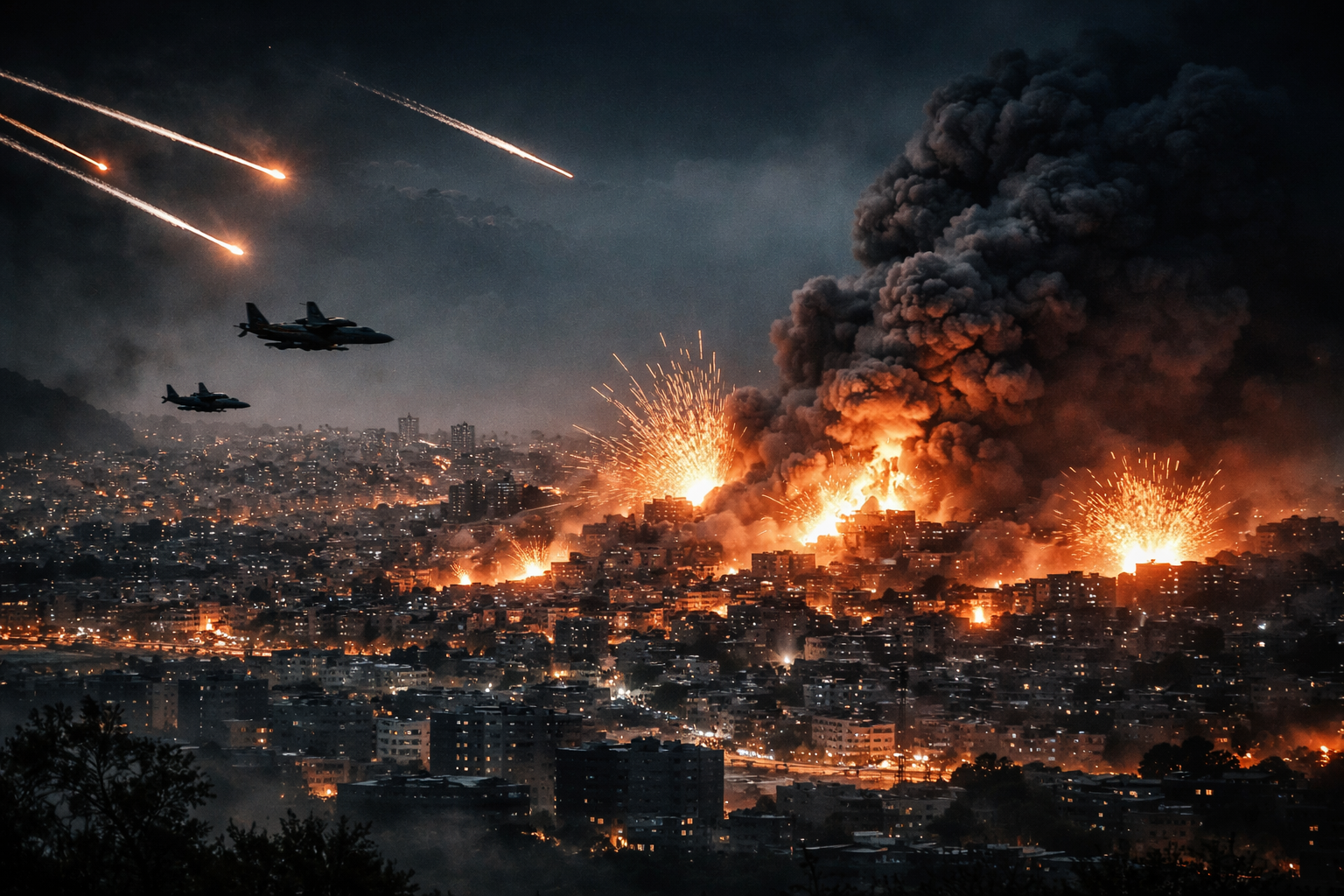
Lebanon on the Brink as Israel–Hezbollah War Explodes
Hezbollah–Israel War Widens: Lebanon Becomes the Dangerous Second Front
Airstrikes are pounding Beirut’s southern suburbs. Rockets and drones are crossing the Israel–Lebanon border. Civilians are fleeing their homes across southern Lebanon.
The long-simmering confrontation between Israel and Hezbollah has erupted into a major escalation tied to the wider regional war involving Iran. Israeli airstrikes across Lebanon have intensified dramatically recently, while Hezbollah has issued evacuation warnings to towns in northern Israel and launched missile and drone attacks across the border.
The violence has already caused hundreds of casualties and mass displacement, with Lebanese authorities reporting nearly 300 deaths and over 1,000 injuries since Israel began expanded strikes earlier this month.
What makes this moment especially dangerous is not simply the scale of the strikes but the strategic shift unfolding in the background: Lebanon is rapidly becoming the second front of a much larger regional war.
The outcome of the Israel–Hezbollah confrontation hinges on whether it remains confined to the border or escalates into a full regional war.
Key Points
Israeli forces have dramatically intensified airstrikes across Lebanon, including Hezbollah strongholds in southern Beirut and eastern regions.
Hezbollah has fired rockets and drones into northern Israel and warned residents of some Israeli towns to evacuate.
Lebanese officials report nearly 300 people killed and more than 1,000 wounded since the latest wave of strikes began in early March 2026.
Southern Lebanon has displaced hundreds of thousands of civilians.
The escalation is closely tied to the broader war involving Israel, the United States, and Iran, as it reflects the increasing tensions and military actions that have drawn multiple nations into the conflict.
The central strategic question is whether Lebanon becomes a full-scale battlefield.
How the Lebanon Front Reignited
The current escalation traces back to March 2, 2026, when Hezbollah launched rockets and missiles into northern Israel following the assassination of Iranian Supreme Leader Ali Khamenei, a development that dramatically intensified the regional conflict.
Israel responded with a sweeping campaign of airstrikes across Lebanon, targeting Hezbollah infrastructure, command sites, and weapons facilities.
Within days, the conflict expanded:
Israeli aircraft struck Hezbollah positions in Beirut’s southern suburbs, a longtime stronghold of the group.
Heavy bombardment spread to southern and eastern Lebanon.
Israeli troops began preparing for potential ground operations near the border, indicating an escalation in military readiness in response to the ongoing conflict with Hezbollah.
The escalation effectively collapsed the fragile ceasefire framework that had held since late 2024 after previous rounds of fighting between Israel and Hezbollah.
That ceasefire had required Hezbollah fighters to withdraw north of the Litani River and Israeli forces to leave southern Lebanon. In reality, neither side fully complied.
Now the conflict has exploded back into open warfare, with both Hezbollah and Israeli forces engaging in intense military operations across the region.
The Battlefield Expands
The military dynamic is escalating on several fronts simultaneously.
Israeli warplanes have struck dozens of Hezbollah targets across Lebanon, including intelligence facilities, missile sites, and suspected command centers. Israeli officials say the strikes aim to degrade Hezbollah’s ability to launch large-scale rocket attacks into northern Israel.
Meanwhile, Hezbollah has stepped up cross-border attacks:
Rockets targeting northern Israeli towns
Drone strikes against military positions
Warnings to Israeli civilians to evacuate areas near the border
This pattern mirrors the early stages of the 2006 Israel–Hezbollah war, but the scale and regional context are far more dangerous today.
The current escalation is unfolding while Israel and the United States are already engaged in direct military confrontation with Iran across multiple theaters.
That means Hezbollah is not fighting in isolation.
It is part of a broader axis.
The Human Cost in Lebanon
The humanitarian impact has escalated rapidly.
Lebanese authorities report that hundreds of civilians have been killed and more than a thousand wounded in Israeli airstrikes since the conflict intensified earlier this week.
Entire neighborhoods in southern Lebanon have emptied as families flee north.
Key developments include:
Major displacement from villages near the border
Airstrikes hitting dense urban areas in Beirut’s southern suburbs
Growing pressure on Lebanon’s already fragile economy and infrastructure
Lebanon was already facing one of the worst economic crises in its modern history.
A prolonged war could push the country further toward state collapse, exacerbating the existing economic crisis and leading to increased poverty, unemployment, and a breakdown of essential services.
What Most Coverage Misses
Much of the reporting focuses on the airstrikes and rocket attacks themselves.
But the deeper strategic shift is happening inside Lebanon’s politics.
For the first time in years, the Lebanese government has formally declared Hezbollah’s military operations illegal and outside state authority.
That decision matters because Hezbollah has long operated as both a political party and an independent armed force inside Lebanon.
In theory, the government’s declaration means the state—not Hezbollah—should control decisions about war and peace.
In practice, enforcing that decision would be extraordinarily difficult.
Hezbollah remains the most powerful military force in the country.
But the political backlash inside Lebanon signals something important: Hezbollah’s decision to enter the regional war may be eroding its domestic legitimacy, even among some Lebanese factions.
That tension could shape the next phase of the conflict.
Why This War Is Different From Previous Israel–Hezbollah Clashes
The Israel–Hezbollah confrontation has flared repeatedly over the past two decades.
But the strategic environment in 2026 is radically different.
Three factors increase the stakes.
First: the Iran war
The Hezbollah front directly connects to the broader conflict between Israel and Iran. Hezbollah is widely considered Iran’s most powerful regional proxy.
Second: the scale of military capabilities
Since the 2006 war, Hezbollah has dramatically expanded its arsenal of missiles, drones, and precision weapons.
Israel, in turn, has built layered missile defense systems and increased its ability to strike targets deep inside Lebanon, which enhances its deterrence strategy against Hezbollah's expanded military capabilities.
Third: regional volatility
The conflict now intertwines with:
Iranian missile strikes
U.S. military involvement
Gulf state defenses
Energy market instability
That combination creates a far wider escalation ladder than past wars.
The Fork in the Road for Lebanon and the Region
The next phase of the conflict will depend on several key indicators.
One scenario is containment.
In this path:
Israel limits its campaign to airstrikes
Hezbollah maintains cross-border attacks but avoids full mobilization
International pressure pushes both sides toward de-escalation
Another scenario is full-scale war.
That would likely involve:
Israeli ground operations deep into southern Lebanon
Hezbollah launching large-scale missile barrages
Wider Iranian involvement
Massive regional displacement
Early warning signs of the second scenario would include:
Large Israeli troop movements near the border
Sustained missile fire into major Israeli cities
Direct Iranian military engagement
Crossing those thresholds could once again make Lebanon the epicenter of the Middle East's most dangerous war.
And this time, the conflict would not stop at its borders.
