Trump Declares “Victory” in Iran — But the Rescue Mission May Be Hiding a Much Bigger Problem
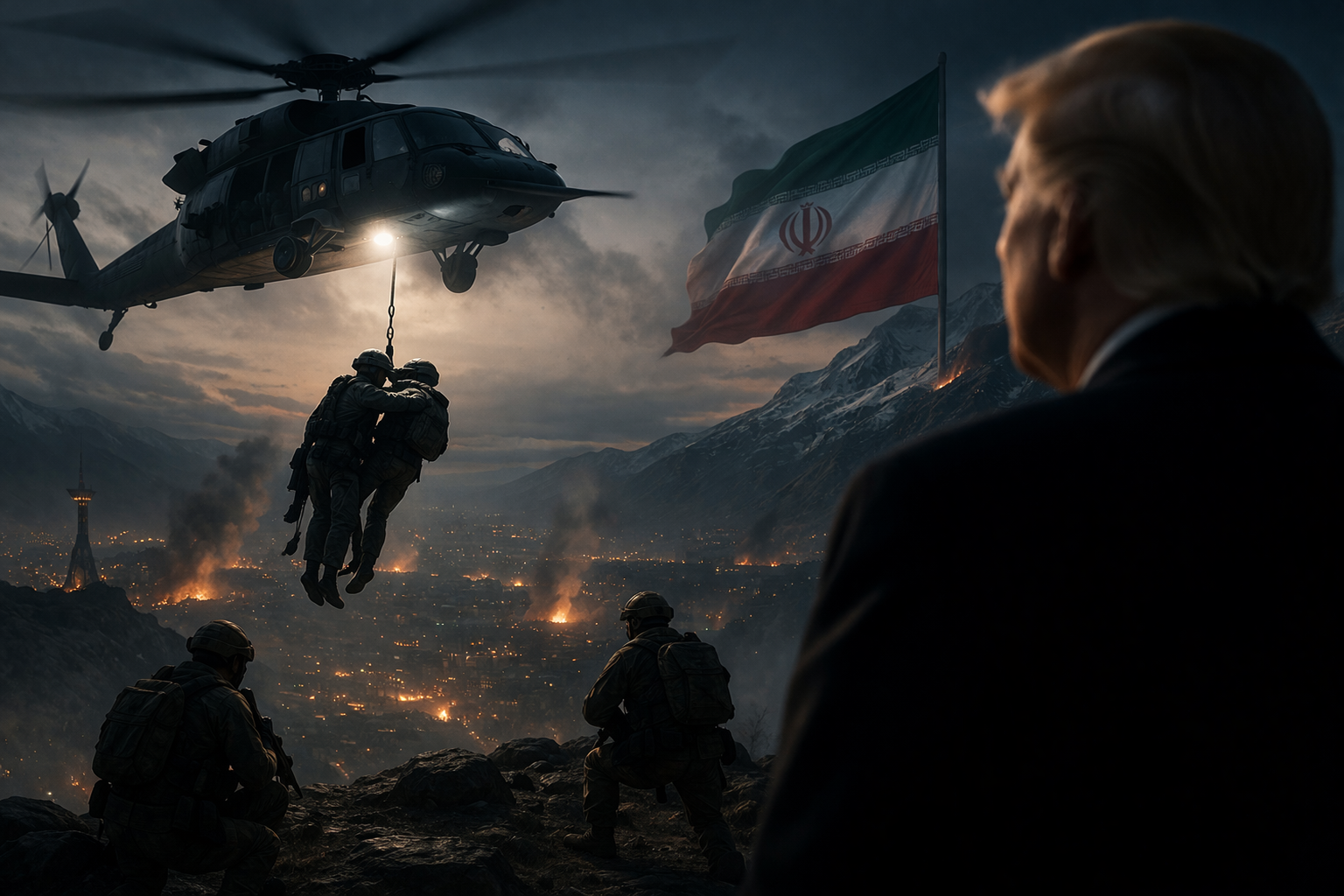
A high-risk military rescue becomes political theater—and a tool to reshape a war many Americans no longer fully understand or support.
Trump Turns Daring Iran Rescue Into War “Win” Narrative Amid Rising Doubts
The Iran Rescue That Let Trump Rewrite the War—And Why It Matters
A Heroic Rescue, A Fragile Narrative: How Trump Is Reframing the Iran War
A high-risk military rescue becomes political theater—and a tool to reshape a war many Americans no longer fully understand or support.
The story of one rescued airman is now carrying the weight of an entire war narrative
Behind the triumph: a strategic pivot in how the Iran conflict is being sold to the public
An extraordinary military success has become something else entirely: a narrative weapon.
The rescue was real. The victory is not so simple.
A wounded American airman survives in hostile Iranian terrain, evading capture for days, before being pulled out in a complex, high-risk operation involving special forces, deception tactics, and overwhelming firepower.
It is, by any military standard, extraordinary.
But what happened next may matter more than the rescue itself.
Within hours, Donald Trump seized on the mission not just as a success—but as proof that the war in Iran is working, even won.
That shift—from tactical success to strategic validation— is the real story.
A war searching for a narrative
The Iran conflict, now several weeks in, has suffered from a basic problem:
No clear, stable explanation of why it exists.
The justification has shifted repeatedly—from imminent threat to deterrence to regime change to broader geopolitical control.
That creates a vacuum.
In modern warfare, narrative fills the vacuum.
The rescue mission filled it perfectly.
It is human
It is dramatic
It is visual
It is easy to understand
Unlike missile strategy or nuclear doctrine, a rescue story requires no explanation. It feels like success.
So it becomes the story.
From operation to spectacle
Trump didn’t just announce the rescue.
He performed it.
He described it as historic, cinematic, almost providential—invoking divine language and framing it as a symbol of American dominance.
This result is not accidental.
This is narrative construction.
Because the underlying reality is far less clean:
The war is ongoing
American casualties exist
The strategic endgame remains unclear
Public support is uneven at best
The rescue does not resolve any of that.
But it reframes it.
The psychology of “we won”
One of the most striking elements is the claim itself:
“We won.”
That statement does not describe reality—it attempts to create it.
Declaring victory early does three things:
Closes the psychological loop—people prefer finished stories
Reduces scrutiny — success narratives face less questioning
Repositions critics—opposition becomes “anti-victory””
This is not military logic.
It is political logic.
What media misses
The rescue is not being overhyped.
It is being repurposed.
Most coverage treats the event as a story about the following:
military capability
operational bravery
tactical success
All true.
But the deeper layer is this:
The rescue is being used to solve a narrative failure in the war itself.
Without a clear strategic story, the administration is anchoring the entire conflict to a single emotionally powerful event.
That is fragile.
Because if the war continues—and it will—the gap between symbolic victory and the actual outcome widens.
The hidden risk: narrative overreach
This is where things become dangerous.
When leadership leans too heavily on symbolic wins:
Expectations rise
Reality becomes harder to manage
Credibility becomes tied to maintaining the illusion
History shows this pattern clearly.
Wars that rely on moments of triumph rather than coherent strategy tend to drift—and eventually fracture public trust.
The Iran conflict is showing early signs of that tension.
What happens next
Three paths are now emerging:
1. Narrative consolidation (most likely)
The administration continues using moments like these to reinforce the idea of success—even as the war continues.
2. Reality collision (most dangerous)
A major setback — casualties, escalation, or strategic failure — breaks the narrative frame.
3. Quiet recalibration (most underestimated)
The rhetoric softens over time, and the definition of “success” subtly shifts without admission.
None of these depend on the rescue.
They depend on what the war actually becomes.
The deeper truth
The rescue mission proves something real:
The United States retains extraordinary military capability.
But Trump’s framing tries to prove something else:
That capability equals victory.
It doesn’t.
And that gap—between what happened and what it was made to mean— is where this story truly lives.
Because in modern war, the battle is not just fought on the ground.
It is fought in perception.
And right now, that battle is still very much undecided.
