

Trump Claims King Charles Backs Iran Nuclear Red Line — And Sparks A Constitutional Storm
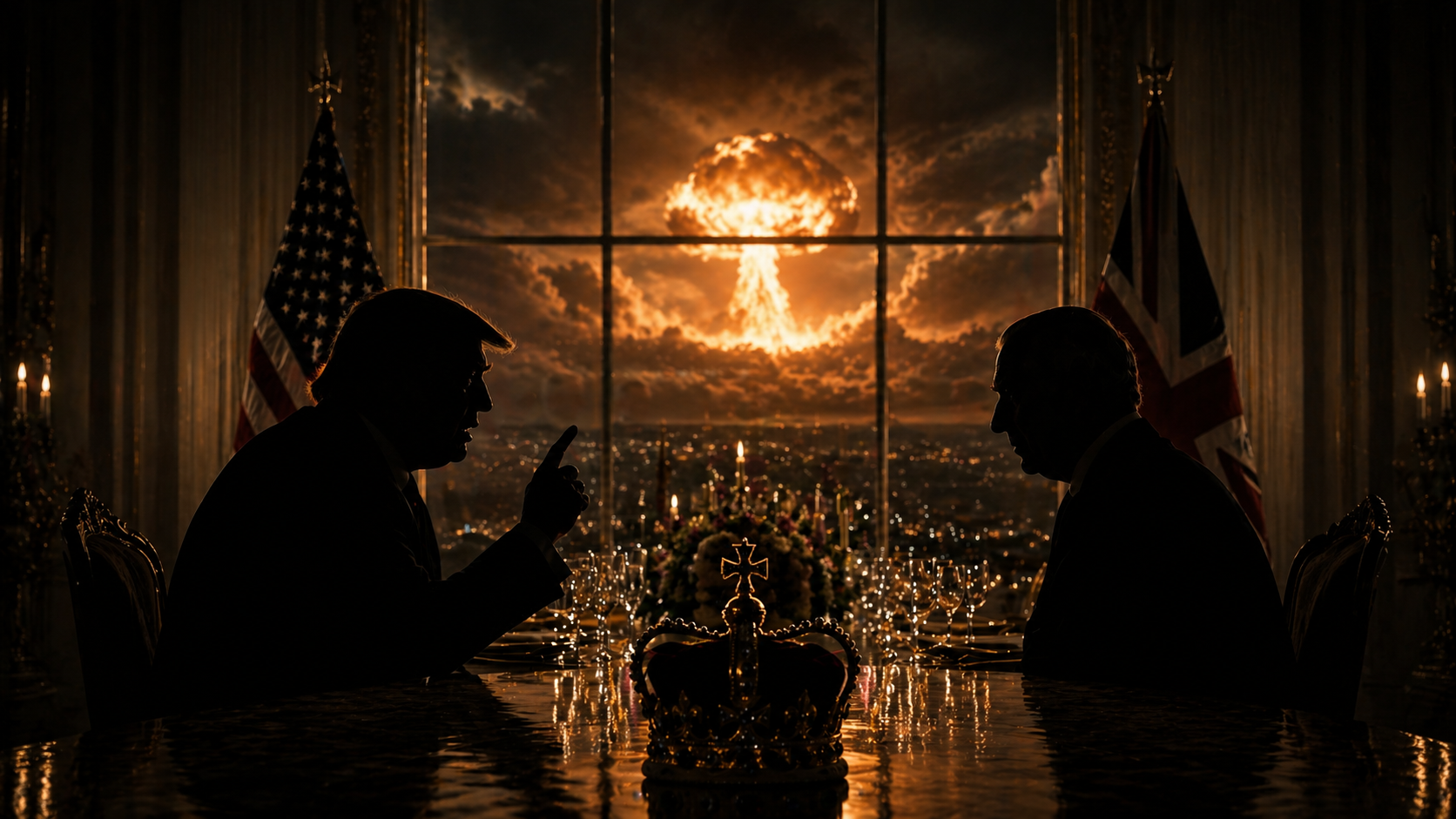
Trump Pulls King Charles Into Iran Nuclear Showdown — A Royal Line Crossed In Real Time
Donald Trump’s claim that King Charles opposes Iranian nuclear weapons has sparked a geopolitical and constitutional debate. Here’s what really happened — and why it matters.
A single sentence at a White House dinner has just done something British diplomacy spends decades trying to avoid.
It dragged the monarchy into a live geopolitical conflict.
During a formal state banquet, Donald Trump publicly claimed that King Charles supports the position that Iran must never obtain a nuclear weapon.
On the surface, that sounds aligned with long-standing Western policy.
Underneath, it is something far more consequential.
Because King Charles never said it.
What Actually Happened
The moment came during a high-profile state visit—one designed to reinforce UK–US relations at a fragile time.
In front of diplomats, officials, and global media attention, Trump stated that the king “agrees” with him on preventing Iran from acquiring nuclear weapons, even suggesting the monarch shared the view strongly.
But in his own speeches—including a rare address to Congress—King Charles avoided any direct reference to Iran, the war, or US policy positions.
That contrast matters.
BecausThis is becauseritish monarch does not publicly take positions on active geopolitical conflicts.
Why This Is Not A Small Diplomatic Slip
The British Crown operates under a rigid constitutional principle:
Political neutrality is not optional — it is foundational.
The monarch does not:
Endorse military policy
Align with active war positions
Comment on contested international disputes
Even when the UK government holds a clear stance, the monarch stays above it.
So when a foreign leader attributes a position to the king—especially in a war context—it creates a problem no official statement can easily unwind.
This is not about whether the UK opposes nuclear proliferation.
It is about who is allowed to say it.
The Iranian Context Behind The Statement
The backdrop is critical.
The US is currently engaged in heightened confrontation with Iran, with the following:
Military pressure in the region
Disputes over the Strait of Hormuz
Ongoing tensions around Iran’s nuclear programme
Trump has repeatedly framed the situation in absolute terms—Iran must never obtain nuclear weapons—while also claiming strategic success in the conflict.
Iran, meanwhile, maintains that its nuclear program is civilian under international agreements.
This is not a settled issue.
It is an active fault line in global security.
What Trump’s Statement Actually Does
By linking King Charles to that stance, Trump achieves three things simultaneously:
1. He Expands Legitimacy
It reframes the position as not just American but shared at the highest symbolic level of an allied state.
2. He Signals Unity Without Formal Agreement
Even if no official UK statement exists, the implication suggests transatlantic alignment.
3. He Applies Subtle Pressure On The UK
If the monarchy appears to agree, UK political leadership finds it harder to appear divergent.
None of this requires confirmation to have impact.
The statement itself is enough.
The Palace Problem
Buckingham Palace cannot directly engage in political debate.
Its response, where given, stays carefully within doctrine:
Emphasising general opposition to nuclear proliferation
Avoiding endorsement of specific military narratives
That leaves a gap.
A public claim has been made.
But it cannot be publicly challenged in equal terms.
That asymmetry is where the tension lives.
What Most People Will Miss
This conflict is not really about Iran.
It is about control of narrative authority.
The monarchy is one of the few institutions in global politics that still operates outside direct political alignment.
That neutrality gives it power—symbolic, diplomatic, and stabilizing.
But it also makes it vulnerable.
Because:
It cannot respond like a government
It cannot openly contradict political actors
It relies on convention being respected
Trump’s statement tests that system.
Not by breaking rules outright, but by stretching them in public.
A Deeper Shift In How Power Is Used
Modern geopolitics is no longer just about military capability or economic leverage.
It is about narrative positioning.
Who appears aligned.
Who appears supported.
Who appears isolated.
By invoking King Charles, Trump is not just making a claim.
He is reshaping perception.
And in global politics, perception often moves faster than policy.
The UK–US Relationship Under Pressure
The visit itself was meant to reinforce the “special relationship.”
Instead, it has exposed a subtle fracture:
The US operating with direct, assertive messaging
The UK maintaining diplomatic restraint
The monarchy caught between symbolism and interpretation
King Charles emphasized unity, NATO cooperation, and global stability in his official remarks.
Trump emphasized strength, victory, and hard red lines.
Those are not the same languages.
The Risk Going Forward
The immediate impact is reputational.
The longer-term risk is structural.
If political leaders begin routinely attributing positions to neutral institutions:
Neutrality becomes harder to maintain
Diplomatic signals become blurred
Institutions designed to stabilise become politicised
That is how norms erode.
Not through a single breach but through repeated pressure.
What This Moment Really Means
This was not just a comment at a dinner.
It was a demonstration of how quickly the boundaries between
Symbolic authority
Political messaging
Military narrative
can collapse into one line.
King Charles did not step into the Iran conflict.
But for a moment, the conflict stepped inside him.
And once that happens, it is very difficult to step back out.
Summary
Trump publicly claimed King Charles agrees Iran must never have nuclear weapons
The King made no such statement in his own speeches
The monarchy’s political neutrality makes such attribution highly sensitive
The move reshapes perception of UK–US alignment without formal agreement
The deeper issue is not policy—but narrative control and institutional boundaries
