Trump Offers Putin Russian Diesel Lifeline to Revive Ukraine Peace Talks as Zelenskyy Condemns ‘Gift to Putin’
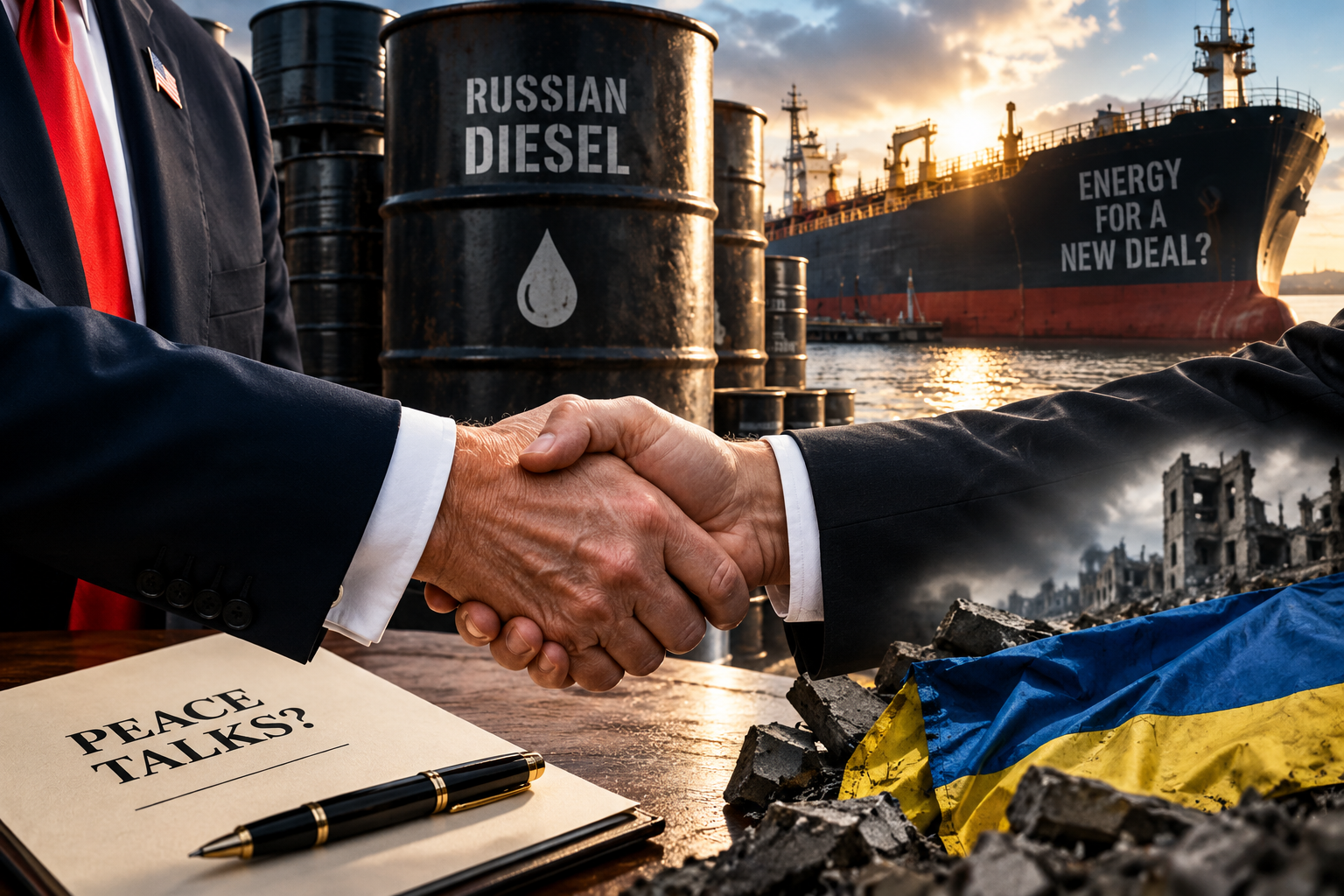
Ukraine Fears the Cost of Trump’s Deal With Moscow
US envoys see Russian fuel exports as a possible route back to negotiations, but Ukraine fears Moscow is gaining economic concessions before agreeing to stop fighting.
President Donald Trump is trying to turn a controversial diesel agreement with Vladimir Putin into a way of restarting negotiations to end Russia's war in Ukraine. The strategy offers Moscow an economic opening at a time when Washington has struggled to persuade the Kremlin to make meaningful concessions.
American envoys Steve Witkoff and Jared Kushner have presented the decision to allow Russian diesel exports as part of a wider diplomatic effort to bring Russia back to the negotiating table. The arrangement involves more than 2.25 million barrels of diesel intended for American and international markets.
The United States has also temporarily eased restrictions affecting Russian diesel transactions.
For Trump, the calculation appears to combine two objectives: increasing global fuel supplies and creating an incentive for Putin to engage in serious peace negotiations.
For Ukrainian President Volodymyr Zelenskyy, the arrangement raises a different concern. Russia could receive additional revenue while continuing the military campaign that has devastated Ukrainian cities, infrastructure and communities since February 2022.
Zelenskyy has described Washington's decision as a "gift to Putin".
The dispute comes as diplomatic negotiations remain fragile, Russian attacks continue and the two sides show little sign of agreeing on the territory or security arrangements required for a lasting settlement.
Why Trump Is Using Russian Diesel to Pursue Peace
The diesel arrangement was announced on 9 October 2026, following direct discussions between Trump and Putin.
Trump said Russia had agreed to release substantial quantities of diesel into American and global markets. His announcement included an initial 300,000 metric tonnes, another 500,000 tonnes during November and a further one million tonnes afterwards.
The administration argued that additional supply could ease pressure on international fuel prices, which have become a major domestic economic issue ahead of the American midterm elections.
Yet fuel prices were not the only consideration.
During diplomatic meetings in Miami on 9 October, Witkoff and Kushner outlined how the agreement could fit into renewed efforts to bring Putin into negotiations with Ukraine.
The account of those private discussions rests on people familiar with the meeting, rather than a complete public transcript or a formally published diplomatic plan.
Their account indicates that American negotiators believed an economic gesture towards Moscow might make the Kremlin more receptive to further discussions.
It reflects a bargaining strategy in which Washington offers limited commercial opportunities in the hope of securing political or military concessions later.
The difficulty is establishing whether Moscow has any intention of making those concessions.
Previous diplomatic initiatives have examined sanctions relief, investment opportunities and broader economic cooperation. None has yet produced a comprehensive ceasefire or a final settlement.
The latest diesel deal therefore represents another attempt to create an incentive for negotiation rather than evidence that peace is close.
The Sanctions Decision That Benefits Moscow
On 9 October, the US Treasury's Office of Foreign Assets Control issued General License 135, authorising certain transactions involving Russian-origin diesel.
The licence provides a legal mechanism for activity relating to the sale, delivery, unloading and importation of Russian diesel that would otherwise face sanctions-related restrictions.
It is a significant shift in the treatment of this category of Russian energy trade.
Sanctions introduced following Russia's full-scale invasion of Ukraine were intended partly to restrict Moscow's access to international markets and reduce the financial resources available to support its military operations.
Oil and refined petroleum products are important sources of export revenue for Russia.
Allowing additional diesel sales can therefore create an economic benefit, depending on the volumes delivered, prices achieved and costs involved.
However, the financial value of this particular arrangement remains uncertain. The announced fuel quantities do not establish how much additional revenue Moscow will ultimately receive, and not every dollar earned from an export becomes government income.
The sanctions relief also does not amount to a complete removal of American restrictions on Russian energy.
Its importance lies in the specific trade it enables and the broader signal that Washington is prepared to consider economic accommodation while peace negotiations remain unresolved.
The Kremlin has previously shown interest in discussing commercial relations with Washington as part of a wider political settlement.
In late September, Russian envoy Kirill Dmitriev held discussions with American officials concerning the war and possible future energy cooperation.
Those contacts formed part of a developing diplomatic approach in which economic incentives were being considered alongside questions of territory, security and reconstruction.
The earlier discussions over US-Russia energy cooperation help explain why the diesel decision has attracted attention beyond the fuel industry.
It suggests that trade and investment may become bargaining instruments in efforts to end the conflict.
Why Ukraine Fears the Agreement Could Strengthen Putin
Ukraine has spent years trying to weaken Russia's capacity to fund and sustain its invasion.
Its strategy has combined military resistance, diplomatic engagement and attacks against infrastructure considered important to Russia's war economy.
Russian refineries and fuel facilities have become prominent targets because they produce products needed for transport, industry and military logistics.
Disrupting those facilities can impose repair costs, reduce available production capacity and complicate fuel distribution.
Kyiv regards the operations as a way to increase pressure on Moscow.
Trump has repeatedly criticised Ukrainian strikes against Russian refineries, arguing that they contribute to higher international fuel prices.
American officials have asked Ukraine to suspend those attacks.
The administration appears to believe that stopping refinery strikes could help stabilise fuel supplies while creating a more favourable environment for diplomatic engagement.
Ukraine faces a difficult strategic calculation.
If it voluntarily stops attacking Russian oil infrastructure, Moscow could receive relief from an important source of military and economic pressure.
Unless Russia agrees to comparable restrictions, that decision could leave Kyiv surrendering an advantage without securing a matching concession.
Ukrainian officials have therefore expressed willingness to discuss reciprocal measures rather than accepting a unilateral halt.
The conflict has already produced significant disagreements between Trump and Zelenskyy over Russian energy infrastructure.
The new diesel agreement intensifies that disagreement because Washington is now enabling some Russian fuel exports while continuing to urge Ukraine to restrain its attacks.
The competing arguments are clear.
Washington believes additional economic incentives might help move negotiations forward.
Kyiv fears that concessions made too early could reduce the pressure needed to persuade Putin to accept a settlement.
Whether the American strategy works will depend on what Russia does in response.
Inside the Miami Peace Negotiations
The latest diplomatic discussions took place in Miami, where American, Ukrainian and European representatives considered options for restarting negotiations.
Witkoff and Kushner were central figures in the American delegation.
The discussions extended beyond diesel exports.
Participants addressed possible security guarantees for Ukraine, reconstruction funding and broader arrangements intended to support an eventual settlement.
Representatives of the World Bank also participated virtually in discussions concerning financial matters.
A central issue was whether economic measures could create enough momentum to resume direct negotiations involving Washington, Kyiv and Moscow.
According to accounts from people familiar with the meeting, American representatives acknowledged that Putin was not then prepared to negotiate an end to the war.
That assessment is important because Trump has publicly suggested that both Putin and Zelenskyy want the conflict to end.
Those positions are not necessarily incompatible. A leader might express support for peace while refusing the terms currently under discussion.
Nevertheless, an unwillingness to make concessions creates a substantial obstacle.
The Ukrainian delegation left the Miami meeting without formally agreeing to suspend strikes against Russian refineries.
It did, however, indicate openness to an energy ceasefire if Russia accepted equivalent restrictions.
There is also an important distinction concerning American military assistance.
Accounts of the Miami discussions indicate that Witkoff and Kushner did not threaten to suspend US military or intelligence support if Ukraine refused to stop attacking Russian refineries.
That does not eliminate broader tensions over American assistance, but it means the specific meeting should not be presented as an established ultimatum.
On 13 October, Trump publicly stated that the United States was continuing to share intelligence with Ukraine.
He also said Washington was working with both Ukraine and Russia to bring the war to an end.
Those comments are significant because intelligence-sharing remains an important part of Ukraine's ability to identify threats and coordinate military operations.
Trump's Energy Ceasefire Claim Faces a Test
The diesel agreement was followed by another announcement.
On 11 October, Trump said an energy ceasefire was in place between Russia and Ukraine.
Such an arrangement would be intended to prevent attacks against energy infrastructure, potentially reducing the risk of serious disruptions to electricity supplies, heating systems and fuel production.
However, neither Russia nor Ukraine had confirmed a mutually agreed ceasefire on the terms Trump described.
Russian attacks against Ukrainian energy targets were reported after the announcement.
Zelenskyy has expressed a willingness to consider reciprocal restraint, but has also warned that Ukraine will respond if Russia continues targeting its infrastructure.
The distinction between proposing an energy ceasefire and securing one is substantial.
An effective agreement would require both countries to establish which facilities were protected, when restrictions began and how alleged violations would be addressed.
Without those arrangements, a public declaration cannot reliably establish that hostilities against energy infrastructure have stopped.
The situation is particularly sensitive as winter approaches.
Ukraine's electricity network has suffered extensive damage during the war, leaving energy infrastructure central to both civilian protection and military planning.
Preventing further attacks could reduce the risk of outages and disruption to essential services.
Yet Ukraine is unlikely to regard an agreement as secure if Russian strikes continue while it is expected to stop attacking Russian facilities.
The immediate diplomatic question is whether Washington can turn a disputed announcement into a reciprocal commitment that both governments accept and observe.
Putin's Territorial Demands Remain the Greater Obstacle
Even if the energy dispute were resolved, the wider peace process would still face serious disagreements.
Territory remains among the most difficult questions.
Russia continues to occupy substantial areas of Ukraine, including parts of the eastern Donbas region.
Moscow has repeatedly sought territorial arrangements that Ukraine regards as unacceptable.
One person described as close to the Kremlin has claimed that Putin would be willing to return to negotiations if Russia obtained the remaining Ukrainian-controlled portion of Donbas.
That is an account of a reported Russian negotiating position, not a verified formal concession or a publicly agreed requirement.
Ukraine has rejected the idea of simply surrendering additional territory to satisfy Moscow.
Kyiv has instead indicated that the existing front line could provide a basis for discussing a ceasefire, without necessarily recognising Russian sovereignty over occupied territory.
Those positions illustrate why a diesel agreement cannot resolve the central conflict by itself.
Fuel exports can provide economic incentives, but the war also concerns sovereignty, territorial control and Ukraine's future security.
A settlement would need to address the ability of Ukraine to defend itself against renewed aggression.
Security guarantees are therefore central to the discussions.
The challenge is determining what those guarantees would involve, which countries would provide them and how they would be enforced.
Previous efforts to restart three-way talks between Russia, Ukraine and the United States have demonstrated that willingness to consider negotiations does not automatically translate into agreement on their substance.
The diesel arrangement has not changed those underlying demands.
Will Russian Diesel Actually Lower Fuel Prices?
Trump has presented the agreement as a measure that could help American consumers.
That argument deserves separate examination because the economic benefits are not guaranteed.
Diesel is essential for freight transport, agriculture, construction and industrial activity.
Higher diesel prices can increase the cost of moving goods, operating machinery and supplying businesses.
Those costs may eventually affect households through higher prices for food and other products.
Additional fuel supplies can help ease market pressure when demand exceeds available production.
However, the Russian quantities announced by Trump are relatively modest when compared with the scale of international fuel consumption.
The United States is also a major diesel producer and exporter, making the precise destination and distribution of the additional Russian supply important.
On 13 October, Trump clarified that the diesel was being released onto the world market rather than necessarily being delivered directly to American buyers.
That clarification matters because the economic effects would depend on how the fuel enters international supply chains.
A rise in global diesel availability could affect prices indirectly, even if the United States receives little or none of the fuel itself.
But there is no guarantee that the announced volumes will produce a measurable reduction in American pump prices.
Fuel markets are being affected by more than the war in Ukraine.
Conflict in the Middle East has disrupted energy infrastructure and increased uncertainty over supplies.
Refining capacity, shipping routes, inventories and demand also influence prices.
It would therefore be misleading to suggest that Ukrainian attacks against Russian refineries are solely responsible for the rise in diesel costs.
The Trump administration's decision may provide some additional market flexibility, but its ultimate impact will depend on actual deliveries and broader supply conditions.
The political significance of the arrangement could prove greater than its immediate impact on fuel prices.
Congress Questions the Cost of Sanctions Relief
The agreement has also drawn criticism within the United States.
Lawmakers from both major political parties have questioned whether allowing Russian diesel transactions is consistent with restrictions introduced in response to Moscow's invasion.
Their concern centres on the possibility that additional energy revenue could help Russia sustain its military campaign.
The administration has argued that increased fuel availability serves American economic interests.
The disagreement raises two separate questions.
First, does the arrangement comply with the relevant legal framework, including the Treasury's authority to license transactions otherwise restricted by sanctions?
Second, even where the transactions are legally authorised, do they undermine the broader objective of limiting Russia's ability to finance the war?
Those questions should not be confused.
The issuance of a Treasury licence does not, by itself, establish that the administration has acted unlawfully.
Equally, the existence of legal authority does not settle whether the policy is strategically effective.
For sanctions to create negotiating leverage, the targeted country must believe that restrictions will remain significant unless it changes its behaviour.
Easing those restrictions can become a useful bargaining tool if it produces identifiable concessions.
If relief is granted without a meaningful response, critics argue that the targeted government may benefit without altering its position.
That is the risk at the centre of Washington's current disagreement over Russian diesel.
Russia's Response Will Determine Whether the Gamble Works
For Moscow, the diesel agreement offers an opportunity to increase exports and demonstrate that economic engagement with Washington remains possible despite the war.
Russian Deputy Prime Minister Alexander Novak has suggested that the country could restore diesel exports towards earlier levels by the end of the year.
That remains a projection rather than proof that additional exports have already been delivered at the forecast level.
Russia's ability to expand exports will depend partly on production capacity, domestic fuel requirements and the condition of infrastructure damaged during the conflict.
Putin also faces a diplomatic choice.
He can respond to Washington's opening by engaging in substantive negotiations, or he can accept the commercial benefits while maintaining Russia's existing demands.
The United States has not announced a comprehensive peace agreement, and Ukraine has not accepted a new territorial settlement.
No verified reciprocal energy ceasefire was in force as of 13 October.
For Zelenskyy, the priority remains obtaining security arrangements that protect Ukraine from another invasion while preventing Moscow from gaining an advantage through one-sided concessions.
For Trump, the immediate task is converting commercial engagement into a Russian commitment that changes the course of negotiations.
The next significant development will not be another statement about diesel supplies.
It will be whether Moscow agrees to concrete negotiating steps, accepts verifiable restrictions on attacks or changes the terms it has demanded from Ukraine.
Until then, the diesel agreement remains a commercial and diplomatic opening, not evidence that the war is nearing an end.
Sources
Reuters — US Hopes Diesel Deal Can 'Soften' Moscow on Peace Talks, Sources Say — 12 October 2026. Accounts of the Miami diplomatic meeting, US peace strategy, Ukrainian concerns and continuing disagreements over a ceasefire.
US Treasury Office of Foreign Assets Control — Issuance of Russia-Related General License 135 — 9 October 2026. Official confirmation of the sanctions authorisation covering specified Russian diesel transactions.
Reuters — Trump Says US Still Sharing Intel With Ukraine, Defends Russian Diesel Deal — 13 October 2026. Trump's latest statements on intelligence cooperation, peace efforts and the intended international distribution of diesel.
Next Reads
Trump–Putin Phone Call: Kremlin Reveals Unusual Detail — Examines the leaders' direct discussions and the diesel announcement that preceded the latest diplomatic dispute.
Trump Tells Zelenskyy to Stop Hitting Russian Diesel — But the Fuel Crisis Has More Than One Front — Explains the strategic and economic dispute over Ukrainian attacks against Russian fuel infrastructure.
Trump Calls for New Ukrainian President as He Turns on Zelenskyy and Strikes Controversial Deal With Putin — Covers the political tensions between Washington and Kyiv following the Russian fuel agreement.
