Trump Wants Congress To Fund The Iran War — And Expose Who Still Has His Back
Trump’s Iran War Funding Request Is About More Than Money
Trump Has Put The Bill On The Table
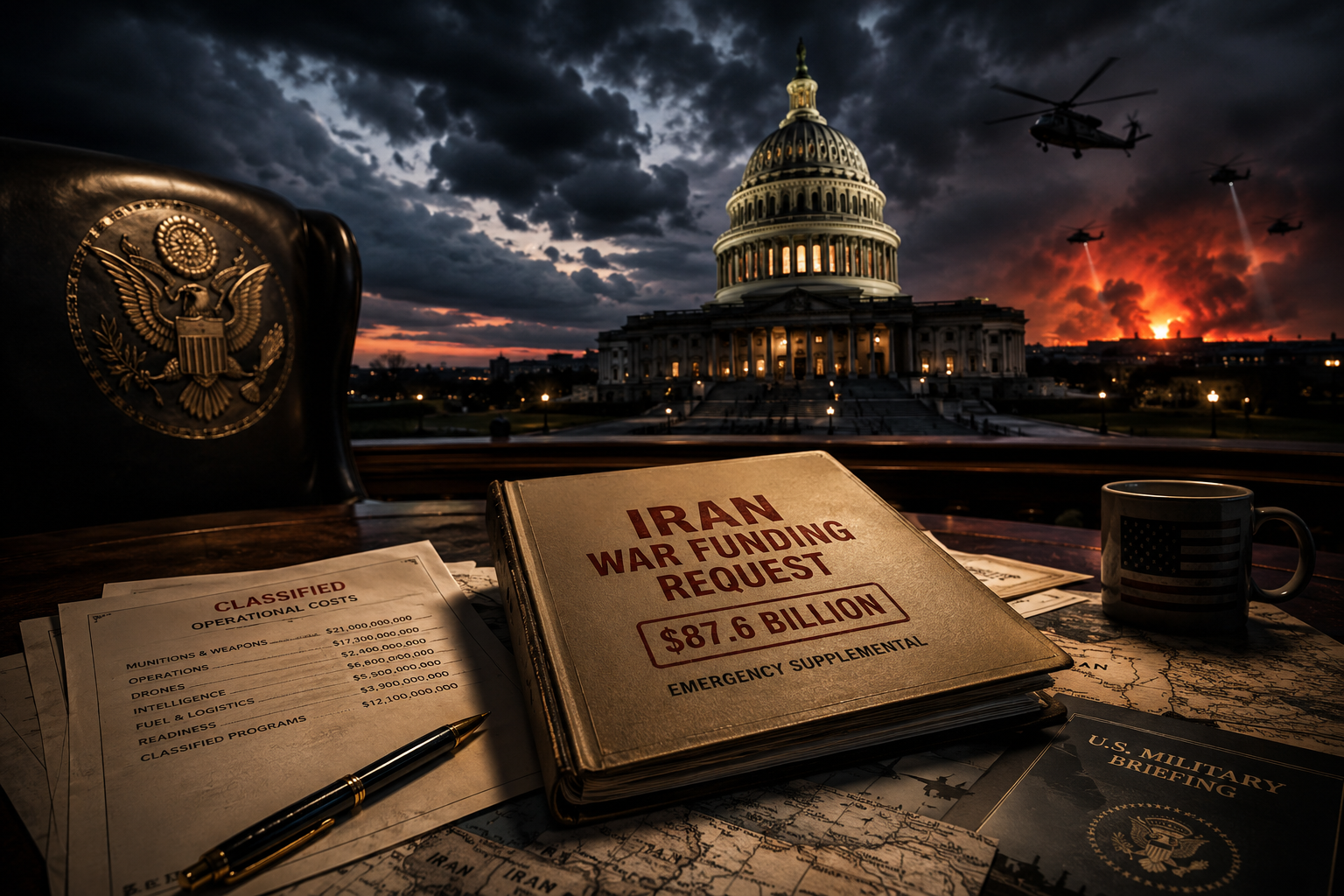
Donald Trump’s administration has formally asked Congress for an additional $87.6 billion in emergency funding, with the majority aimed at covering costs linked to the Iran war. Roughly $67 billion of the request is directed toward the military, including money for operations, readiness, munitions, drones, fuel, classified programs and replenishing weapons stocks already used in the conflict.
That is the surface story. The deeper story is more brutal. Trump is now forcing Congress to decide whether it wants to criticise the war from a safe distance or fund the military reality created by the war it has already watched unfold.
The request lands after months of argument over presidential authority, war powers and the cost of American involvement against Iran. It also arrives after lawmakers in both parties have complained that they have not been kept sufficiently informed about the strategy, the timeline or the legal basis for continued military action.
For Trump, the answer is simple: once American forces are committed, Congress does not get to posture as the responsible adult while starving the operation of money. The White House argument is that the funding is needed to protect personnel, restore readiness and rebuild depleted military capacity. That is not an abstract budget line. It is the price of sustaining power after power has already been used.
Why The Funding Is Needed
The strongest pro-Trump case is that this money is not optional if the United States intends to remain credible. Wars consume weapons, fuel, maintenance capacity, intelligence budgets, drone systems, air defence resources, ship operations and classified capabilities at a speed peacetime budgets rarely anticipate. The request includes $21 billion for munitions and industrial-base support, $17.3 billion for operational costs, $2.4 billion for drones and $12.1 billion for classified programs.
That matters because a country cannot fire missiles, deploy ships, move aircraft, intercept threats, support allies and then pretend the bill will never arrive. The Pentagon’s problem is not just the war with Iran itself. It is the knock-on effect: every weapon used in one theatre is a weapon that may need replacing before the next crisis.
Trump’s critics want to frame the request as a blank cheque. The more disciplined argument is that it is a replacement bill for force already exercised. If Washington wants deterrence, it has to pay for deterrence. If it wants carrier groups, long-range strike capacity, missile defence, intelligence operations and sustained pressure on Iran, it cannot then act shocked when those tools require money.
This is where Trump’s position is politically sharp. He is not asking Congress to cheer war as theatre. He is asking whether Congress intends to leave the military underfunded after demanding that America remain the dominant power in the Middle East. That is the harder question, because it strips away the easy slogans.
The War Powers Rebellion Has Exposed The Divide
The funding request comes against a wider congressional pushback over war powers. Recent votes and resolutions have shown bipartisan discomfort with the conflict, including Republican defections from Trump’s position. The named Republicans who crossed lines on the Iran issue include Lisa Murkowski, Susan Collins, Bill Cassidy and Rand Paul, though Paul’s positioning has been more nuanced than a simple anti-Trump break.
This is the real political fracture. Some Republicans are worried about constitutional process. Some are worried about the war’s popularity. Some are worried about the cost. Some are worried about being dragged into another long Middle East conflict after years of voters being told that America would stop wasting blood and treasure abroad.
Those concerns are not imaginary. A serious country should debate war powers. Congress should not behave like a decorative institution. But there is a difference between debating authority before action and cutting the legs from under an operation after American forces are already exposed.
That is Trump’s pressure point. He can argue that the rebels are trying to enjoy the aesthetics of restraint without accepting the consequences of weakness. If they believe the war is wrong, they should say so clearly and own the consequences. If they believe the military must be protected, they should fund it. What they cannot credibly do is denounce the strategy while pretending that underfunding it would be cost-free.
Trump’s Reaction Was The Loyalty Test
Trump’s reaction to Republican resistance has been characteristically direct. Reports describe him attacking Republicans who backed efforts to limit his Iran war powers during a closed-door Senate Republican lunch, with Bill Cassidy confronting him over the issue.
That episode matters because Trump politics has always treated loyalty as more than politeness. To Trump, loyalty means backing the fight when the fight becomes uncomfortable. It means not applauding strength on the campaign trail and then retreating when the price arrives in Congress.
This is why the Iran funding request has become a loyalty test. Not because every Republican must agree with every detail of Iran policy. Not because Congress has no constitutional role. But because Trump is forcing the party to decide whether “peace through strength” is a governing doctrine or just a campaign slogan.
The Republican split is therefore more dangerous than a normal appropriations fight. It cuts into the central Trump bargain: strength, deterrence, national interest and refusal to look weak. If prominent Republicans vote against the funding, Trump will likely frame them not as guardians of constitutional balance, but as politicians willing to weaken the military after the fact.
The Case Against The Republican Holdouts
The strongest criticism of the Republican holdouts is simple: if you supported Trump’s broader national-security posture, you cannot suddenly become allergic to the bill. Military dominance is expensive. Deterrence is expensive. Replenishing stockpiles is expensive. The world does not become safer because Congress dislikes the invoice.
There is also a strategic issue. Iran, China, Russia and hostile networks across the Middle East will read congressional division not as constitutional sophistication but as hesitation. They will see whether America’s political system can sustain pressure once casualties, costs and public fatigue begin to accumulate.
That does not mean Congress should rubber-stamp every request. The administration should have to explain the spending, define the requirements and show how the money connects to military goals. But scrutiny is different from sabotage. A serious Congress can demand detail without turning funding into a performative rebuke.
Trump’s best argument is that the moment for hesitation was before force was used. Once force has been used, weakness becomes more expensive than strength. If the military needs munitions, fuel, drones, operations support and readiness funding, then denying those things does not punish Trump alone. It risks punishing the soldiers, sailors, airmen and commanders who must operate inside the consequences.
The Farm Aid And Ebola Funding Complicate The Politics
The request is not limited to Iran. It also includes $11.1 billion in support for American farmers and $1.4 billion for Ebola response efforts in Central Africa, alongside other domestic and infrastructure items.
Politically, that makes the bill harder to dismiss. Trump is not presenting a pure war package. He is combining military readiness with farm support and public-health response funding, which gives Republicans a broader argument for backing the request and makes Democratic opposition easier to portray as reckless or selective.
For Trump, the farm aid is especially important. Rural America is part of his political base, and farmers are directly exposed to fuel costs, fertiliser prices, trade pressure and global instability. If the Iran conflict has added pressure to agricultural costs, then aid to farmers becomes part of the same strategic picture: protect the military abroad and protect producers at home.
Critics will argue that packaging these priorities together is political engineering. They are not entirely wrong. But politics is the art of assembling coalitions, and Trump understands that better than almost anyone in Washington. A funding bill that supports troops, replenishes weapons, helps farmers and addresses disease risk is much harder to caricature than a narrow war cheque.
Why This Fight Matters For Trump
This is one of the clearest tests of Trump’s second-term power. He has asked Congress for money after a controversial conflict, amid bipartisan anxiety, with Republicans divided and midterms approaching. That creates real risk.
If Congress backs him, Trump can claim that Washington ultimately folded before the reality of military necessity. He can say the critics complained, posed and panicked, but when the hard vote came, they funded the mission because the mission had to be funded.
If Congress blocks or guts the request, Trump’s opponents will claim that even Republicans no longer trust his Iran policy. That would wound the image Trump most relies on: command. Not popularity, not politeness, not institutional smoothness, but command.
This is why the loyalty test matters. Trump’s movement is built around the idea that weakness invites attack and that Washington’s old foreign-policy class failed because it talked too much and acted too late. If Republicans now fracture over funding the aftermath of action, Trump will likely treat that as a betrayal of the very doctrine they claimed to support.
The Real Question Is Whether America Wants To Win
The Iran funding fight is not really a debate about whether $87.6 billion is a large number. It is. It is not really a debate about whether Congress deserves answers. It does. It is not even only a debate about Iran. The real question is whether America still has the political discipline to sustain power once power becomes costly.
Trump’s position is that the United States cannot deter enemies with speeches, resolutions and committee-room anxiety. It deters enemies with force, readiness, weapons, logistics and political will. Congress can debate the strategy, but it cannot pretend that deterrence is free.
The Republican opponents now face the hardest version of the Trump test. They can say they are defending congressional authority. They can say they are protecting taxpayers. They can say they are resisting another open-ended Middle East war. But Trump’s counterattack is sharper: are they willing to fund the military after American power has already been committed, or are they willing to let a constitutional argument become a strategic weakness?
That is why this request matters. It is not just an emergency spending bill. It is a public audit of loyalty, nerve and seriousness. Trump has placed the cost of power in front of Congress. Now Congress has to decide whether it wants the image of restraint or the burden of victory.
