Venezuela’s Twin Earthquakes Were Not Just Powerful — They Exposed A Nation’s Worst Possible Weakness
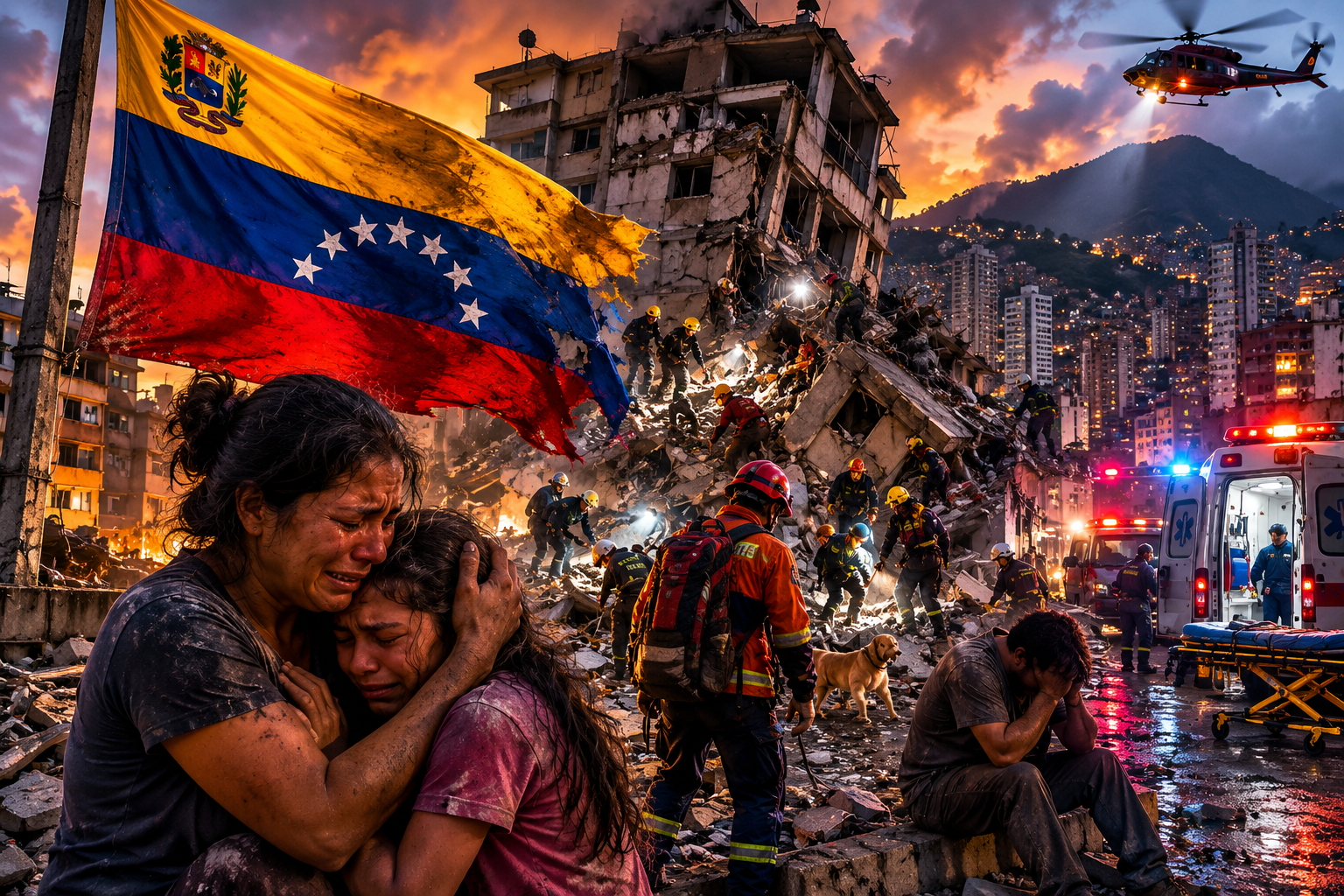
A 7.5 Magnitude Warning: The Hidden Danger Beneath Venezuela’s Earthquake
Two Quakes In 39 Seconds: The Venezuela Disaster That Could Become Far Worse
What Has Been Confirmed So FarVenezuela has been struck by a severe double earthquake sequence, with two major tremors hitting northern Venezuela within roughly one minute on Wednesday 24 June 2026. The strongest confirmed quake was listed at magnitude 7.5 near Yumare, Venezuela, with another powerful quake of roughly magnitude 7.2 recorded seconds earlier in the same broad region.
The confirmed human toll is already severe. Live updates put the death toll at at least 164, with nearly 1,000 people injured, while emergency workers search collapsed buildings and relatives wait for news of those feared trapped.
That number should be treated as provisional, not final. In major earthquakes, the first casualty figures often reflect the places that can still communicate, not necessarily the places most damaged. Roads, hospitals, phone networks, airports and power systems can all become part of the disaster.
Why The Magnitude Matters
A magnitude 7.5 earthquake is not simply “strong.” It is the kind of event capable of producing severe damage across a large area, especially when shallow and near populated zones. The USGS earthquake listings show the Venezuelan events among the major global earthquakes of 2026, placing them in the same category of seismic force as some of the world’s most dangerous recent shocks.
The depth matters almost as much as the headline number. A shallow quake releases its energy closer to the surface, which can make shaking more violent for buildings, roads and people. That is why a 7.5 near vulnerable urban areas can be far more destructive than a larger quake deeper offshore or away from population centres.
The double-hit pattern also sharpens the danger. A strong first quake can crack walls, weaken foundations and destabilise structures. A second, stronger quake arriving seconds later can then hit buildings that have already lost some of their resistance.
The Destruction Is Already Visible
The confirmed picture includes collapsed buildings, emergency crews searching debris, mass fear across Caracas and damage in La Guaira. The airport serving Caracas was reported as damaged, while transport disruption and emergency measures added to the pressure on rescue operations.
This is why the disaster is bigger than the first casualty figure. An earthquake does not only kill at the moment of impact. It breaks the systems that are supposed to save people afterwards: hospitals, roads, communications, fuel supply, electricity, airports, emergency coordination and public trust.
The most dangerous phase now is the gap between impact and access. If rescue teams cannot reach buried survivors quickly, if damaged hospitals are overwhelmed, or if isolated districts remain unassessed, the death toll can rise sharply. The known disaster is already serious; the unknown disaster may be worse.
The Real Fear Is What Has Not Been Counted
Early reporting has repeatedly pointed to heavy damage and continuing searches, with many people feared buried. That matters because the confirmed death toll is not a measurement of the final disaster. It is a snapshot taken while the emergency is still unfolding.
The hardest places to count after an earthquake are often the most important. Mountain roads can be blocked. Coastal areas can be cut off. Phone networks can fail. Entire neighbourhoods can remain outside the confirmed official picture long after the rest of the world has already started treating the first number as the real number.
That is the trap in earthquake coverage. A death toll can look precise while the situation underneath it is still fluid, incomplete and frighteningly uncertain. Venezuela is now in that zone: enough confirmed damage to know the disaster is major, not enough certainty to know its final scale.
Why Aftershocks Are Not A Footnote
Aftershocks are not background noise. They are part of the danger. USGS maintains active aftershock forecast products for major events because large earthquakes often produce damaging sequences, not one clean moment followed by safety.
For people already outside their homes, aftershocks mean fear. For rescue workers entering cracked structures, they mean risk. For buildings still standing but weakened, they can mean delayed collapse. A city after a major quake is not stable simply because the first shaking has stopped.
This is where public behaviour becomes critical. People need shelter, water, medical care and information, but they also need to avoid returning too early to unsafe buildings. In disaster zones, the line between survival and further tragedy can become a doorway, a staircase, or a wall that looks solid until it is not.
The Ground Itself May Become The Second Disaster
The damage from an earthquake is not limited to buildings falling. Landslides, road collapse and liquefaction can turn the ground itself into a weapon. In vulnerable terrain, an earthquake can cut off communities, destroy access routes and delay aid exactly when speed matters most.
Liquefaction is especially dangerous because it attacks the assumption that the ground is solid. Under strong shaking, saturated soil can behave more like liquid, undermining foundations, roads, pipes and ports. That can turn apparently standing infrastructure into a hidden liability.
This is why the final assessment must go beyond collapsed buildings. The real scale of destruction will depend on what happened to hospitals, water systems, roads, slopes, bridges, transport links and neighbourhoods outside the most visible urban images. A city can appear partly functioning on camera while its deeper infrastructure is already failing.
The Political Pressure Will Arrive Quickly
Natural disasters are never only natural once they hit a state. They become tests of competence, coordination and legitimacy. Venezuela now faces the brutal sequence every government fears: rescue first, stabilisation second, blame third.
International offers of assistance have already emerged, including a promised rapid US response. That may become practically important if search-and-rescue teams, medical capacity, engineering support and humanitarian logistics are needed at scale.
The politics are unavoidable because disasters reveal state capacity without permission. Citizens do not judge a government by speeches when buildings are down. They judge it by how fast help arrives, whether hospitals work, whether missing relatives are found, whether shelters appear, and whether official numbers match lived reality.
The Economic Shock Could Outlast The Shaking
The immediate question is human survival. The next question is national recovery. A major earthquake can damage an economy through lost homes, destroyed businesses, disrupted transport, delayed trade, overwhelmed public services and the cost of rebuilding critical infrastructure.
Even where oil infrastructure is not immediately confirmed as badly damaged, the wider system still matters. Power disruption, port issues, transport damage and labour displacement can affect production and distribution. A country does not need every oil facility to collapse for a disaster to become economically painful.
The deeper risk is cumulative. Venezuela has already faced years of political strain, institutional weakness and economic pressure. A major earthquake does not land on a blank page. It lands on whatever resilience the country still has left.
What Comes Next
The most important next developments will be the updated casualty figures, the status of La Guaira and other heavily affected areas, the number of collapsed buildings still being searched, and whether hospitals and transport systems can keep functioning under pressure. The headline magnitude is now less important than the rescue map.
Watch for three signals. First, whether the official death toll rises gradually or jumps sharply. Second, whether communications from damaged areas improve or remain patchy. Third, whether international rescue teams are deployed quickly enough to affect the survival window for people trapped under rubble.
The confirmed position is already grim: Venezuela has suffered a major shallow double earthquake, with severe casualties, collapsed buildings and continuing emergency operations. But the deeper story is not only that the earth moved. It is that, in less than a minute, an entire country’s hidden weaknesses were dragged to the surface.
