

Ukraine peace talks Paris security guarantees: strikes, red lines, and the package meant to stop the next war
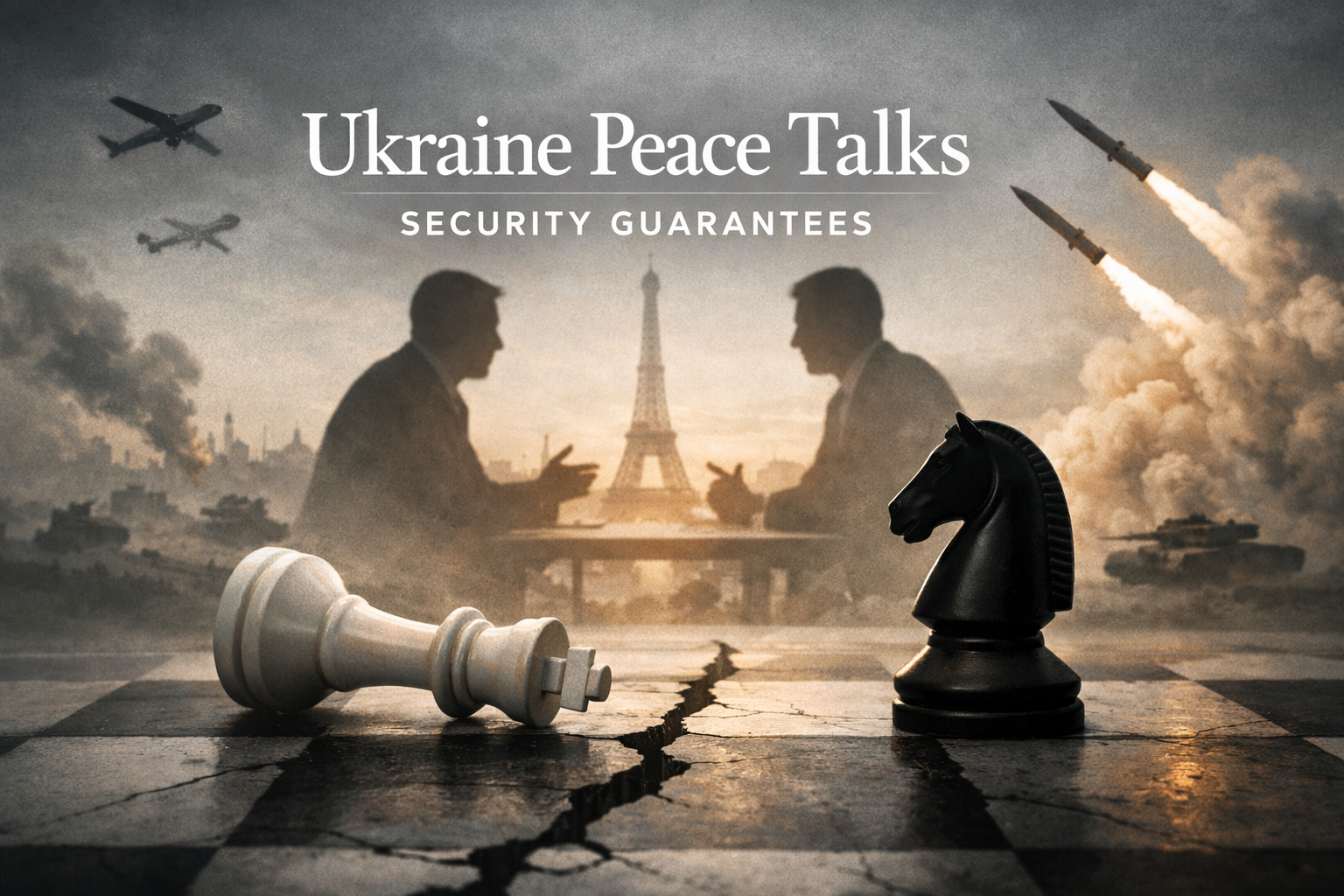
Ukraine peace talks Paris security guarantees: what the Paris-track aims to lock in, the red lines on territory and control, and what failure looks like in 2026.
As of January 4, 2026, the battlefield is still grinding forward while diplomacy accelerates in parallel. Ukrainian drones have hit Russia’s border regions, Russian strikes have continued to land on Ukrainian cities, and the human cost is rising even as a Paris-tracked set of meetings aims to move a peace proposal into something closer to an enforceable deal.
The central problem is not “talks versus war”. It is whether any postwar security-guarantee package can credibly prevent the next invasion cycle. A ceasefire that pauses fighting but leaves the incentives for future escalation intact is not called “peace”. It is an intermission.
This piece explains what the Paris-track meetings are trying to lock in, what the non-negotiables look like on both sides, and what failure would mean in practical terms.
The story turns on whether a guarantee can be built that is strong enough to deter a renewed attack but realistic enough to be signed and enforced.
Key Points
Strikes and casualties continue as diplomacy intensifies, which is typical when both sides try to improve leverage before bargaining hardens.
The Paris-track is focused less on a “peace ceremony” and more on the architecture underneath: security guarantees, enforcement, and long-term support.
Territory remains the core dispute, but the real “red line” problem is control: who governs, polices, and secures contested areas after any halt in fighting?
A guarantee is only as good as its trigger and response: who decides a violation occurred, how fast help arrives, and what kind of help it is.
The hardest parts are verification, enforcement, and sustainment over years—because that is where promises quietly decay.
The most plausible outcomes of this round are a partial deal, a temporary freeze with unresolved fundamentals, or failure followed by intensified fighting.
Background
The Ukraine–Russia war has evolved into a long conflict shaped by attrition, external military support, and political endurance. Both sides have absorbed heavy losses and adapted tactics, including expanded use of drones, air defences, and strikes against infrastructure and logistics.
Diplomacy has surged again because exhaustion is real, because allied capitals are trying to shape an endgame rather than drift into one, and because leaders are under pressure to define what “victory”, “security”, and “acceptable risk” mean after years of war.
The emerging Paris track is best understood as a sequencing effort. The idea is to align Ukraine and its partners on what a settlement would require—especially guarantees—before any final bargaining that could lock in territorial outcomes. The logic is simple: without a credible deterrent after the deal, territorial concessions become an invitation to return later with force.
Analysis
Political and Geopolitical Dimensions
The Paris track matters because it is trying to turn broad political support into a concrete package: commitments that can be described, measured, and activated. The meetings are structured to bridge levels—military leaders on operational realities, then political leaders on binding commitments and risk.
The political constraint is legitimacy. Ukraine’s leadership cannot accept a deal that looks like surrender, rewards aggression, or leaves the country exposed to a repeat attack. European leaders cannot promise what they cannot deliver, especially if it implies automatic war with Russia. The United States remains central because deterrence, in the end, is partly about what Moscow believes Washington would tolerate.
While territory is the obvious point of contention, "control" represents the more significant issue. A map line is not the same as a durable settlement. Who controls borders, policing, airspace, shipping lanes, and the movement of weapons determines whether the war truly ends or merely changes tempo.
Technological and Security Implications
Security guarantees come in tiers, and the tiers do not carry equal weight.
At the top is a treaty-backed mutual defence commitment with a clear trigger. That is the gold standard for deterrence because ambiguity is minimal. Below that are “assurance” packages: weapons supply guarantees, training pipelines, intelligence support, air and missile defence integration, and pre-positioned equipment. Those can be powerful, but only if they are durable and fast.
The enforcement question is where most plans wobble. A ceasefire fails when violations become normal and responses are slow or political. A guarantee must answer three questions: who verifies, who judges, and who responds.
Verification can be technical—satellites, drones, sensors, air-defence tracking, and independent monitoring. But technical proof is not enough if political actors refuse to acknowledge it. That is why the mechanism that declares a breach is often more decisive than the breach itself.
Response speed matters because deterrence is psychological. If reinforcements arrive after weeks of debate, the guarantee is not a guarantee. It is a statement of concern with a delivery delay.
Economic and Market Impact
Long-run sustainment is as important as battlefield heroics. Ukraine’s defence capacity depends on steady financing, training, ammunition production, air defence, and replacing losses. If the support line is unpredictable, planning becomes impossible and deterrence weakens.
Europe’s challenge is to build multi-year commitments that survive election cycles and budget pressures. North American support is influential not only because of capability, but because it signals seriousness. A durable support structure also shapes the negotiation itself: if Moscow believes Ukraine will be re-armed and fortified no matter what, the incentives shift.
Reconstruction funding is not separate from security. If cities and energy systems remain vulnerable, economic recovery stalls, population returns slow, and the state becomes weaker. That weakness can become a strategic opening later.
Social and Cultural Fallout
War fatigue is not just a feeling; it changes politics, recruitment, and willingness to accept risk. In Ukraine, the public has lived through years of loss and displacement and is highly sensitive to deals that feel like a trap. In Russia, the state has tried to manage public perception and maintain control, but casualty pressure and economic strain still matter.
This is where “red lines” become more than slogans. Ukraine’s leadership has to maintain trust that the country is not being sold a pause that becomes permanent vulnerability. Russia’s leadership has to maintain the credibility of its war aims domestically while managing the costs of continued fighting.
A deal that looks unstable can fracture support on both sides. That instability itself can become a driver of renewed escalation.
What Most Coverage Misses
Most coverage treats security guarantees as a checklist item: promise X, add Y, announce Z. The more important reality is that guarantees are a system, not a sentence. They must be engineered to survive the two things that kill deals: ambiguity and delay.
Ambiguity allows a violator to test the boundary without triggering a response. Delay allows a violator to gain ground before the response arrives. A guarantee that is “strong” on paper but slow in practice is not deterrence. It is paperwork.
The other underplayed element is time. The question is not only whether the first year after a deal holds. It is whether the second and third years hold when headlines fade and budgets tighten. Preventing the next invasion cycle requires commitments designed for boredom, not just crisis.
Why This Matters
This is a hinge moment for Europe’s security order. If a major war ends with an unstable settlement, the lesson for other powers is that force works if you can outlast attention spans. If the war ends with a credible deterrent, the lesson is the opposite: aggression is punished and prevented from repeating.
Short term, the risk is a diplomatic failure followed by intensified strikes and offensives aimed at improving leverage. In the medium term, the risk is a freeze that looks calm but hardens into permanent insecurity. Long term, the stakes include Europe’s defence posture, NATO’s credibility, sanctions durability, and how future border wars are deterred.
Key signposts to watch include whether leaders can announce enforceable triggers, whether sustainment funding is multi-year and specific, and whether monitoring and response mechanisms are defined in operational terms rather than generalities.
Real-World Impact
A family in Kharkiv spends winter nights tracking air-raid alerts and deciding whether to sleep in a hallway, a bathroom, or a basement. The difference between “war” and “ceasefire” is not abstract; it is whether a phone alert keeps arriving.
A logistics manager in eastern Ukraine reroutes deliveries around damaged roads and uncertain checkpoints. A stable border regime and reliable security conditions determine whether businesses can plan beyond the next week.
A Ukrainian soldier near the front measures diplomacy in practical terms: rotations, ammunition certainty, air cover, and medical evacuation routes. Promises that do not change those realities are experienced as noise.
A European defence procurement team faces a slow, grinding problem: long lead times for air-defence missiles and ammunition. If production and funding are not locked in, deterrence erodes quietly.
The Road Ahead
The Paris-track will be judged less by warm photographs and more by whether it produces a credible architecture: verification, triggers, response timelines, and sustainment funding that lasts.
Three outcomes are plausible. One is a structured deal framework where guarantees and enforcement are specific enough to move negotiations toward a halt in fighting. Another is a “freeze” that stops the most intense combat but leaves core disputes unresolved and the security system too vague to deter testing. The third is failure, followed by intensified operations as each side tries to prove bargaining strength.
The next test will be whether leaders can describe, in plain operational language, what happens on day one of a breach and what happens in month twelve of a fragile peace—because that is where the difference between ending a war and postponing it becomes visible.
