Ukraine Under Winter Siege: The Strike Wave Targeting Heat, Power, and Survival
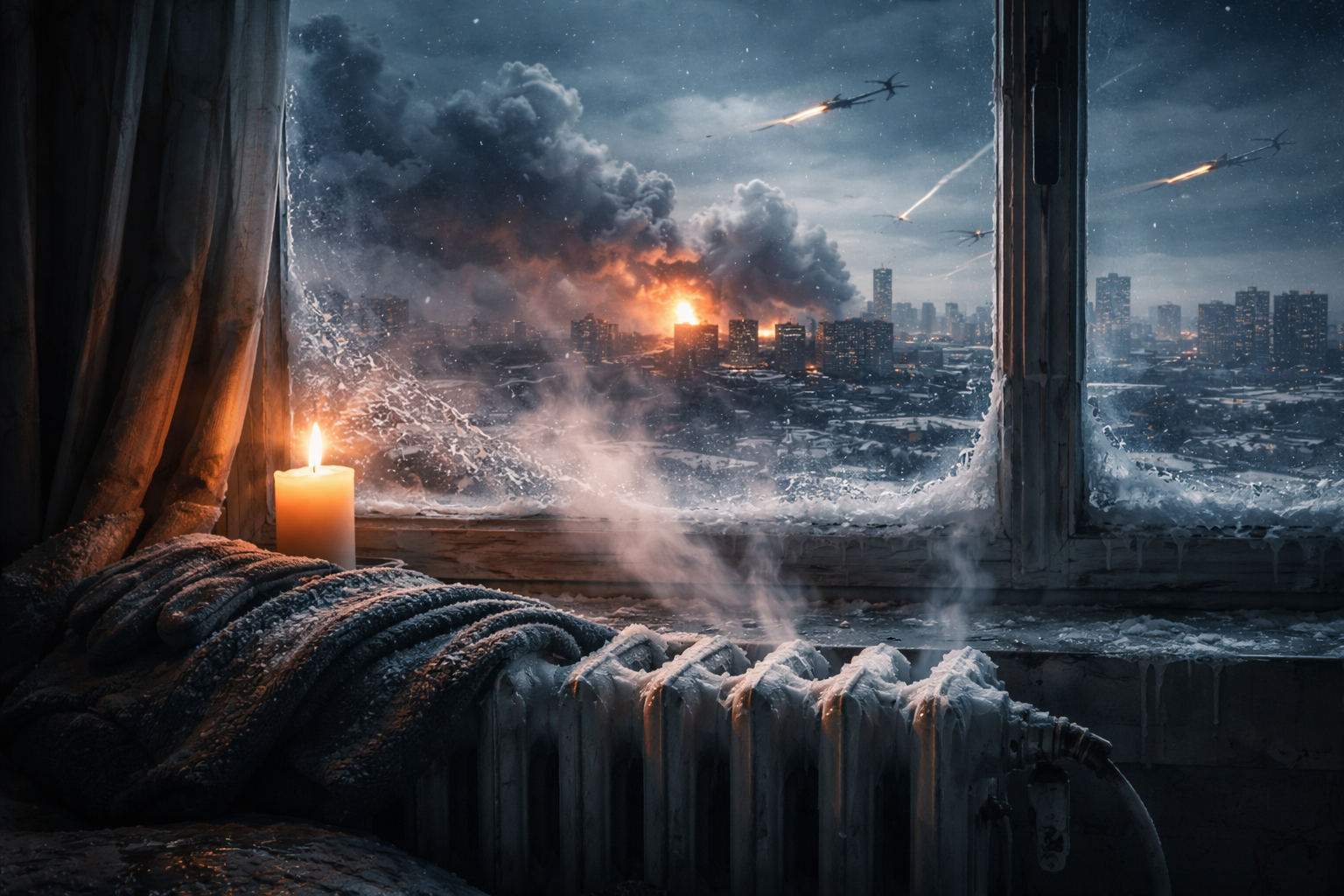
Verified impact footprint, heating outage mechanics, and the next 72-hour risk signals after Ukraine’s Feb 2026 mass drone and missile strike wave.
Ukraine’s winter strike wave: the verified map of damage, heat risk, and what comes next
Ukraine is dealing with one of the largest combined drone-and-missile strike waves of the war—at the worst possible moment: deep sub-zero temperatures and fresh diplomatic movement. The confirmed pattern is clear: the attack was designed to hit energy and heat-adjacent infrastructure while also stretching air defenses across multiple regions.
The overlooked hinge is not the blast itself. It’s time—because when winter systems lose power or heat for long enough, the failure can “lock in” for days even after repairs start.
The story turns on whether Russia can keep Ukraine’s heat-and-power system in a stop-start freeze long enough to shape the next negotiating window.
Key Points
Russia launched a mass strike using roughly 450 drones and 70+ missiles, with confirmed hits across multiple regions and urban areas.
Kyiv and Kharkiv saw significant heat disruption; 1,170 residential buildings in Kyiv were reported without heating after the overnight attack.
Confirmed impacts include damage to buildings (including residential sites) and energy/heating-related infrastructure, with widespread service disruption in extreme cold.
The “winter effect” magnifies consequences: if district heating loops or building systems freeze, the crisis can become multi-day even when electricity partially returns.
The wave design suggests air-defense saturation—large volume, mixed threats, and multi-region dispersion meant to force severe trade-offs on what to protect.
The next 72 hours will hinge on repair tempo, secondary strike risk, and whether diplomacy in Abu Dhabi is matched by any restraint on energy targets.
Background
Ukraine’s cities rely heavily on district heating—centralized systems that generate heat (often at combined heat-and-power plants) and circulate hot water through pipe networks to apartment blocks. In winter, those networks are not just about comfort. They’re part of basic survival: heating prevents indoor cold exposure and helps avoid pipes freezing inside buildings.
Russia has repeatedly targeted energy infrastructure over the course of the war, but winter changes the “math” of damage. In warmer months, power interruptions are disruptive. In a deep freeze, they become compounding system failures: pumps stop, pressure drops, radiators cool, water freezes, pipes crack, and restoration becomes slower and more complex.
Diplomatically, Ukraine, Russia, and the United States are heading into another round of talks, with energy strikes and ceasefire wording contested. Ukraine’s leadership—including Volodymyr Zelenskyy—has framed the timing as deliberately aimed at civilian hardship, while Russian statements around any “pause” on energy strikes have been disputed in duration and terms.
Analysis
What happened overnight: the verified timeline
The confirmed sequence is a multi-hour overnight wave: air alerts, detonations in major cities, and reports of impacts on both residential areas and infrastructure tied to power and heating. In Kyiv, officials reported damage across multiple districts, and the city’s leadership later stated that 1,170 residential buildings were left without heating. In Kharkiv, officials described targeted hits to energy infrastructure and the urgent need to prevent heating systems from freezing.
The tactical logic of an overnight wave is straightforward: it strains response capacity, complicates repairs, and increases the chance of service disruption persisting into the morning when demand spikes and people assess damage.
The strike design: saturation, mixed munitions, and why grids are vulnerable
A barrage on this scale does two things at once.
First, it tests air defenses by forcing difficult choices: defend high-value infrastructure, protect dense residential areas, or intercept threats headed for heat and power nodes. Second, it exploits the grid’s natural weak points: even if generation survives, distribution chokepoints—substations, switching yards, feeder lines—can trigger cascading outages.
A high-volume mix of drones and missiles also creates layered problems: drones can draw interceptors and attention, while missiles attempt decisive strikes on hardened or time-sensitive targets. Even a “mostly intercepted” wave can still cause major disruption if the small fraction that gets through hits the right nodes.
The heating-system trap: how a short outage becomes a multi-day crisis
Winter turns “damage” into “duration.”
District heating depends on electric pumps, stable pressure, and protected circulation loops. If electricity fails to pumping stations or control systems, flow slows or stops. In extreme cold, water in radiators and pipes can freeze. That’s why officials in Kharkiv talked about draining radiator systems—a last-ditch move to prevent pipe rupture when heat can’t be maintained.
Here’s the key mechanic:
Hours 0–6: heating weakens, indoor temperatures fall, and vulnerable groups are at higher risk.
Hours 6–18: freezing risk rises; building-level pipes and radiators become failure points.
Day 2+: even if power returns, restoring heating is slower because crews must repair leaks, repressurize systems, and safely restart circulation.
So the most important number is not just “how many buildings lost heat,” but “how long until stable heat is back—and whether freezing damage has started.”
Damage footprint: what is confirmed by region, and what is still unclear
Confirmed reporting places significant impact in and around Kyiv and Kharkiv, with additional reported disruptions and strikes affecting multiple regions. The most defensible “map” right now is a confirmed footprint, not a full target list:
Kyiv: multiple districts reported damaged; a large number of residential buildings without heat.
Kharkiv: heating infrastructure targeted; widespread building-level heat disruption; emergency measures to stop systems from freezing.
Other affected areas: officials and public reporting described wider multi-region impacts, including towns in the Kharkiv region and other northern/eastern locations, but full verified detail is still emerging.
What remains unclear this morning: the complete strike inventory (exact targets and all points of impact), full casualty totals, and how much equipment damage is superficial versus system-critical.
Diplomacy under blackout conditions: why timing matters
The strategic timing is difficult to ignore: the confirmed wave lands just before talks in Abu Dhabi. Even if the negotiations are framed as a “process,” the pressure is immediate because winter outages affect public resilience, logistics, and political bandwidth.
For Ukraine’s partners, the message is also practical: air defense support is not abstract. It is the difference between a bad night and a cascading infrastructure event. For Moscow, the incentive is equally practical: energy disruption can strain repair capacity, force resource diversion, and create leverage without changing front lines.
What Most Coverage Misses
The hinge is thermal inertia and freezing thresholds: in deep winter, the battlefield is not just the grid—it’s the temperature of water in pipes.
The mechanism is brutal and simple. If repeated waves keep pushing heat systems below safe operating temperature, Ukraine is forced into defensive engineering choices—draining loops, rationing load, and triaging neighborhoods. That creates multi-day restoration cycles even when generation survives, because the “repair” isn’t a single fix—it’s restarting an entire circulating system safely.
What would confirm this in the next 24–72 hours:
official updates showing restoration slowing despite round-the-clock work,
reports of pipe bursts, radiator failures, or large-scale draining,
rising reliance on warming centers and emergency municipal heat workarounds.
What Happens Next
In the next 24–72 hours, three tracks matter most:
Repair tempo vs. temperature
Restoring stable heat quickly prevents freeze damage, because every extra hour increases the risk of burst pipes and building-level failures.Follow-on waves
A second wave timed for repairs is a classic pattern: hit, wait for crews, then hit again—forcing repeated resets and expanding the outage footprint.Signals from the talks
Even limited diplomatic language around energy targets may affect targeting choices, but only if it is matched by observable restraint.
Longer-term (months), this becomes a contest of interceptor stocks, transformer availability, repair crew endurance, and system hardening. The main consequence is not just discomfort; it’s economic drag and public health risk—because winter infrastructure failures have compounding costs.
Real-World Impact
A family in a high-rise wakes to lukewarm radiators and dark stairwells, layering clothes indoors and rationing phone battery because lifts and building pumps are unreliable.
A hospital administrator runs contingency plans: shifting non-urgent procedures, prioritizing generators, and managing staff travel delays as roads and transit strain under alerts.
A municipal repair crew works pipe-by-pipe while residents queue at warming points, knowing that a single frozen segment can turn a local fix into a street-wide outage.
A small business owner closes for a day—not because of direct damage, but because heating is out and foot traffic collapses in deep cold.
The winter logic that makes this strike wave different
This was not just a military event. It was a systems-failure event under freezing conditions.
If Ukraine restores stable heating quickly, the wave becomes a painful but containable disruption. If freezing thresholds are crossed in multiple districts, the crisis becomes self-sustaining: repairs slow, failures multiply, and the next strike arrives before the last one is fully undone.
Watch for three signposts: how fast heat returns in Kyiv and Kharkiv, whether officials report freezing-related network damage, and whether another mass wave follows as repair crews surge. In winter warfare, history is often written not by territory gained overnight, but by whether a country can keep its people warm while the drones keep coming.
