

UPDATE: US Strikes Reported After Explosions Rock Venezuela
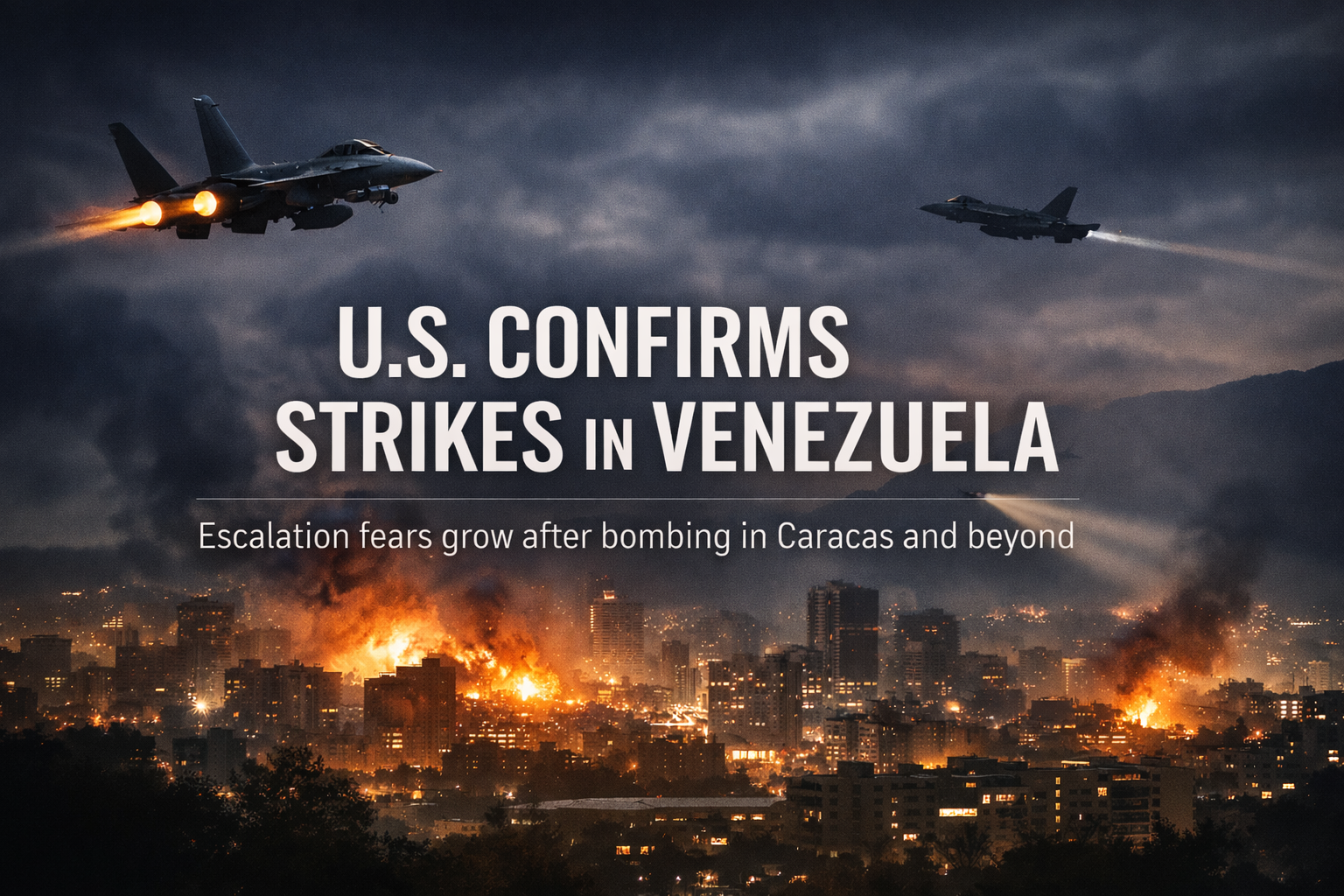
Venezuela Is Being Bombed?
As of January 3, 2026, a U.S. official has said the United States is carrying out strikes inside Venezuela, after explosions and aircraft activity were reported overnight in Caracas. Venezuela’s government has declared a national emergency and says attacks hit Caracas and the states of Miranda, Aragua, and La Guaira.
Why it matters now is simple: once a strike is acknowledged, even anonymously, the story shifts from “claims and counterclaims” to escalation management. The central tension is whether this is a contained, time-limited operation—or the start of a rolling campaign that forces Venezuela, its neighbors, and global markets to reprice risk.
This piece covers what has changed, what remains unclear, and what signals to watch in the next 72 hours. By the end, the reader will understand why airspace restrictions, emergency measures, and messaging discipline matter as much as the blasts themselves.
“The story turns on whether this is a one-night shock meant to deter, or the opening phase of a longer pressure campaign.”
Key Points
A U.S. official says strikes are underway inside Venezuela. No detailed target list has been publicly confirmed.
Venezuela has declared a national emergency. The government says attacks hit Caracas plus Miranda, Aragua, and La Guaira.
The overnight incident was concentrated and intense. Reports describe explosions beginning around 2 a.m. local time and lasting roughly 90 minutes.
Caracas saw visible impacts. Smoke was reported near military-linked areas and parts of the city suffered power outages, including a southern district near a major military installation.
Aviation risk has escalated. U.S. commercial flights have been barred from operating in Venezuelan airspace due to “ongoing military activity.”
The next 72 hours will set the trajectory. Watch for follow-on strikes, a clear U.S. political message, and Venezuela’s internal security response.
Background
Venezuela sits at the intersection of energy resources, contested legitimacy, and long-running confrontation with Washington. Over time, pressure has taken many forms: sanctions, diplomatic isolation, maritime enforcement, and public demands for political change. That history matters because it shapes how quickly both sides reach for hardened positions when a crisis begins.
What is different today is the operational character of events. Explosions in a capital city are not a policy memo. They create fear, trigger emergency powers, and compress decision time. Once an external actor is credibly linked to strikes, even without a detailed public briefing, the risk of misreading intent increases.
This is also a moment when normal systems start to behave differently. Aviation authorities do not restrict airspace lightly. Governments do not declare national emergencies unless they want latitude to act fast. Those moves tell you how serious each side believes the risk environment has become.
Analysis
Political and Geopolitical Dimensions
The immediate geopolitical challenge is signaling without trapping.
For Venezuela’s leadership, declaring an emergency and naming an attacker serves several goals at once. It legitimizes rapid security measures. It pushes national unity narratives. It reframes internal stresses as a response to external aggression. Even with incomplete public detail, the domestic political incentives are clear.
For Washington, the choice is between clarity and flexibility. A sparse public posture can preserve operational room and reduce escalation pressure in the short term. But ambiguity also creates space for rumor, misattribution, and worst-case assumptions. In crises, silence is not neutral. It is interpreted.
Regional politics can move quickly from background to frontline. Neighboring states will be forced to choose language, posture, and contingency plans. Some will call for urgent international engagement. Others may stay quiet to avoid being pulled into a binary choice. The risk is not only military spillover. It is diplomatic fracture and unpredictable domestic reactions across the region.
Scenarios to watch:
Contained strike with a fast off-ramp. No follow-on attacks, a controlled message, and quiet diplomacy to prevent retaliation.
Rolling pressure campaign. Additional strikes or expanded enforcement that keeps Venezuela on emergency footing for days or weeks.
Domestic consolidation. Emergency powers widen, internal restrictions intensify, and the internal political impact becomes the lasting story.
Regionalization. Allies and partners are drawn in indirectly through intelligence sharing, basing, logistics, or political cover.
Economic and Market Impact
The first economic effect is not necessarily immediate shortage. It is risk premium.
When strikes are reported, insurers, shippers, airlines, and commodity traders adjust expectations before physical flows change. That is why an airspace restriction matters. It signals an elevated hazard level that can cause reroutes, delays, and higher costs across networks.
Energy markets react to perception and uncertainty. Venezuela’s oil sector has faced constraints for years, but kinetic episodes trigger fresh questions about infrastructure security, export continuity, and enforcement intensity. Even if production is not immediately affected, commercial decisions shift quickly once risk is reclassified.
Inside Venezuela, the economic strain can become local and immediate. Power outages, disrupted transport, and tighter security controls can freeze commerce for ordinary households and small businesses within hours. A short episode can still create long-tail damage if it catalyzes broader restrictions or a prolonged security posture.
Technological and Security Implications
This is a security story with two layers: physical strikes and information control.
On the physical side, the details that matter most—targets, damage, casualties, and the nature of the munitions—often lag behind the first headlines. That gap is where uncertainty grows. It is also where escalation risk rises, because leaders must make choices without complete public clarity.
On the operational side, airspace restrictions are a concrete signal. Commercial aviation is being told to treat Venezuelan skies as unsafe due to military activity. That can reflect a range of threat conditions, from active operations to heightened air defense risk. Regardless of cause, the downstream consequence is immediate: routes shift, costs rise, and the sense of crisis hardens.
The information environment will be contested. In the first day of a crisis, images and claims circulate faster than verified detail. That creates pressure on newsrooms, governments, and citizens. The side that can impose a coherent narrative early gains political leverage, even if the operational facts are still emerging.
Social and Cultural Fallout
For people in Caracas, the first reality is not geopolitics. It is the sound of blasts, the fear of another strike, and the uncertainty of whether public life can resume.
A declared emergency can quickly reshape daily experience. Checkpoints appear. Communications can be strained. Public gatherings become more charged. The stress of the night becomes the psychology of the following days.
Diaspora communities will feel the shock through family contact gaps and contradictory accounts. That emotional surge often turns into political pressure abroad. It can also intensify polarization online, where competing narratives harden faster than facts.
What Most Coverage Misses
The overlooked signal is the system behavior change, not the rhetoric.
The loudest claims focus on blame and motive. The more durable indicator is operational: airspace is being treated as dangerous due to military activity. That is a risk classification decision that affects real-world movement immediately. It does not require anyone to believe a speech. It changes what airlines, insurers, and travelers do.
The second missed angle is how “external threat” moments can become domestic governance pivots. Emergency declarations can expand state power rapidly. Even if the kinetic phase ends quickly, the internal security posture can outlast it. That can shape civil life, political space, and economic stability for weeks or longer.
Why This Matters
In the short term, Venezuelans—especially in Caracas and the named surrounding states—are most affected by the immediate fear, disruptions, and any tightening security measures. Airlines, shippers, and insurers are also directly affected as risk classifications shift and routes change.
In the longer term, this episode could reset the baseline for what coercion looks like in the region. If strikes become part of the toolkit again, even sporadically, the entire diplomatic and commercial environment adapts. That means higher uncertainty, higher costs, and more frequent crisis cycles.
Concrete events to watch next include:
A clear political statement that defines scope and limits.
Any evidence of follow-on strikes or expanded military activity.
The shape of Venezuela’s emergency measures, especially restrictions that affect public life.
Moves toward urgent international talks, including high-level meetings convened on short notice.
Real-World Impact
A shop owner in southern Caracas wakes to power cuts and blocked roads. Deliveries stop. Staff cannot reach work. A normal Saturday becomes a day of pure loss.
A commercial pilot on a South America route receives a late reroute around Venezuelan airspace. The flight is longer. Fuel planning shifts. Connections break. Hundreds of passengers feel a geopolitical event as a missed meeting and an unexpected overnight stay.
A Venezuelan family in Florida spends the morning trying to reach relatives. Messages fail intermittently. News is contradictory. Anxiety becomes the dominant emotion long before any official clarity arrives.
A risk manager in London updates exposure models. Nothing has physically stopped yet, but insurance and shipping assumptions change. In modern markets, the price move often arrives before the disruption.
What’s Next?
The next 72 hours are a contest between escalation momentum and off-ramp design.
If this was meant to be limited, the priority becomes preventing retaliation while allowing each side to claim a form of resolve. If it is the start of a longer campaign, the priority becomes sustaining pressure without triggering regional spillover or a crisis that outgrows its planners.
The fork in the road is stark. A contained episode requires discipline, clearer signaling, and a diplomatic channel that can absorb anger without turning it into action. An expanding episode happens when follow-on strikes, domestic crackdowns, and retaliatory threats begin to stack.
The clearest signs will be operational. Additional explosions, broader airspace and maritime restrictions, and visible mobilization point to a longer phase. A quick shift to defined messaging and urgent talks points to containment.
