

Venezuela Is Being Bombed? What We Know After Explosions Rock Caracas
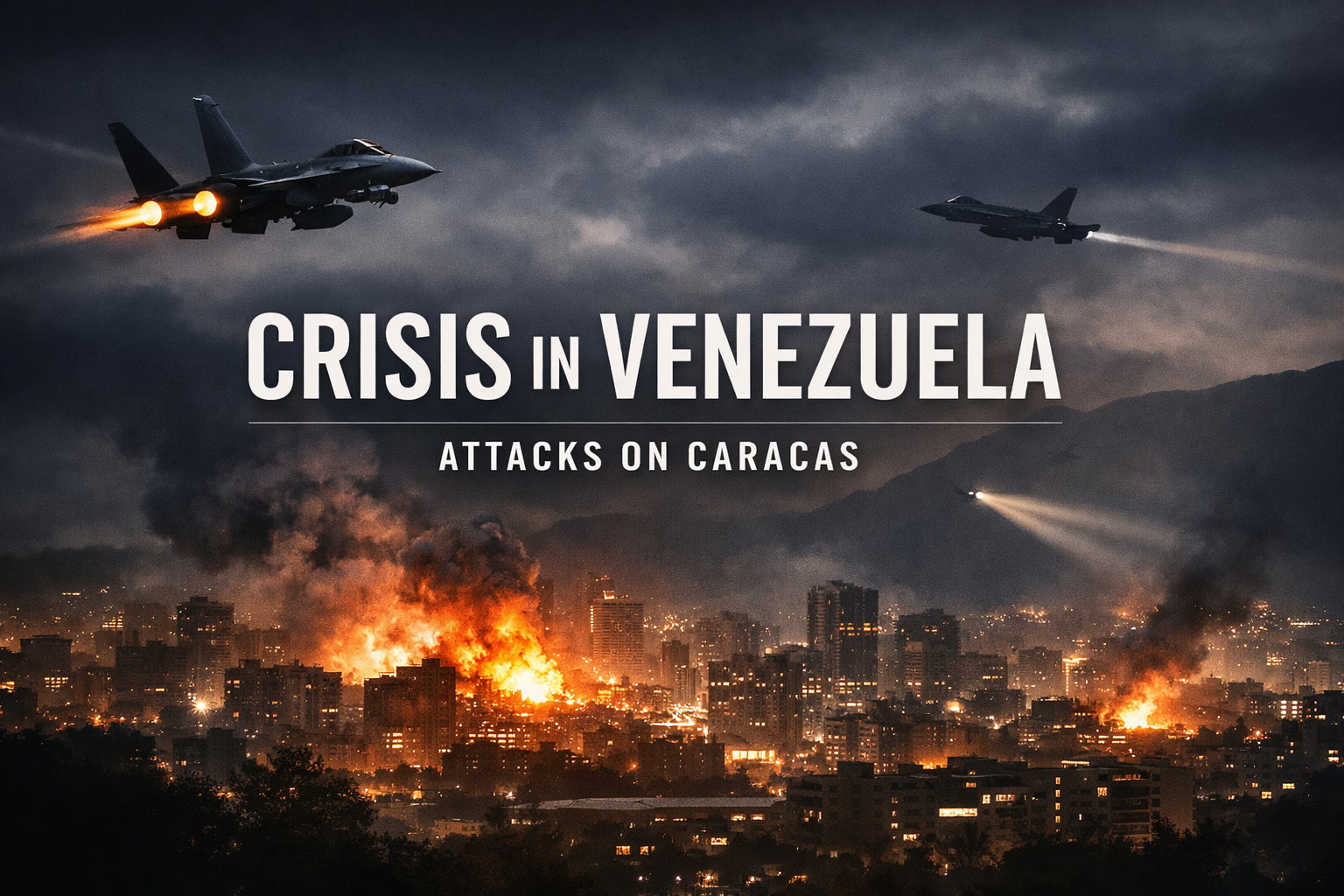
As of January 3, 2026, Venezuela’s capital, Caracas, has been hit by a cluster of overnight explosions and reports of low-flying aircraft. Venezuela’s government says the United States carried out strikes against military and civilian-linked sites. US officials have not publicly confirmed an attack in on-the-record statements, even as some US media report that President Donald Trump authorised strikes.
The central tension is not whether something happened. Residents heard blasts, saw smoke, and experienced outages. The tension is attribution, intent, and what comes next when one side calls it an act of war and the other side stays publicly non-committal.
This piece lays out what is solid, what is still contested, and why the flight restrictions and emergency measures matter beyond the headline. It also explains the practical problem policymakers face in real time: how to signal resolve without accidentally locking into escalation.
“The story turns on whether this was a limited shock-and-awe message or the opening move in a wider campaign.”
Key Points
Explosions hit Caracas overnight. Multiple blasts were reported in the early hours, followed by sightings of low-flying aircraft and visible smoke near key sites.
Venezuela blames the United States. The Maduro government called it “military aggression” and moved to emergency footing, framing the event as an external attack.
The United States has not issued a clear public confirmation. Official statements have been limited, while reports citing US officials describe an authorised strike operation.
Airspace risk signals the stakes. A US aviation restriction covering Venezuelan airspace points to an elevated military risk environment, whatever the cause.
This is bigger than a Caracas night of blasts. The event sharpens the risk of regional spillover, domestic crackdowns inside Venezuela, and disruption in energy and shipping expectations.
The next 72 hours matter most. Watch for evidence of follow-on strikes, a defined US political message, international diplomatic moves, and any Venezuelan retaliation.
Background
Venezuela has lived for years under intense external pressure, internal political strain, and repeated cycles of confrontation. Sanctions, oil-sector constraints, and disputes over legitimacy have created a brittle baseline in which sudden military incidents can move fast.
In late 2025, public signals from Washington suggested a hardening posture around Venezuela’s security environment. Aviation warnings about risk in or around Venezuelan airspace began appearing before this weekend, reflecting concern that military activity could endanger civilian flights. Separately, US actions against alleged drug-smuggling activity in nearby waters pushed the relationship into a more kinetic register, even if framed as counternarcotics enforcement rather than state-to-state conflict.
Inside Venezuela, the state’s response capacity and information control mechanisms are mature. When leadership declares an “external disturbance” or emergency posture, it can expand security powers quickly, tighten restrictions, and mobilise political structures. That matters because the domestic fallout can become a second crisis layered on top of the initial event.
The immediate background, then, is a relationship already primed for escalation. The new variable is the apparent shift from pressure and interdiction into strikes associated with targets on Venezuelan soil.
Analysis
Political and Geopolitical Dimensions
Two political incentives collide here.
For Venezuela’s leadership, naming a foreign attacker quickly serves three purposes. First, it justifies emergency powers. Second, it turns public fear into nationalist mobilisation. Third, it reframes internal discontent as a wartime unity test. Even if details remain disputed, the accusation itself can be strategically useful.
For Washington, ambiguity can also be a tool. If the operation was intended as a limited message, minimal public detail preserves flexibility and reduces the risk of being boxed into a linear “strike → retaliation → larger strike” ladder. But ambiguity has costs. It invites misinformation, increases market anxiety, and makes it harder for allies and regional governments to calibrate their own response.
Regional spillover is the most immediate geopolitical risk. Neighbours and nearby maritime routes do not need a full war to feel the effects. A short burst of strikes can still trigger flight diversions, shipping caution, and political volatility in capitals that would prefer not to choose sides.
Scenarios to watch:
Limited strike, rapid diplomatic containment. One-night action, followed by calls for restraint and back-channel messaging to prevent retaliation.
Rolling pressure campaign. Additional strikes or interdictions, paired with tighter economic and logistical constraints.
Domestic consolidation inside Venezuela. A sweeping internal crackdown justified as a security response, regardless of whether external action continues.
Regionalisation. Proxy dynamics grow as aligned partners offer intelligence, equipment, or political cover.
Economic and Market Impact
The first economic impact is not necessarily oil price spikes on day one. It is risk premium. Traders and firms price uncertainty before they price physical shortages.
Venezuela’s oil sector has long been constrained, but a strike narrative reintroduces questions about infrastructure security, shipping insurance, and sanction enforcement pathways. Even a limited attack can raise the perceived likelihood of disruptions, inspections, or delays. For countries and companies reliant on predictable flows, the headline is enough to trigger contingency planning.
The second impact is aviation and logistics. Once airspace is labelled risky, carriers reroute. That means longer flight times, higher costs, and knock-on scheduling disruption. The change is subtle at first, then obvious once it compounds across networks.
The third impact is domestic Venezuelan economics. Emergency footing often correlates with tighter controls. That can hit supply chains, daily commerce, and the availability of essentials, especially if outages or transport disruptions persist.
Technological and Security Implications
Modern strike narratives are not only about munitions. They are about sensors, attribution, and information dominance.
If aircraft were involved, radar signatures, flight paths, and physical damage patterns become central evidence. But those details rarely appear cleanly or quickly in public. That gap is where speculation blooms. The faster the gap fills with verifiable indicators, the faster markets and policymakers can stabilise expectations.
There is also the question of cyber and communications resilience. Power outages and communications disruptions do not automatically prove cyber action. They do, however, increase the pressure on emergency services and magnify public fear. When lights go out after explosions, the psychological impact can exceed the physical damage.
On the US side, aviation restrictions suggest concern about “ongoing military activity,” a phrase that can cover many possibilities: active operations, elevated air defence risk, or a rapidly changing threat picture. Whatever the cause, the practical consequence is clear: commercial aviation is being told to treat Venezuelan skies as higher-risk.
Social and Cultural Fallout
Caracas is a city with deep political scars and long memories of instability. Overnight blasts change the social temperature instantly.
In the short term, fear is the story. Families shelter. Rumours spread faster than facts. In the medium term, the story becomes control: checkpoints, detentions, public demonstrations, and the state’s effort to define what people believe happened.
For Venezuelans already living with economic hardship, the burden is cumulative. A single night of disruption can still mean lost wages, stalled transport, and fresh uncertainty about whether normal life resumes on Monday.
Outside Venezuela, the social fallout plays out through diasporas and online narratives. Competing claims of “attack,” “false flag,” “regime change,” and “necessary enforcement” will flood feeds. That information conflict is not background noise. It shapes the political space in which leaders make decisions.
What Most Coverage Misses
The overlooked factor is the airspace signal.
Most headlines focus on the blasts and the accusation. The more durable indicator of risk is the formal shift in how aviation is told to treat Venezuelan skies. Airspace warnings and bans are a concrete, operational reaction. They reflect threat assessment, not rhetoric, and they change real-world behaviour immediately.
That matters because it suggests the story is not only political theatre. It is also an active risk management moment for a system that hates uncertainty. Airlines do not reroute because of speeches. They reroute because someone believes the probability of a catastrophic outcome has risen.
The second overlooked factor is how quickly “external attack” narratives can become domestic governance tools. Even if the external facts remain contested, emergency measures can reshape civil life inside Venezuela within hours. That internal pivot may end up being the most lasting consequence of this weekend.
Why This Matters
In the short term, the people most affected are Venezuelans in Caracas and nearby regions dealing with fear, outages, and tightened security controls. The next-most-affected are regional governments and transport networks forced to plan around elevated risk.
In the longer term, this incident may reset expectations about what “pressure” looks like in the Americas. If strikes become a plausible tool again, every actor recalculates. That includes energy markets, shipping insurers, migration pressures, and diplomatic alignments.
Concrete events to watch next:
Official US messaging. A clear statement of purpose would reduce uncertainty. Continued ambiguity raises the risk of miscalculation.
Venezuelan emergency measures. Whether restrictions expand, and whether arrests or broader crackdowns follow.
Regional diplomacy. Any move to convene urgent multilateral discussions, or emergency sessions at major international forums.
Follow-on military activity. Any evidence of additional strikes, heightened air defence postures, or retaliation threats.
Real-World Impact
A small business owner in Caracas wakes to closed roads and unreliable power. Deliveries stop. Staff cannot commute. Sales vanish for the day, but costs keep running.
A commercial pilot on a South America route sees a last-minute reroute. The flight is longer. Fuel planning changes. Connections are missed. A single operational decision ripples across hundreds of passengers.
A Venezuelan family in Florida spends the night refreshing messages from relatives. News is contradictory. Phone calls do not connect. The emotional toll is immediate, and it shapes how communities pressure elected officials.
An energy risk manager in London updates a dashboard at dawn. Nothing has physically stopped yet, but the question is insurance, shipping confidence, and whether political risk is becoming kinetic risk.
What’s Next?
The world is now watching for clarity: not only about who did what, but about whether this is meant to end quickly.
If this was a limited strike intended to signal capability, the next step is diplomacy disguised as de-escalation. If it was designed to weaken military infrastructure over time, the next step is repetition. Venezuela’s choice, meanwhile, is between retaliation and internal consolidation, and those are not mutually exclusive.
The fork in the road is ugly but simple. De-escalation requires both sides to accept ambiguity without turning it into humiliation. Escalation happens when either side believes restraint looks like weakness.
The clearest signs will be operational. Additional blasts, sustained flight restrictions, or visible mobilisation will point to a longer episode. A fast shift into formal talks, limited emergency measures, and a stabilising public message will point to containment.
